Bārakonā-Ghāṭa
In His youth, Nimāī Paṇḍīta used to teach Sanskrit grammar to students in His own school. After class, He would discuss the scriptures with His students at Bārakonā-ghāṭa. Once, the eminent Keśava Kāśmīrī, a digvijayī-paṇḍita from Kāśmīra, arrived there with hundreds of his disciples. Keśava Kāśmīrī was famous for having defeated brilliant scholars all over India. In East India, Navadvīpa was known as an important centre of learning where the Vedas, Upaniṣads, Smṛtis, Purāṇas and the six systems of Indian philosophy, especially navyanyāya (a new kind of logic) were taught. People came from great distances to study here.
Keśava Kāśmīrī had received the blessings of Sarasvatī, the goddess of learning. He was especially gifted in composing highly ornamented poetry, and in a moment hundreds of original Sanskrit verses would issue forth from his mouth in an unbroken stream. He could defeat the most prominent scholars with his brilliant speech, which revealed his great expertise in logic and other talents. When, therefore, he arrived in the town of Navadvīpa he very proudly declared that any of the scholars there should come forward to debate with him; otherwise, they should write a letter declaring his victory over them.
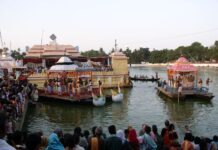
But no scholar came forward. These scholars were all envious of Nimāī Paṇḍita and with great cunning they told Keśava Kāśmīrī, “The boy Nimāī Paṇḍita is Navadvīpa’s most insignificant scholar. First debate with Him, and then you can debate with us.” It was dusk, and as the sun set into the Gaṅgā, its red rays playfully danced on her waves. The brilliant Nimāī Paṇḍita sat on the bank of the Gaṅgā amongst a group of students, teaching them grammar. The sky was reddish as if filled with anurāga and the atmosphere was serene. Seeing the students, Keśava Kāśmīrī, intoxicated with pride, came over to them. Nimāī’s sweet voice was speaking excellent and logical statements on grammar and navyanyāya, thus revealing His extraordinary brilliance.
This attracted Keśava Kāśmīrī, who sat down amongst them, thus making some of the boys quite nervous. Keśava Kāśmīrī asked one boy, “What is this student’s name?” The boy replied, “He is our Nimāī Paṇḍita.” Merely hearing this name filled Keśava Kāśmīrī with fear. One of the boys whispered into Nimāī’s ear, “This is Keśava Kāśmīrī.” Nimāī Paṇḍita turned to Keśava Kāśmīrī and spoke respectfully. “It is our good fortune that today you have come into our midst. We have heard of your glories. Please recite something for us.” Keśava Kāśmīrī asked, “What subject matter would you like to hear about?” Nimāī replied, “We would like to hear Śrī Bhagavatī Bhāgīrathī’s glories from your lips.”
Keśava Kāśmīrī immedi ately began reciting a shower of freshly composed verses adorned with alliteration and other literary ornaments. The students were stunned. Nimāī Paṇḍita then asked him to select just one of the verses he had recited and to describe its virtues and faults. Keśava Kāśmīrī asked, “Which verse would you like me to describe?” Nimāī Paṇḍita immediately chose a verse from the middle of the poem. Seeing Nimāī’s capacity to hear something and at once commit it to memory, Keśava Kāśmīrī was struck with wonder and trembled within.
Nonetheless, out of pride he answered, “In Keśava Kāśmīrī’s compositions there is never any fault.” He pointed out the verse’s five virtues in regard to allit eration and he also pointed out other literary ornaments. Nimāī Paṇḍita, with humility and gravity, then pointed out five more virtues. When He further pointed out five faults, everyone was astounded. His pride crushed and unable to respond, the defeated Keśava Kāśmīrī returned to his quarters. That night Mother Sarasvatī consoled him saying, “The person who defeated you is my Master, the Supreme Lord Śrī Kṛṣṇa Himself.
You are highly fortunate to have received His darśana. Fall at His feet and beg forgiveness.” Early the next morning, Keśava Kāśmīrī met Nimāī Paṇḍita and fell at His feet begging forgiveness. Nimāī Paṇḍita instructed him, “The purpose of scholarship is not to defeat others; its only purpose is to worship Kṛṣṇa. Go to Vraja and worship Him with a simple heart.” Keśava Kāśmīrī offered his obeisances to Nimāī Paṇḍita and left.
Nāgariyā-Ghāṭa
Ten yards north of Bārakonā-ghāṭa at nearby Gaṅgā-nagara was Śrī Gaṅgādāsa Paṇḍita’s Sanskrit school, in which Nimāī studied with the other boys. On the way home from school Nimāī would stop by Nāgariyā-ghāṭa and tell the young girls to worship Him. He blessed the girls who worshipped His feet that their future husbands would be handsome, pleasant, wealthy and respected. And He threatened the others with husbands that would be crippled and poor. Sometimes, while taking bath in the Gaṅgā, He would splash water on the brāhmaṇas who were chanting mantras and offering water to the sun, and when they angrily rebuked Him, He took water in His mouth and sprayed them with it.
Angered upon hearing the complaints of the brāhmaṇas and the young girls, Jagannātha Miśra went to the ghāṭa with stick in hand. But he was unable to find Nimāī because He had taken another path home. Nimāī had told the boys to inform His father that He had gone straight home from school. Nimāī smeared dust on His body and sprinkled it with drops of ink, just to hide any indication that He might have bathed.
When Jagannātha Mīśra arrived at the house, he saw the dust and ink on Nimāī’s body and an expression of pure innocence on His face, and he did not say a word. It was at Nāgariyā-ghāṭa that Śrī Śacī-devī first saw Śrī Viṣṇupriyā and selected her to be Nimāī’s bride. On the day the Kazi was subdued, Śrīman Mahāprabhu came here with a huge saṅkīrtana party and chanted for some time. Then, carrying burning torches and performing kīrtana with mṛdaṅgas and karatālas, the party went to Chand Kazi’s residence in Simuliyā-grāma.
Deepen your Bhakti-yoga practice, harmonize relationships, and receive guided coaching — all at Vedavarsity.com