


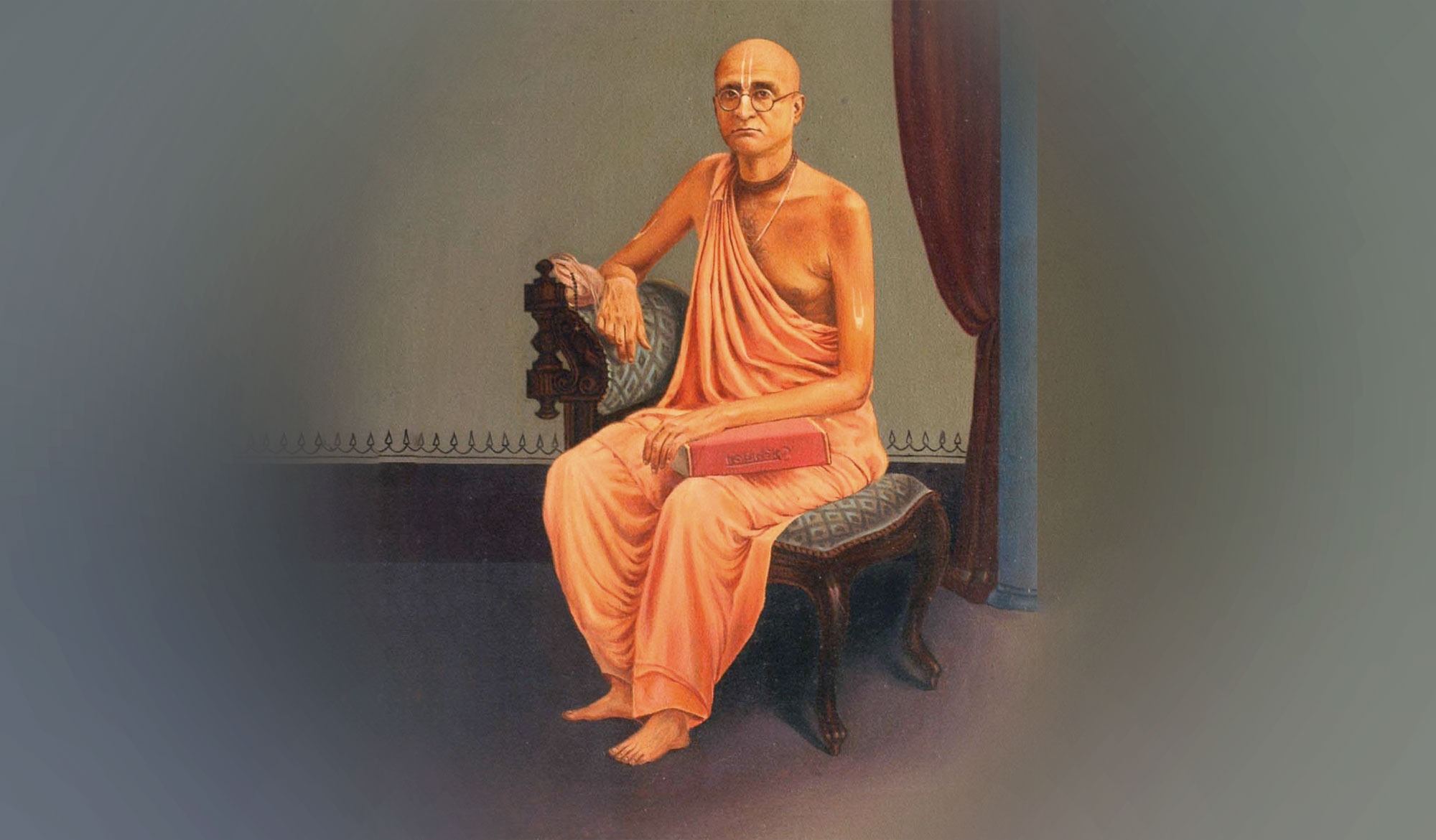
By Śrīla Bhaktisiddhānta Sarasvatī Goswāmī
from the anthology
Śrīla Prabhupāda’s Discourses
Place—The Gaudiya Math, Calcutta, Evening-July 12, 1936
(Within the beautiful marble Temple at Bagh Bazaar, Śrīla Bhaktisiddhānta Sarasvatī Prabhupāda sat upon a raised platform before the assembly (composed of many distinguished persons of learning and theistic culture, prominent amongst whom were Mr. Sultjay, Sj. Supati Ranjan Nag M.A., B.L. of Dacca, Raja Khitendra Deb Roy of Bansberia and Tridandi Swami Sripada Tirtha Maharaja). After pointing out the indispensable necessity of proper cultivation of Kṛṣṇa-bhakti with quotations from the Bhāgavata and other Holy Scriptures, His Divine Grace Śrīla Prabhupāda continued, with all humility, thus:)
We jīvas are really poor, no doubt. We are poor jīvas but we are not poor Nārāyaṇas. (To identify Nārāyaṇa Who is the permanent Possessor of all wealth, with a poor jiva, is an absurdity.) Our poverty should be diminished. And to that end, wealth should be accumulated. Wealth of what kind? It is wealth of Kṛṣṇa-prema, i.e. causeless love for the Absolute Truth-Kṛṣṇa. And for this, we should pray to Him in the same way as a Vaiṣṇava mahājana prays, in the following lines:
prema dhana vina vyartha daridra-jivana
dasa kari vetan more deha prema dhana
Life without Love is useless and poor they say,
Appoint me in Thy service, Oh Lord with Love as my pay.
Our prayer should be of the aforesaid nature. We naturally begin to feel dislike for everything but Kṛṣṇa as soon as we feel necessity for Kṛṣṇa-prema. In absence of this, other tendencies and considerations take firm hold of our mind, exhorting us to be great workers, forgetful of the main object of the Pancharatra.
Now, what course should we adopt, with regard to our propaganda work in England? Mahāprabhu enjoins us to proclaim His Name, throughout the length and breadth of this world-from small hamlets to big cities. Gross, worldly names are being in vogue, everywhere at present; let the Transcendental Name be henceforth proclaimed all over the world.
We do not belittle the importance of Pancharatrik process (system) of having representatives (in theistic institutions), or establishing temples with deities; but we are of the opinion that the duty of better or higher class, is propaganda work. And Mahāprabhu’s open desire was that the Transcendental Name should be proclaimed everywhere. And to that end, we think sufficient number of pamphlets should be published. The rich are the so-called big men of the world, who are running after fame, females and money. They will not listen to our words even if we cry hoarse in their ears, so what’s the use of wasting our time, in trying to make them hear? We say therefore, that the line of our propaganda work should be to publish sufficient number of pamphlets even at the cost of possible suspension of building temples. This will show to them the insignificance of discoveries of truths or discussions that have found expression in their philosophies or applied sciences, in contrast to the enormity and magnitude of the subject matter of our discussions.
So far about our propaganda work. Now, as to the manner in which that work is to be carried out. A self-conceited or vain-glorious man can never successfully carry on propaganda work. How will it be possible for him? For, the Absolute Truth never manifests Itself to a vain-glorious man, who looks upon himself as the only preacher of truths. Such a man can do no good to the world. Of such persons some will be fond of prohibited food as available at Kalighat. Some will be malicious patriots engrossed with considerations of their own advantages, as opposed to others’ interests; while others will be in the clutches of self-enjoying propensities or its opposite-renunciating tendencies with a view to have, respectively, self-emolument or salvation; and the rest will make pretended show of bhakti. But none of them will have the least idea of the Absolute Truth divested of the slightest trace of insincerity and maliciousness.
Oh, how deplorable it is that the propaganda of the Bhakti-Rasamrita-Sindhu, the glorious, unique, devotional teachings of India is stopped here, in the very land of its origin. And it is not the less regrettable to see people suffer under the mistaken idea that mere ringing of bells in places of worship (i.e., mere formal observance of prescribed rites), or touring in holy places, or ostentatiously reading of holy works like the Bhagavata with no other purpose than earning livelihood, or playing the role of preceptors by a right of heredity only, are sure signs of bhakti, they being quite ignorant of the true significance of right worship, the true object of pilgrimage, the right duty of the proper ways of preceptorship, the true culture of theistic works like the Bhagavata and the real difference between true and false bhakti. And it is painful to see people wasting their valuable time in no better work than mischievous, ill-conceived criticisms of others’ conduct. They excel only in giving advice to others. (Their damned mind is, no doubt, responsible for this.) So, every morning, on rising from bed they should make their wicked mind hear the following immortal song of Thakur Bhaktivinoda:
bhaja re bhaja re amara mana ati manda
(bhaja) vraja-vane radha-krsna caranaravinda
(bhaja) gaura-gadadharadvaita guru nityananda
(smara) srinivasa, haridasa, murari, mukunda
(smara) rupa-sanatana-jiva-raghunatha-dvandva
(smara) raghava-gopala-bhatta svarupa ramananda
(smara) gosthi saha karnapura, sena sivananda
(smara) rupanuga sadhu-jana bhajana-ananda
In this song, the mind is asked, first of all, to hold bhajan of Radha-Kṛṣṇa (in Their joyful activity) in the sacred woodland of Vraja. In comparative view, the degrees of excellence of the five rasas, from madhurya (consorthood) to shanta (the state in which active service is wanting), are gradually lowering. A servitor in the last mentioned position (i.e., shanta rasa) is neither actively engaged in bhajan, nor against it. He will neither oppose bhajan nor actively hold it. Now bhajan or bhakti may be of different kinds. There is such a thing as micha bhakti (false bhakti), as opposed to shuddha bhakti (unalloyed bhakti); the former kind of bhakti being taken recourse to by adherents of karma, who again are followers of Smriti. And Thakur Narottama Das warns us against such false bhakti by saying:
karmi jnani, micha bhakta, na habe tate anurakta,
suddha bhajanete kara mana
The cult of the so-called social reformers (or society makers) of the past or present age is quite different from the ideas and principles of bhaktas. And the followers of the former are engaged, at present, in various movements relating to personal advantages and self-enjoyment.
Those agitators, who, leaving aside all considerations of bhakti, are busily engaged in movements for temporal advantages only, are doing harm to themselves. And their failure to serve Kṛṣṇa, Who is the emporium or rather effigy of all endless, immeasurable nectar of love, joys and pleasures, bespeaks simply of their ignorance of the real state of affairs. And such desistance of service to Kṛṣṇa, gradually turns a man into an upholder of nirvishesha-vada (i.e. the doctrine of the unspecifiedness of the Absolute Truth.) And what can be more deplorable than such misfortune of the mankind. So, to counteract the aforesaid tendencies in us, we should sing, every morning, advising our wicked mind to hold bhajan, which is impossible if we be unmindful of the dictum:
trnad api sunicena taror api sahisnuna
amanina manadena kirtaniyah sada harih
-which means that Hari kirtana should be continued ceaselessly and with the humility of low grass.
Now, what is the object of our bhajan? It is only the Holy Feet of Radha-Kṛṣṇa, roaming about freely in the woodland of Vraja. And what should be our line of conduct in holding bhajan? Mahāprabhu’s advice to Śrīla Das Goswami, in this connection, is as follows:
gramya katha na sunibe, gramya katha na kahibe
bhala na khaibe ara bhala na paribe
amani manada hanya sada krsna nama labe
vraje radha-krsna seva manase karibe
Have no worldly talk, nor pay heed to it,
Wear no good clothes, nor rich food eat,
Have Kṛṣṇa-nama always, humbly, on your tongue,
Serve Radha-Kṛṣṇa in the closet of the mind, all day long.
In the aforesaid verse, the first two advices are in the negative and the remaining two are in the affirmative. By “Vraja-seva” Mahāprabhu meant service to Kṛṣṇa by one who has a transcendental body and whose self-realisation is complete. People ignorant of this generally turn into mental speculators, and cannot rightly understand the teachings of the Gaudiya Math.
This wicked mind, which is never to be trusted, should be broom-sticked every morning with such warning as, “Be not anxious to find fault with others, or to proclaim thyself as a true, sincere, bonafide bhakta, which certainly thou art not.” In this connection, the advice of a Vaiṣṇava Mahajana is this:
karmi-jnani micha-bhakta, na habe tate anurakta,
suddha-bhajanete kara mana
vraja-janera yei mata, tanhe habe anugata,
ei se param tattva dhana
Be not attached to karmis, jnanis and bhaktas false.
But pure, unalloyed bhajan you should always endorse.
Follow principles, which Vraja folk adopt,
These being valued truths to be kept aloft.
The mind is always working erroneously in looking upon this thing or that, either as good or bad. The Charitamrita sings:
dvaite bhadrabhadra jnana-saba mano-dharma
ei bhala ei manda-ei saba bhrama
People are usually too much busy with mental speculations. They should relieve themselves of this and try to find out the real good of their own selves or souls. There is an adage to the effect that para-carccakera gati nahi kona kale, “a man who is habituated to criticise others’ conduct will never prosper.” Let others do whatever they like, I have no concern with them. I should rather find fault with my own damned mind, and think like the Vaiṣṇava Mahajana who sings:
amara jivan, sada pape rata, nahi punyera lesa,
para-sukhe duhkhi, sada mithya-bhasi,
para-duhkha sukha-kara
Ever engaged in vicious activity,
And without the slightest trace of virtue in me,
A liar as I am, always sorry at others’ pleasures
And merry at others’ sorrows, troubles and cares.
We should always remember this song and engage our mind ceaselessly in Hari-bhajan. We should not run about attacking others with dissuading policy; such conduct behooves only deceitful persons and not preachers.
The way of Karmis and Jnanis will lead us to immense troubles and difficulties, by engaging our attention to consideration of the shadowy, transient things, instead of the only cause or true origin; viz., the Sac-chid-ananda vigraha (the ever-existing, joyful, conscious Entity-Kṛṣṇa), of Whom every thing visible is a mere shadow. The gross archaeologist is too much busy with ascertaining of material ingredient of idols which may be either of stone or wood or any other material. There are some who work as iconographers or iconoclasts, while there are others who are busy in ascertaining the amount of filth or impurities accumulated in a particular soil. But none of them ever cares to find out or measure the impurities of their own minds. There is no attempt on their part to weed out the undesirable elements in their mind, though such an attempt is of paramount importance in their own personal interest.
Now, whose bhajan are we to hold? Whom are we to worship? Usually we want to worship Mammon, with a view to satisfy our own personal greed; or sometimes we desire to secure the exalted position of presidentship of the American Republic. But we never think of the necessity of worshipping the lotus feet of Radha-Kṛṣṇa moving merrily in the woodland of Vraja, without which there is no other way of securing the permanent good.
There are some who want to worship Kṛṣṇa not of Vrindavan but of Dwaraka, where He is being served majestically by thousands of His Queens; while others are willing to serve respectfully the Lord Vaikuntha-natha (Who is possessed of all wealth and magnificence), with the help of their upper limbs only. But Śrī Caitanya Deva asks, “Should there be any service which may not be unrestrictedly done with the help of all the limbs from head to foot (not excluding the inferior lower limbs)?” One will find no difficulty in finding out proper answer to this, when he thinks within himself thus: If these lower limbs have no use or existence at all in the Transcendental World (of which this gross world is a mere shadow), whence are they and why are they? In fact, to use these limbs in serving the Absolute Lord is their proper adjustment. Want of this, will lead us to woeful ways of karma and jnana.
Tad vanam upasitavyam-the woodland of Vraja alone is to be served and worshipped. And to that end, we should always associate with the followers and devotees of Śrī Caitanya. Association with those who take historic side or speculative side of Kṛṣṇa will spoil everything. Now what does Śrī Caitanya say? He says that His Name will be proclaimed everywhere, all over the world-from small hamlets to big cities. Mahāprabhu desires that all the people of the world should know Kṛṣṇa-katha (details or discussions about Kṛṣṇa) as prevailing in Vrindavan. Notwithstanding their proficiencies in their particular field of activities, they should feel necessity of Radha-Govinda’s bhajan.
The twelve vanas or woodlands, included within Vrindavan are twelve places of Kṛṣṇa-bhajan, in twelve separate rasas (capacities or tastes), of which five are primary, and seven are secondary. Vana-bihari Kṛṣṇa, i.e. Kṛṣṇa who wanders in the woodland of Vraja, playfully, and Who is the effigy, emblem, or incarnation of all rasa, is alone to be served and worshipped and not any other thing like earth, water or mud. And in doing this, we should beware of the ways of the mental speculators, who want to pose as so many Kṛṣṇas, by going to enjoy the world, and thus imitate Him. For such persons are liable to quarrel amongst themselves for their own share of enjoyments and fall ultimately into this lowest depth of degradation. To avoid this calamity, Kṛṣṇa should be worshipped as Vana-bihari, i.e. Kṛṣṇa in bihari, the land of His Own free, joyful movement.
Now, to turn to the third line of the previous song, which is:
(bhaja) gaura-gadadharadvaita guru nityananda
Śrī Gadadhara has taught us the proper way to serve Kṛṣṇa, with His Own example in serving Mahāprabhu. Raya Ramananda and Damodara Svarupa too have set the same example. Mahāprabhu Himself has shown the true functions of a servitor. Though Himself the real Master to be served, Mahāprabhu has played the role of a servitor, with a view to let us know how a servitor is to do his duty. Again, Śrī Gadadhara Prabhu too is a servitor (to Mahāprabhu). The same absolute Lord is Kṛṣṇa (in His enjoying activity), and Śrī Gaurasundara (in His serving capacity). And Śrī Gadadhara Prabhu is His Transcendental Consort. A parallel case of this is the instance in which a man may scratch his body with one of his own limbs, while an entirely separate person (i.e. a third party) also may do the same work. And Śrī Gadadhara Prabhu furnished the example of the last mentioned person, i.e., He stands in the place of the third party, in the aforesaid case. (To be more explicit, Mahāprabhu here serves Kṛṣṇa-His Ownself, while the third party Gadadhara serves Mahāprabhu.)
Now to turn to Advaita Prabhu. He acted as an acharya or preceptor. And so Kaviraja Goswami says:
advaitam harinadvaitad
acharyam bhakti samsanat
bhaktavataram isam tam
advaitacharyam asraye
“Because He is non-different from Hari, the Supreme Lord, He is called Advaita, and because He propagates the cult of devotion, He is called Acharya. He is the Lord of the incarnation of the Lord’s devotee. Therefore I take shelter of Him.”
(Cc. Adi-lila Ch. 1, v.13)
The so-called acharyas of present day are not removers of the afflictions and miseries of their disciples, but removers (stealers) of their disciples’ properties. But what sort of acharya Advaita Prabhu was? From His Own version in Caitanya Charitamrita we find that He declares Himself as a servant’s servant of Śrī Caitanya (Vide Charitamrita 6.86)
Servitude is the predominating feature of bhakti. And the acharya (Advaita Prabhu) sings glory to it by declaring Himself as a servant’s servant of Mahāprabhu. This serving tendency is predominant in the other four rasas. The special characteristic of Advaita Prabhu’s conduct is found in His identification of His Own revered Self as a servitor to Mahāprabhu, in spite of His venerable position like that of a father. But such humble serving attitude is never found in the conduct of the so-called acharyas of present day, whose only object in life is to live happily by acting as gurus.
Next advice in the aforesaid song is to serve Guru Nityananda. We are to follow their ideal only. We should not offer ourselves to be guided by these ignorant, debauched fools, who are fond of eating goats’ flesh. Such persons can never act as gurus, they themselves having fallen to the lowest depth of degradation.
Next advice in the song is:
(smara) srinivasa, haridasa, murari, mukunda
To remember Srinivasa, Haridasa, Murari and Mukunda, who were Nityananda Prabhu’s assistants, and Mahāprabhu’s associates in His earthly activities in Navadvipa. They were asked by Mahāprabhu to go from door to door, and bless everyone with Hari-nama, thus:
prati ghare ghare giya koro ei bhiksa
bolo krsna, bhaja krsna, koro krsna-siksa
iha bai ara na boliba, bolaiba
dina-avasane asi amare kohiba
Go from door to door and beg their favour
To say “Kṛṣṇa,” serve Kṛṣṇa and learn His air,
Say not, and make not others say, anything more,
And at sun-set, come back, with news to my door.
Then we find the following advice in the song:
(smara) rupa-sanatana-jiva-raghunatha-dvandva
Here we are advised to remember Rupa Goswami, Sanatana Goswami, Jiva Goswami, Raghunatha Das Goswami and Raghunatha Bhatta Goswami. We are to follow them. Bhajan is impossible without following Rupa Goswami (in particular).
(At this stage of the discourse, Raja K.C. Deb Roy of Bansberia comes in, offering due obeisances to Śrīla Prabhupāda’s holy feet, and refers, in course of talk, to God’s mercy in letting him incidentally know Prabhupāda’s arrival at the Math on that very day. In reply to which, His Divine Grace remarked thus:)
Prabhupāda: Yes, Bhagavan is always lending us helping hands, and we should stretch our hands on our part to catch hold of them. We should wait for His favour; and when it comes, we should avail of it. It will be alright then.
The Raja: But your blessings-the holy dust of your lotus feet-are above all. Today is a glorious day. Bhagavan has kindly supplied food for my soul today.
Prabhupāda: Yes, the soul requires nourishment, no doubt. The function of the limited soul to the Universal Soul is what is called bhakti, and that is the only thing needful. But unfortunately, people do not understand it. In bhakti alone, all will meet. Nowhere else is union possible.
Everything should be used in Bhagavan’s service. And such use alone is the proper adjustment of things. It will be alright if all our acquired knowledge is used in His service, making coincidence of circumstances possible, in absence of which there will be only chaos.
The Raja: The news about you, in newspaper, at once presented your appearance before my mind.
Prabhupāda: Yes, such association of ideas takes place when one is engaged in serving Śrī-Vigraha (the Deity). And without this, one is likely to be overtaken with nirvishesha ideas (i.e. ideas about the Absolute Truth as without form, figure, attributes and activities). We should have full association with the Absolute Truth. But at present, we are unfortunately detached from the same, with the result that we are bringing miseries and troubles upon ourselves, by running after finite things with out-stretched hands, to grasp any and every limited thing, which is far from being the Undivided Whole or the Absolute Truth. Such state of affairs will not cease to continue unless and until we take shelter under the Holy Feet of Bhagavan, Who is Undivided and Infinite. And Śrī-Vigraha is nothing but direct manifestation of the Absolute Truth, i.e., Bhagavan.
The Raja: But the ideas about the Trueself of the Bhagavan are different in different sects and communities, some opining that He is invisible, while others are of the opinion that He is visible.
Prabhupāda: Yes, but they are mere different perspectives of mental speculation. Such attitude as to accept one idea now, and reject it the next moment, is useless and should be avoided. We should relieve ourselves of this, and try to directly approach Bhagavan, Who is the effigy of the nectar of endless rasa (akhila-rasamrita-murti).
But we should not lose sight of the fact that He is Transcendental, and so, not measurable or perceptible to our gross senses. And effort in that direction, viz., to measure Him, will bring in varied sceptic views. And it is for this reason, that the Bhakti-Rasamrita-Sindhu and the
Brahma-saṁhitā says:
atah sri-krsna-namadi
na bhaved grahyam indriyaih
sevonmukhe hi jihvadau
svayam eva sphuraty adah
“So the Name Who is identical with Kṛṣṇa, is not perceptible to gross senses but manifests Himself (i.e. is articulated) of His Own accord, on the tongue (i.e. in the mouth) of those who are eager to serve Him.”
(B.r.s. 2.109)
premanjana-cchurita-bhakti-vilocanena
santah-sadaiva hrdayesu vilokayanti
yam syama-sundaram acintya-guna-svarupam
govindam adi-purusam tam aham bhajami
“I worship that original Lord Shyama Sundara (Kṛṣṇa) Who is possessed of inconceivable Form and Attributes, perceptible to such (transcendental) eyes only as are painted and so invigorated, as it were, with the paint of loving service known as bhakti.” (Bs. 5.38)
Deepen your Bhakti-yoga practice, harmonize relationships, and receive guided coaching — all at Vedavarsity.com