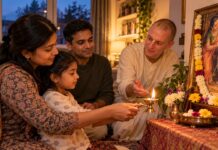




Dipawali, also known as Deepavali, is one of the most auspicious festivals celebrated throughout the Vedic tradition. The festival of lights reminds us of the eternal victory of righteousness over unrighteousness, divine knowledge over ignorance, and devotion over material attachment. The spiritual significance of Dipawali goes far beyond lighting lamps, exchanging gifts, and celebrating with family. It invites every individual to awaken the divine consciousness within the heart and return to a life of devotion to the Supreme Lord.
For devotees, Dipawali is especially associated with the glorious return of Lord Ramachandra to Ayodhya after fourteen years of exile and His victory over the demon king Ravana. The citizens of Ayodhya welcomed their beloved Lord by illuminating the kingdom with rows of lamps, expressing their boundless love and happiness.
This timeless celebration carries a profound message for humanity: when the Supreme Lord is welcomed into our lives, the darkness of ignorance is dispelled by the light of spiritual knowledge.
The Historical and Spiritual Origin of Dipawali
The word Deepavali comes from two Sanskrit words: Deepa, meaning lamp, and Avali, meaning a row or series. Thus, Deepavali means a row of lights.
According to the celebrated account of the Ramayana, Lord Ramachandra, the Supreme Personality of Godhead appearing as the ideal king, was sent into exile for fourteen years. Accompanied by His eternal consort Sita Devi and His devoted brother Lakshmana, He resided in the forest.
During this period, Ravana, the powerful but arrogant king of Lanka, abducted Mother Sita. Lord Rama subsequently formed an alliance with Sugriva and His great devotee Hanuman, and eventually defeated Ravana to rescue Sita Devi.
After completing His exile and fulfilling His divine mission, Lord Rama returned to Ayodhya.
The citizens were overwhelmed with happiness. They decorated their homes and streets with lamps to welcome their beloved King.
This joyous occasion became associated with the celebration of Dipawali.
However, the deeper lesson is not simply the return of a king. It is the return of divine consciousness, righteousness, and devotion to their rightful place in human life.
Spiritual Significance of Dipawali: The Victory of Dharma over Adharma
One of the most important teachings of Dipawali is the victory of dharma (righteousness) over adharma (unrighteousness).
Ravana possessed extraordinary material power, wealth, scholarship, and influence. Yet, despite these achievements, his pride and uncontrolled desires ultimately brought about his destruction.
Lord Ramachandra, on the other hand, demonstrated ideal character through His commitment to truth, duty, compassion, humility, and devotion.
The contrast between Rama and Ravana teaches us that material accomplishments alone cannot bring lasting happiness or spiritual perfection.
A person may possess great wealth, knowledge, and influence, but without self-control and submission to divine principles, these qualities can become instruments of destruction.
The Bhagavad-gita teaches that the Supreme Lord appears to protect the devotees, annihilate miscreants, and re-establish the principles of religion.
Bhagavad-gita 4.8:
paritranaya sadhunam
vinashaya cha dushkritam
dharma-samsthapanarthaya
sambhavami yuge yuge
Translation: To deliver the pious and to annihilate the miscreants, as well as to re-establish the principles of religion, I Myself appear millennium after millennium.
Dipawali reminds us that divine justice ultimately prevails and that human life should be guided by the principles of dharma.
Lighting Lamps: From Material Darkness to Spiritual Enlightenment
Lighting lamps is among the most recognizable traditions of Dipawali. Homes, temples, streets, and public places are illuminated with rows of beautiful lights.
From the Vedic perspective, however, the lamp carries a deeper spiritual meaning.
Material existence is compared to darkness because the conditioned soul forgets its eternal relationship with the Supreme Personality of Godhead.
The Vedic prayer expresses this aspiration:
Tamaso ma jyotir gamaya.
“Lead me from darkness to light.”
The light referred to here is not merely physical illumination. It represents the awakening of transcendental knowledge.
A lamp can illuminate a dark room, but spiritual knowledge illuminates the consciousness and helps the soul understand its true identity.
According to Bhagavad-gita 15.7, every living entity is an eternal fragmental part of Krishna.
When we understand that we are not these temporary material bodies but eternal spiritual beings, our priorities begin to change.
We gradually become less attached to temporary material pleasures and more interested in serving the Supreme Lord.
Thus, the true celebration of Dipawali begins when the lamp of devotion is kindled within the heart.
Lord Rama: The Ideal King and the Supreme Personality of Godhead
Dipawali offers an opportunity to remember the transcendental qualities of Lord Ramachandra.
In Vedic literature, Lord Rama is glorified as Maryada Purushottama, the Supreme Lord who demonstrates the highest standards of righteous conduct.
His life teaches humanity the importance of fulfilling responsibilities, respecting parents, protecting the innocent, remaining faithful to one’s promises, and maintaining spiritual integrity.
Lord Rama’s relationship with His devotees is especially inspiring.
Hanuman’s complete dedication to Lord Rama demonstrates the perfection of devotional service.
Hanuman did not desire material wealth, prestige, or personal enjoyment. His greatest happiness was to serve his beloved Lord.
This is the essence of bhakti-yoga, the path of loving devotional service.
The Ramayana therefore presents not only an extraordinary divine history but also practical spiritual lessons for everyday life.
By hearing about Lord Rama and remembering His transcendental activities, one can develop devotion and appreciation for the Supreme Personality of Godhead.
Dipawali and the Principle of Lakshmi-Narayana Worship
Dipawali is also widely associated with the worship of Goddess Lakshmi, the goddess of fortune.
According to Vedic philosophy, Lakshmi Devi is the eternal consort of Lord Narayana, the Supreme Personality of Godhead.
She is never independent of Him. Her divine position is that of serving the Supreme Lord.
This understanding provides an important lesson regarding wealth and prosperity.
Material wealth is temporary and should not become the ultimate goal of human life. Rather, prosperity should be understood as a facility that can be engaged in the service of the Supreme Lord.
When wealth is used for devotional activities, charity, prasadam distribution, temple service, and the welfare of others, it becomes spiritually beneficial.
A devotee therefore prays not simply for material prosperity but for the intelligence to engage everything in Krishna’s service.
The real wealth of human life is pure devotion.
How to Celebrate Dipawali According to Vedic Principles
The celebration of Dipawali becomes especially meaningful when external festivities are accompanied by spiritual practices.
Devotees can observe the occasion through several devotional activities.
1. Offer Lamps to the Supreme Lord
Light traditional lamps and offer them before the Deities of Sri Sri Sita-Rama, Lakshmi-Narayana, or Sri Sri Radha-Krishna with devotion.
The offering should be accompanied by gratitude and remembrance of the Lord.
2. Chant the Hare Krishna Maha-mantra
The chanting of the holy names is the most effective spiritual process recommended for the present age of Kali.
Hare Krishna Hare Krishna, Krishna Krishna Hare Hare / Hare Rama Hare Rama, Rama Rama Hare Hare.
By chanting sincerely, one can purify the heart and develop a loving relationship with the Supreme Lord.
3. Read the Ramayana and Bhagavad-gita
Spend time hearing about the transcendental activities of Lord Ramachandra and studying the teachings of the Bhagavad-gita.
Spiritual hearing (sravanam) is an essential limb of devotional service.
4. Prepare and Distribute Krishna Prasadam
Prepare vegetarian food, offer it to the Supreme Lord, and distribute the sanctified remnants as prasadam.
Sharing prasadam is a wonderful expression of devotion, hospitality, and spiritual compassion.
5. Practice Charity and Compassion
Use the auspicious occasion to serve others through food distribution, supporting spiritual education, and helping those in need.
True celebration should cultivate kindness and selfless service.
6. Avoid Excessive Material Enjoyment
The festival should not become an occasion for uncontrolled consumption or wasteful activities.
Devotees can celebrate with simplicity, cleanliness, devotion, and consideration for other living beings and the environment.
The Deeper Message of Dipawali for Modern Society
Modern society often measures success through wealth, technological advancement, social influence, and material comforts.
Yet, despite these developments, people continue to experience anxiety, dissatisfaction, conflict, and spiritual emptiness.
Dipawali offers a timeless alternative.
It reminds us that real happiness comes from reconnecting with our eternal spiritual identity and reviving our relationship with the Supreme Lord.
The story of Lord Rama teaches that power must be guided by righteousness, knowledge must be accompanied by humility, and prosperity must be engaged in service.
Similarly, the example of Hanuman teaches that genuine greatness lies in surrender and loving devotion.
The festival therefore has relevance far beyond a single day of celebration. Its message can guide our thoughts, decisions, relationships, and daily conduct throughout the year.
Conclusion: Let the Light of Bhakti Illuminate Your Heart
The spiritual significance of Dipawali is rooted in the eternal message of divine victory, righteousness, and loving devotion to the Supreme Lord.
The return of Lord Ramachandra to Ayodhya reminds us that the Supreme Lord is the ultimate shelter of all living beings. The lighting of lamps symbolizes our aspiration to overcome ignorance and awaken transcendental knowledge.
As we celebrate Dipawali, let us not limit the festival to external decorations and temporary happiness. Instead, let us illuminate our hearts with the light of bhakti, chant the holy names, hear the glories of the Lord, serve His devotees, and offer everything in His service.
When devotion becomes the guiding principle of our lives, every day becomes an opportunity to celebrate the eternal presence of the Supreme Lord.
May the divine grace of Sri Sri Sita-Rama illuminate every heart with the eternal light of Krishna consciousness.
Deepen your Bhakti-yoga practice, harmonize relationships, and receive guided coaching — all at Vedavarsity.com