



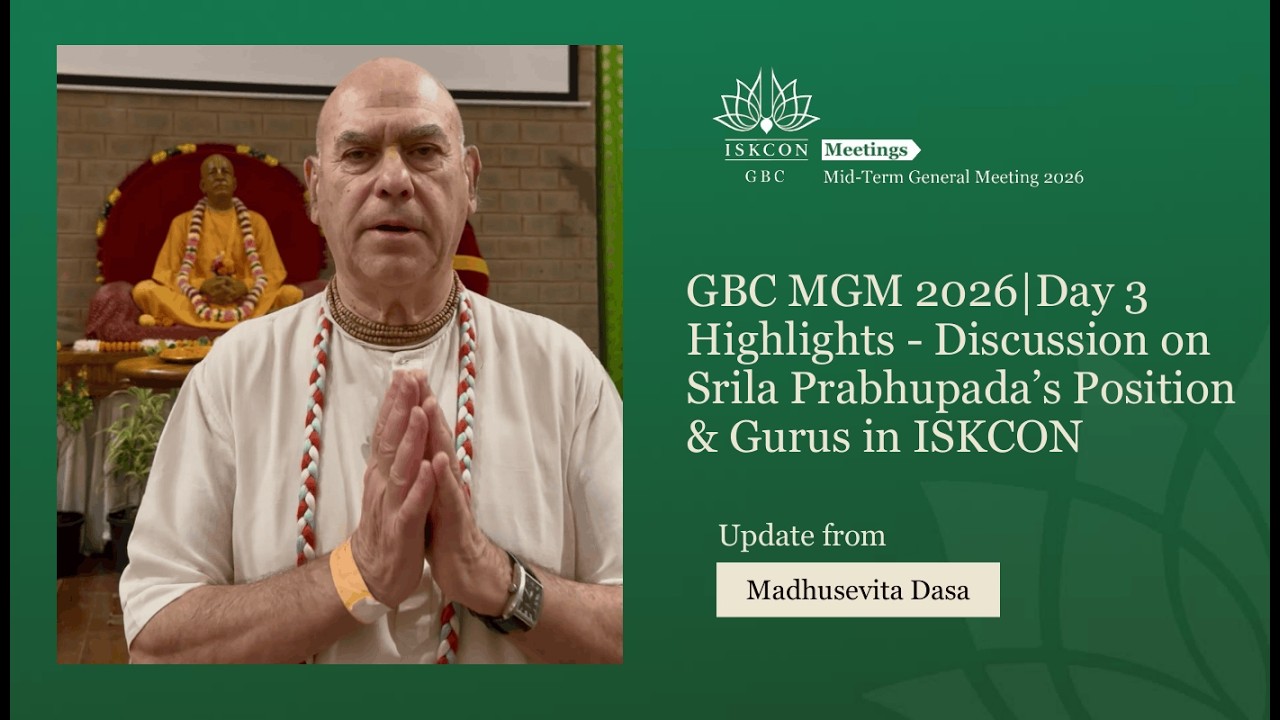
The discussion of Vaishnavi diksha gurus has become a significant subject during the Governing Body Commission’s (GBC) 2026 Midterm General Meeting (MGM). According to updates published by ISKCON News on October 21, 2026, GBC members have continued deliberations on the role of female initiating spiritual masters within the International Society for Krishna Consciousness (ISKCON).
The discussions have also expanded to examine broader theological and institutional questions concerning the position, function, and spiritual status of the guru. Recognising the importance of these matters, the GBC adjusted its meeting agenda to allow additional time for deliberation.
For students of Vedic philosophy, this development offers an opportunity to reflect upon the nature of spiritual authority, the qualifications of a guru, and the sacred responsibilities inherent in the guru-disciple relationship.
Vaishnavi Diksha Gurus and the 2026 GBC Discussions
The GBC is ISKCON’s principal governing authority, responsible for overseeing the Society’s spiritual mission, institutional administration, and long-term development.
During the second and third days of its 2026 Midterm General Meeting, the GBC devoted considerable attention to the question of Vaishnavi diksha gurus. In this context, Vaishnavi refers to a female devotee of Lord Vishnu or Krishna, while diksha refers to formal spiritual initiation.
A diksha-guru is a spiritual master who accepts a disciple through the process of initiation and undertakes the sacred responsibility of guiding that disciple in spiritual life.
According to the ISKCON News report, GBC Chairman Madhusevita Dasa explained in video updates that the discussions had broadened beyond the immediate question of female initiating gurus. Members were also examining fundamental theological and institutional considerations concerning the spiritual master’s role within ISKCON.
The agenda was modified to provide further time for these discussions. Madhusevita Dasa described the deliberations on the third day as intense and meaningful, with the subject scheduled to continue on the fourth day.
These updates indicate that the GBC was still deliberating at the time of the report. They should not be interpreted as confirmation of a final decision or an adopted policy.
Understanding Diksha in the Vaishnava Tradition
To appreciate the significance of the discussion, it is helpful to understand the meaning of diksha within the Vaishnava tradition.
Diksha is more than a formal ceremony. It marks a sacred commitment through which a disciple accepts spiritual guidance and undertakes to follow the principles of devotional life under the direction of a bona fide spiritual master.
The spiritual master introduces the disciple to the practices, teachings, and disciplines of bhakti-yoga, the path of loving devotional service to the Supreme Personality of Godhead.
In Gaudiya Vaishnavism, this relationship is understood as an essential element of spiritual progress. The disciple learns to approach transcendental knowledge with humility, sincerity, and a willingness to transform one’s life through devotional practice.
The Bhagavad-gita 4.34 teaches that transcendental knowledge should be received through submissive inquiry and service to those who have realised the truth.
This principle emphasises that spiritual learning requires more than intellectual curiosity. It calls for a sincere disposition to hear, inquire, and apply spiritual instructions.
The guru-disciple relationship is therefore both personal and deeply theological. It concerns the transmission of spiritual knowledge, the cultivation of devotion, and the disciple’s progress towards understanding the eternal relationship between the living being and Krishna.
The Role and Qualifications of the Spiritual Master
The question of who may serve as an initiating spiritual master naturally brings attention to the qualifications and responsibilities of a guru.
In the Gaudiya Vaishnava tradition, spiritual authority is not meant to rest merely upon social position, institutional influence, personal popularity, or external appearance. It is connected with genuine spiritual knowledge, fidelity to the disciplic succession, exemplary conduct, and dedication to the service of the Supreme Lord.
The Sanskrit term parampara refers to the disciplic succession through which spiritual knowledge is transmitted from teacher to disciple. Maintaining this continuity is a central concern within traditions that emphasise authorised transmission of sacred teachings.
A bona fide spiritual master is expected to guide disciples according to the teachings of scripture and the principles received through the authorised spiritual lineage.
The guru’s responsibility includes teaching the process of devotional service, encouraging spiritual discipline, and helping disciples develop a deeper understanding of Krishna.
These responsibilities make the question of spiritual leadership a matter of serious consideration. It involves not only eligibility for a particular role but also the theological principles, standards, and responsibilities by which that role is understood.
The GBC’s reported decision to broaden its discussion reflects the connection between the question of Vaishnavi diksha gurus and the larger framework of spiritual authority within ISKCON.
Vaishnavi Diksha Gurus: Scriptural Principles and Spiritual Eligibility
The question of Vaishnavi diksha gurus invites careful study of scripture, the teachings of the acharyas, and the established principles of the Gaudiya Vaishnava tradition.
One important principle in spiritual life is that the eternal identity of the living being is distinct from the temporary material body. Bhagavad-gita 2.13 describes the soul’s passage through bodily changes, establishing the distinction between the conscious self and the body it inhabits.
This teaching provides a philosophical foundation for understanding spiritual identity. However, applying it to institutional questions about initiating authority requires careful theological interpretation rather than relying on a single verse in isolation.
The discussion of female initiating spiritual masters must therefore be approached through a comprehensive examination of relevant scriptural teachings, the conclusions of recognised acharyas, and the standards governing spiritual initiation within ISKCON.
It is equally important to distinguish between the spiritual dignity of women and men as living beings and the specific qualifications and responsibilities associated with a particular spiritual office.
All devotees are encouraged to cultivate devotion, humility, knowledge, and service. Questions concerning formal initiating authority, however, also involve the interpretation of tradition and the institutional procedures through which such responsibilities are recognised.
A thoughtful examination should avoid premature conclusions, personal speculation, or the assumption that a complex theological question can be settled through slogans alone.
Instead, sincere students can approach the subject through shastra (revealed scripture), sadhu (saintly devotees), and guru (the spiritual master), carefully considering how authoritative teachings are understood and applied.
The Guru’s Spiritual Position and Institutional Responsibilities
According to the October 21 report, the GBC’s deliberations extended to the guru’s role, function, and ontological status within ISKCON’s spiritual and organisational framework.
The term ontological concerns the nature of being or existence. In this context, it points to theological questions about the spiritual master’s position and the relationship between the guru, the disciple, and the Supreme Lord.
Within Gaudiya Vaishnava theology, the spiritual master is honoured as Krishna’s representative, entrusted with guiding the disciple towards devotional service. The guru does not replace Krishna as the Supreme Personality of Godhead; rather, the guru serves as a transparent medium through whom the disciple receives spiritual guidance.
This relationship demands both reverence and theological clarity. The spiritual master is honoured because of the sacred responsibility of representing the teachings of the disciplic succession and guiding others towards Krishna consciousness.
At the institutional level, ISKCON must also consider how spiritual responsibilities are recognised, how standards are maintained, and how its governing structures implement decisions consistently.
These dimensions are related but distinct. The theological understanding of the guru concerns spiritual truth, while institutional policies establish procedures for carrying out responsibilities within a worldwide religious organisation.
The GBC’s expanded deliberations, as described in the report, reflect the importance of considering these questions together without confusing theological principles with administrative procedures.
The Importance of Careful Deliberation in ISKCON
Questions concerning spiritual leadership can affect individual devotees, congregations, temple communities, and the wider organisation. They therefore require thoughtful discussion and a commitment to preserving both spiritual integrity and respectful relationships.
The decision to modify the meeting agenda indicates that the GBC considered the matter important enough to warrant additional discussion time.
Such deliberation provides an opportunity to examine scriptural references, consider the teachings of previous acharyas, clarify institutional responsibilities, and evaluate the implications of different interpretations.
For devotees following the issue, it is important to distinguish official decisions from ongoing discussions. Video updates describing the progress of a meeting provide useful information, but they do not necessarily establish the final outcome of deliberations.
The most reliable approach is to follow official GBC communications and published ISKCON statements for any subsequent resolutions or policy changes.
At the same time, devotees can maintain a constructive spirit by continuing their spiritual practices, studying authorised literature, and discussing difficult questions with humility and respect.
The purpose of theological inquiry is not merely to prevail in debate. It is to deepen understanding of the Absolute Truth and strengthen one’s commitment to devotional service.
Preserving the Guru-Disciple Relationship Through Bhakti
The guru-disciple relationship occupies a central place in the practice of bhakti-yoga. Through hearing, chanting, study, service, and personal guidance, disciples learn to cultivate the qualities necessary for spiritual advancement.
The Sanskrit word seva means service, while shraddha means faith or a deepening confidence in the spiritual path. Both qualities help establish a foundation for sincere devotional life.
The disciple is encouraged to hear attentively, inquire resp
Deepen your Bhakti-yoga practice, harmonize relationships, and receive guided coaching — all at Vedavarsity.com