Among the great saints of the Gaudiya Vaishnava tradition, Rupa Goswami is revered as the foremost theologian of devotional service and the principal disciple entrusted with systematically presenting the science of bhakti. Through his profound scholarship, exemplary renunciation, and deep realization of Lord Krishna’s transcendental pastimes, he laid the philosophical and devotional foundation upon which the Gaudiya Vaishnava tradition continues to flourish.
The life of Rupa Goswami demonstrates that true knowledge reaches perfection when it awakens loving devotion to the Supreme Personality of Godhead. His teachings continue to guide sincere practitioners toward pure devotional service (prema-bhakti), the highest goal of human life.
Rupa Goswami’s Mission in Vrindavan
In 1517, Rupa Goswami arrived in Vrindavan with his elder brother, Sri Sanatana Goswami, to fulfill four important instructions personally given by Sri Chaitanya Mahaprabhu.
Their mission consisted of four essential services:
- Rediscover the lost pastime places of Lord Krishna.
- Establish Deity worship and proper standards of temple service.
- Compose authoritative scriptures explaining devotional service.
- Teach and preserve the principles of bhakti-yoga for future generations.
These four instructions became the blueprint for preserving the spiritual heritage of Vrindavan and establishing Gaudiya Vaishnavism on firm theological foundations.
A Life of Complete Renunciation
Although Rupa Goswami had previously held a prestigious government position, he voluntarily renounced wealth, influence, and social status after receiving the mercy of Sri Chaitanya Mahaprabhu.
In Vrindavan he lived as a humble mendicant, possessing only a kaupina (loincloth) and a kantha (patched cloth). His days were entirely dedicated to hearing and chanting the holy names, studying the Vedic scriptures, writing devotional literature, and meditating upon the eternal pastimes of Sri Sri Radha and Krishna.
His simple lifestyle reflected an important Vedic truth: the eternal self (atma) finds lasting happiness not through material possessions but through loving service to the Supreme Lord.
The Founder of Gaudiya Vaishnava Theology
Among the Six Goswamis of Vrindavan, Rupa Goswami is especially honored for presenting the philosophy of devotional service in a systematic and accessible form.
Through extensive study of the Vedic scriptures, he established that the teachings of Sri Chaitanya Mahaprabhu represent the highest expression of devotional realization and the perfection of religion. His writings remain the standard theological works for practitioners and scholars of Gaudiya Vaishnavism.
Because of his unparalleled contribution, followers of Sri Chaitanya Mahaprabhu are known as Rupanugas, meaning those who follow the teachings and devotional example of Rupa Goswami.
Sri Narottama Dasa Thakura beautifully expresses this mood in his celebrated prayer:
“The lotus feet of Sri Rupa Manjari are my greatest treasure. They are the only object of my worship and service.”
Rupa Goswami and the Science of Bhakti-rasa
The Bhakti-rasacharya
Recognizing his extraordinary qualification, Sri Chaitanya Mahaprabhu personally empowered Rupa Goswami to explain the confidential science of rasa-tattva—the transcendental relationships between the Supreme Lord and His devotees.
For this reason he became known as the Bhakti-rasacharya, the foremost teacher of devotional mellows.
His literary works explain not merely devotional practices but the progressive development of love for Krishna, culminating in pure love (prema) free from all material motivation.
Major Literary Contributions
Rupa Goswami authored numerous Sanskrit masterpieces that continue to shape devotional practice throughout the world.
Bhakti-rasamrita-sindhu
His most influential work, Bhakti-rasamrita-sindhu, systematically explains the science of devotional service from its beginning stages to the attainment of pure love for Krishna.
It describes:
- The characteristics of pure devotion.
- The stages of spiritual advancement.
- The practices of devotional service.
- The various transcendental relationships between the devotee and the Lord.
This work has become the theological foundation for Gaudiya Vaishnava practice.
Ujjvala Nilamani
This profound text elaborates upon the confidential devotional exchanges of Sri Sri Radha and Krishna, especially the highest expressions of divine love.
Lalita Madhava and Other Works
Through devotional dramas and philosophical writings, Rupa Goswami presented Krishna’s eternal pastimes with remarkable literary beauty while remaining fully grounded in scriptural authority.
His writings continue to inspire seekers by revealing the spiritual goal of loving service to Krishna.
The Potency of His Devotional Writing
Gaudiya Vaishnava tradition preserves a remarkable account illustrating the spiritual depth of Rupa Goswami’s realization.
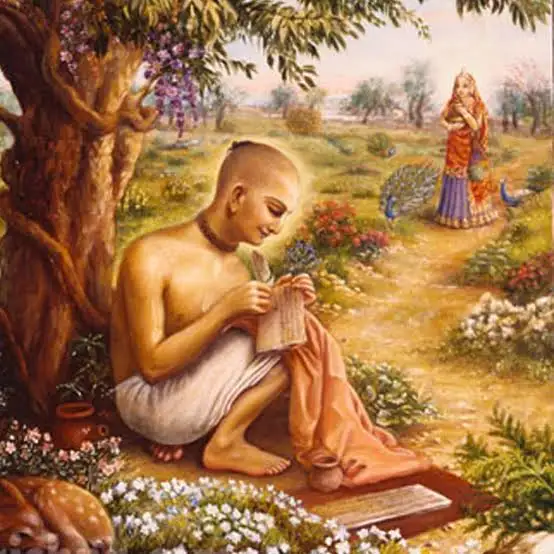
While residing in his bhajana-kutira at Ter Kadamba near Nandagram, he composed works describing the loving exchanges between Sri Radha and Krishna.
It is said that when he wrote about Their feelings of separation, the leaves of a nearby Kadamba tree would fall like tears. When he described Their joyful reunion, the same tree immediately blossomed with fresh leaves and flowers.
This traditional narration emphasizes the transformative spiritual potency attributed to the writings of realized devotees, whose hearts are fully absorbed in divine love.
Establishing Sri Sri Radha-Govindaji
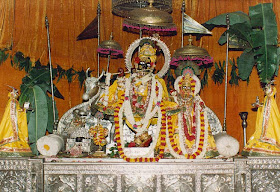
One of the greatest services of Rupa Goswami was establishing the worship of Sri Sri Radha-Govindaji in Vrindavan.
The beauty of Govindaji has been glorified by many Vaishnava saints. Traditional literature describes how Srimati Radharani Herself becomes enchanted upon beholding the incomparable beauty of Govinda, whose transcendental form captivates the hearts of all devotees.
Today, the original Deities of Radha-Govindaji are worshiped in Jaipur, Rajasthan, where thousands of pilgrims gather daily for mangala-arati and devotional worship. A representative Deity continues to receive worship in the historic Govindaji Temple associated with Vrindavan.
According to Sri Krishna Dasa Kaviraja Goswami, Radha-Govindaji teaches devotees how to serve Sri Sri Radha and Krishna with increasing surrender and devotion, acting as the guiding spiritual master through divine inspiration.
The Legacy of the Rupanugas
The influence of Rupa Goswami extends far beyond his lifetime.
Every generation of Gaudiya Vaishnava teachers has carefully preserved and transmitted his teachings. His instructions continue to serve as the standard for understanding devotional practice, spiritual relationships, and the gradual awakening of love for Krishna.
The devotional tradition especially emphasizes that genuine understanding of Radha-Krishna’s confidential pastimes is attained only through faithfully studying, practicing, and serving according to the teachings of Rupa Goswami under proper spiritual guidance.
Final Pastimes
Traditional authorities record that Rupa Goswami entered the eternal pastimes of Sri Sri Radha-Govinda in approximately 1564, twenty-seven days after the disappearance of his elder brother, Sri Sanatana Goswami.
His samadhi and bhajana-kutira are situated in Seva Kunja, within the courtyard of the historic Radha-Damodara Temple in Vrindavan. These sacred places remain important destinations for pilgrims seeking inspiration from his life of devotion and scholarship.
Conclusion
The life of Rupa Goswami reveals how profound learning, complete humility, and unwavering devotion can transform the world. By fulfilling the mission entrusted to him by Sri Chaitanya Mahaprabhu, he established the philosophical foundations of Gaudiya Vaishnavism, preserved the sacred heritage of Vrindavan, and illuminated the path of pure devotional service for generations to come.
His writings remind us that the living being is an eternal servant of Krishna, and that the highest fulfillment of life is attained not through temporary worldly achievements but through awakening pure love for the Supreme Lord. For this reason, Rupa Goswami continues to be honored as the eternal guide of all sincere practitioners who aspire to follow the path of bhakti.
Deepen your Bhakti-yoga practice, harmonize relationships, and receive guided coaching — all at Vedavarsity.com