


Bārakonā-ghāṭa Pastime: The Triumph of Divine Wisdom
The sacred pastime of Bārakonā-ghāṭa reveals the extraordinary brilliance and divine purpose of Nimāī Paṇḍita, who later became Śrī Caitanya Mahāprabhu. In His youth, He displayed unparalleled mastery over Sanskrit grammar (vyākaraṇa) and logic (navya-nyāya), astonishing scholars across India. Yet, beyond intellectual superiority, this pastime teaches a deeper spiritual truth—the futility of pride and the supremacy of devotion (bhakti).
The Scholarly Glory of Navadvīpa
Navadvīpa, situated on the banks of the sacred Ganga River, was renowned as a foremost center of Vedic learning. Students from distant lands gathered to study:
Vedas (revealed scriptures)
Upaniṣads (philosophical teachings)
Smṛtis (codes of conduct)
Purāṇas (historical narratives)
Six systems of Indian philosophy (ṣaḍ-darśana)
Among these, navya-nyāya (refined logic) flourished as a sophisticated intellectual discipline.
At Bārakonā-ghāṭa, Nimāī Paṇḍita would teach His students daily. After classes, He engaged them in scriptural discussions, illuminating subtle truths with effortless clarity.
Arrival of the Digvijayī Scholar
At this time, a renowned scholar named Keśava Kāśmīrī arrived in Navadvīpa. Known as a digvijayī-paṇḍita (one who conquers all directions through debate), he had defeated learned scholars throughout India.
Blessed by Sarasvatī, he possessed an extraordinary gift: he could spontaneously compose hundreds of Sanskrit verses filled with poetic ornaments (alaṅkāra).
With great pride, he challenged the scholars of Navadvīpa:
“Either debate with me, or accept defeat.”
However, none stepped forward. Out of envy toward Nimāī Paṇḍita, they cunningly directed him:
“First defeat Nimāī Paṇḍita, the youngest among us.”
Divine Meeting at Bārakonā-ghāṭa
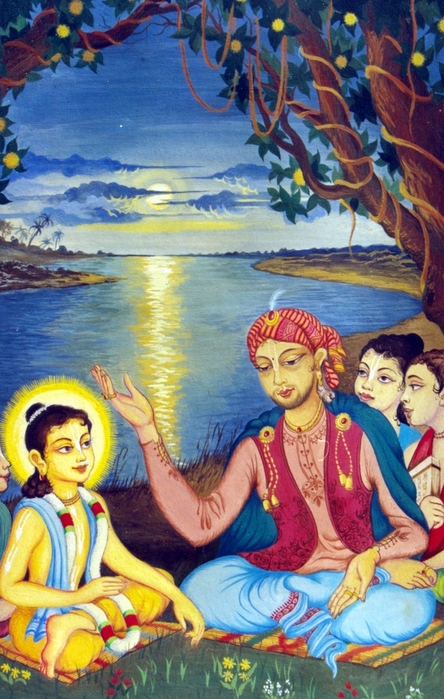
One evening at Bārakonā-ghāṭa, as the sun set and painted the sky crimson, Nimāī Paṇḍita sat surrounded by His students. The serene atmosphere was filled with the gentle sound of the flowing Ganga.
At that moment, Keśava Kāśmīrī approached.
Observing Nimāī’s profound explanations of grammar and logic, he became intrigued. Nimāī, displaying humility (vinaya), welcomed him respectfully and requested:
“Please recite the glories of Mother Ganga.”
Immediately, the scholar began composing exquisite verses in praise of Bhāgīrathī, demonstrating his poetic genius.
The Astonishing Memory of Nimāī Paṇḍita
After listening attentively, Nimāī Paṇḍita made a surprising request:
“Please explain one of the verses you have just recited.”
Keśava Kāśmīrī agreed and asked which verse to analyze.
To his astonishment, Nimāī selected a verse from the middle of the long composition—reciting it perfectly from memory.
This revealed Nimāī’s extraordinary intelligence (medhā-śakti), leaving the scholar inwardly shaken.
Analysis of Poetry: Virtues and Faults
Confident in his abilities, Keśava Kāśmīrī declared:
“There are no faults in my compositions.”
He then described several poetic virtues such as:
Alliteration (anuprāsa)
Metaphor (rūpaka)
Ornamentation (alaṅkāra)
Nimāī Paṇḍita, with gentle composure, acknowledged additional virtues. Then, with precise reasoning, He pointed out subtle faults in the verse.
These included:
Logical inconsistencies
Redundancies
Improper metaphor usage
The audience was stunned. No one had ever challenged Keśava Kāśmīrī so effectively.
The Crushing of Pride
Unable to respond, the once-victorious scholar was defeated—not by harsh words, but by truth illuminated with humility.
That night, the goddess Sarasvatī appeared to him in a dream and revealed:
“The one who defeated you is none other than the Supreme Lord, Kṛṣṇa.”
She instructed him to surrender.
This divine revelation transformed his heart.
Surrender and Transformation
The next morning, Keśava Kāśmīrī approached Nimāī Paṇḍita and fell at His feet.
With sincerity, he begged forgiveness.
Nimāī Paṇḍita instructed him:
“The purpose of scholarship is not to defeat others, but to glorify Kṛṣṇa.”
This teaching reflects the essence of bhakti-yoga—that knowledge (jṣāna) must culminate in devotion.
He advised the scholar to go to Vraja and worship Kṛṣṇa with simplicity.
Philosophical Significance of Bārakonā-ghāṭa
The Bārakonā-ghāṭa pastime carries profound philosophical teachings:
- Knowledge Without Humility is Incomplete
True wisdom (vidyā) must be accompanied by humility (amānitvam). Pride blinds the intellect and obstructs spiritual realization. - Supremacy of Divine Intelligence
Nimāī Paṇḍita’s effortless brilliance demonstrates that all knowledge originates from the Supreme.
As stated in the Bhagavad-gītā:
“From Me come knowledge, remembrance, and forgetfulness.”
- Purpose of Education
The ultimate goal of learning is not intellectual dominance but devotion to Kṛṣṇa. - Transformation Through Grace
Even a proud scholar like Keśava Kāśmīrī can be transformed through divine mercy (kṛpā).
Relevance for Modern Seekers
In today’s world, where academic achievement is often pursued for prestige, the lesson of Bārakonā-ghāṭa remains deeply relevant.
Modern education emphasizes competition, yet spiritual wisdom teaches cooperation and surrender.
One may master countless subjects, but without devotion, such knowledge remains incomplete.
Thus, this pastime invites us to reflect:
Are we seeking knowledge for ego or enlightenment?
Are we using our abilities to serve or to dominate?
Conclusion: The Eternal Lesson of Bārakonā-ghāṭa
The divine pastime of Bārakonā-ghāṭa beautifully illustrates the victory of humility over pride and devotion over dry scholarship. Nimāī Paṇḍita, the embodiment of divine wisdom, demonstrated that true knowledge culminates in loving service to Kṛṣṇa.
By studying this pastime, one learns that intellectual brilliance finds its perfection only when offered at the lotus feet of the Lord.
Let us, therefore, follow the example set at Bārakonā-ghāṭa—cultivating knowledge with humility and dedicating it to the eternal service of the Supreme.
Deepen your Bhakti-yoga practice, harmonize relationships, and receive guided coaching — all at Vedavarsity.com