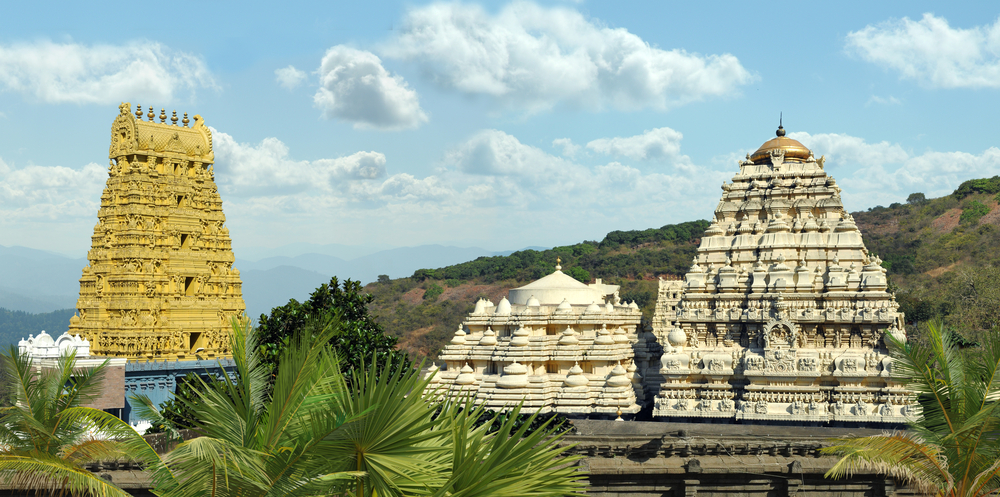
The Simhachalam Temple is one of the most revered shrines dedicated to Lord Narasimha, the fierce yet compassionate incarnation of Lord Vishnu. Situated on a picturesque hill near Visakhapatnam in Andhra Pradesh, this ancient temple has attracted pilgrims and devotees for many centuries.
The Simhachalam Temple stands about 18 kilometers from Visakhapatnam and can be seen as one approaches the city from Vizianagaram by train. Nestled upon the hill known as Simhachalam, meaning “the hill of the lion,” the temple embodies a profound spiritual heritage connected with the worship of Lord Narasimha.
In the Vedic tradition, temples are not merely architectural structures but sacred centers of bhakti (devotional service). The Simhachalam Temple beautifully exemplifies this principle, where spiritual philosophy, sacred rituals, and magnificent architecture come together to glorify the Supreme Personality of Godhead.
The Sacred Deity of Simhachalam Temple
The presiding deity of the Simhachalam Temple is known as Varaha Lakshmi Narasimha, a unique form that combines the characteristics of two incarnations of Lord Vishnu—Varaha (the divine boar) and Narasimha (the man-lion).
In the Vedic scriptures, the Lord manifests in various avatāras (incarnations) to protect the righteous and annihilate the wicked. The Varaha incarnation appeared to rescue the Earth from the depths of the cosmic ocean, while Narasimha manifested to protect His pure devotee Prahlāda Mahārāja.
At the Simhachalam Temple, the deity represents a synthesis of these two divine forms, symbolizing the Lord’s boundless compassion and protective power.
Interestingly, the deity does not appear in the usual anthropomorphic form. Instead, it resembles a Śiva-liṅga-like shape and is completely covered with sandalwood paste throughout the year.
Why the Deity Is Covered with Sandal Paste
One of the most remarkable traditions of the Simhachalam Temple is that the deity remains covered with sandal paste (candana) almost the entire year.
According to temple tradition, the fierce form of Lord Narasimha after killing the demon Hiraṇyakaśipu was so intense that it required cooling. Therefore, sandalwood paste—known for its soothing properties—is applied to calm the Lord’s fiery mood.
This covering gives the deity a smooth, rounded appearance resembling a sacred emblem rather than a visible form.
The Chandana Visarjana Festival
The only time the original form of the deity is revealed is during the annual festival known as Chandana Visarjana.
On this auspicious day, the sandal paste is ceremonially removed, allowing pilgrims to behold the true form of the Lord. Thousands of devotees gather at the Simhachalam Temple during this festival to receive the rare darśana (sacred viewing) of Varaha Lakshmi Narasimha.
Such occasions hold great spiritual significance because darśana is considered a form of divine blessing in Vedic culture.
Historical Background of Simhachalam Temple
The Simhachalam Temple possesses a rich historical legacy supported by numerous inscriptions and records.
Historical evidence indicates that the temple has been patronized by many powerful dynasties over the centuries. These rulers offered endowments, renovations, and architectural additions, demonstrating their deep devotion to Lord Narasimha.
Chola Contributions
Inscriptions reveal that Kulottunga Chola I, the great Chola king of Tamil Nadu, made significant endowments to the Simhachalam Temple around the year 1087 CE. Such patronage shows that the temple was already an important center of worship during that time.
Renovation by the Chalukyas
The Vengi Chalukyas of Andhra Pradesh renovated the original shrine in the eleventh century. Their contributions helped strengthen the temple’s architectural foundation and ritual traditions.
Eastern Ganga Dynasty
The present structure of the Simhachalam Temple owes much to the renovations carried out by Narasimha I of the Eastern Ganga dynasty in the early thirteenth century.
Their architectural vision introduced magnificent structural elements that still define the temple’s grandeur today.
Visit of Krishna Deva Raya
The renowned Vijayanagara emperor Krishna Deva Raya visited the Simhachalam Temple in the year 1516 CE. His pilgrimage is documented through inscriptions found within the temple complex.
Overall, historians have identified more than 525 inscriptions at the temple, providing valuable insight into its long and glorious history.
Architectural Beauty of Simhachalam Temple
The Simhachalam Temple is also celebrated for its extraordinary architectural design.
The temple represents a unique combination of Orissan and Chalukyan architectural styles, which can be seen in its pillars, sculptures, and decorative elements.
Stone Chariot
One of the most striking features of the temple is a stone chariot drawn by horses.
Such chariot sculptures are symbolic representations of divine movement and spiritual progress, reminding devotees that the Lord guides the soul toward liberation.
Kalyana Mandapa
Within the temple complex lies the Kalyana Mandapa, a beautiful hall supported by sixteen intricately carved pillars.
These pillars contain bas-reliefs depicting the various incarnations of Lord Vishnu, including Matsya, Kurma, Varaha, Vamana, Rama, Krishna, and Narasimha.
Such carvings serve as visual narrations of the Lord’s divine pastimes described in the Purāṇas.
Artistic Elements and Sculptures
The artistic elements of the Simhachalam Temple bear a remarkable resemblance to the sculptures of the famous Konark Sun Temple in Odisha.
The temple walls are richly decorated with carvings of elephants, flowers, plants, and celestial figures.
These motifs symbolize prosperity, harmony, and divine beauty.
Royal Figures on the Sanctum Walls
The outer walls of the sanctum feature sculptures believed to represent King Narasimha of the Eastern Ganga dynasty.
These depictions portray the king in various postures, illustrating the traditional relationship between rulers and temples in ancient India.
Kings were considered protectors of dharma (righteousness), and supporting temples was regarded as a sacred duty.
Spiritual Significance in Vaishnava Tradition
The Simhachalam Temple holds great significance for followers of the Vaishnava tradition.
Lord Narasimha represents the Lord’s unwavering commitment to protecting His devotees. In the Śrīmad-Bhāgavatam, the appearance of Narasimha demonstrates that the Supreme Lord is always present to defend those who sincerely surrender unto Him.
Prahlāda Mahārāja, the young devotee saved by Lord Narasimha, embodies the ideal qualities of faith, humility, and devotion.
The Simhachalam Temple reminds devotees of this eternal truth—that sincere devotion (bhakti) is stronger than any material power.
Pilgrimage and Devotional Experience
For pilgrims visiting Andhra Pradesh, the Simhachalam Temple offers a deeply spiritual experience.
The scenic hilltop location, sacred rituals, and historical atmosphere create an environment conducive to meditation and devotion.
Devotees climb the hill or travel by road to reach the temple, chanting prayers and remembering the Lord’s divine pastimes.
The temple festivals, daily worship, and sacred traditions make the pilgrimage both spiritually uplifting and culturally enriching.
Conclusion: The Eternal Glory of Simhachalam Temple
The Simhachalam Temple stands as a magnificent testimony to India’s rich spiritual heritage and devotion to Lord Vishnu.
From its unique Varaha Lakshmi Narasimha deity to its remarkable architectural beauty and ancient inscriptions, the temple continues to inspire countless devotees.
More importantly, the Simhachalam Temple reminds us of the timeless message of the Vedic scriptures: the Supreme Lord always protects His sincere devotees and establishes righteousness in the world.
For pilgrims, scholars, and seekers of spiritual knowledge, the Simhachalam Temple remains a sacred place where history, devotion, and divine grace beautifully converge.
Deepen your Bhakti-yoga practice, harmonize relationships, and receive guided coaching — all at Vedavarsity.com