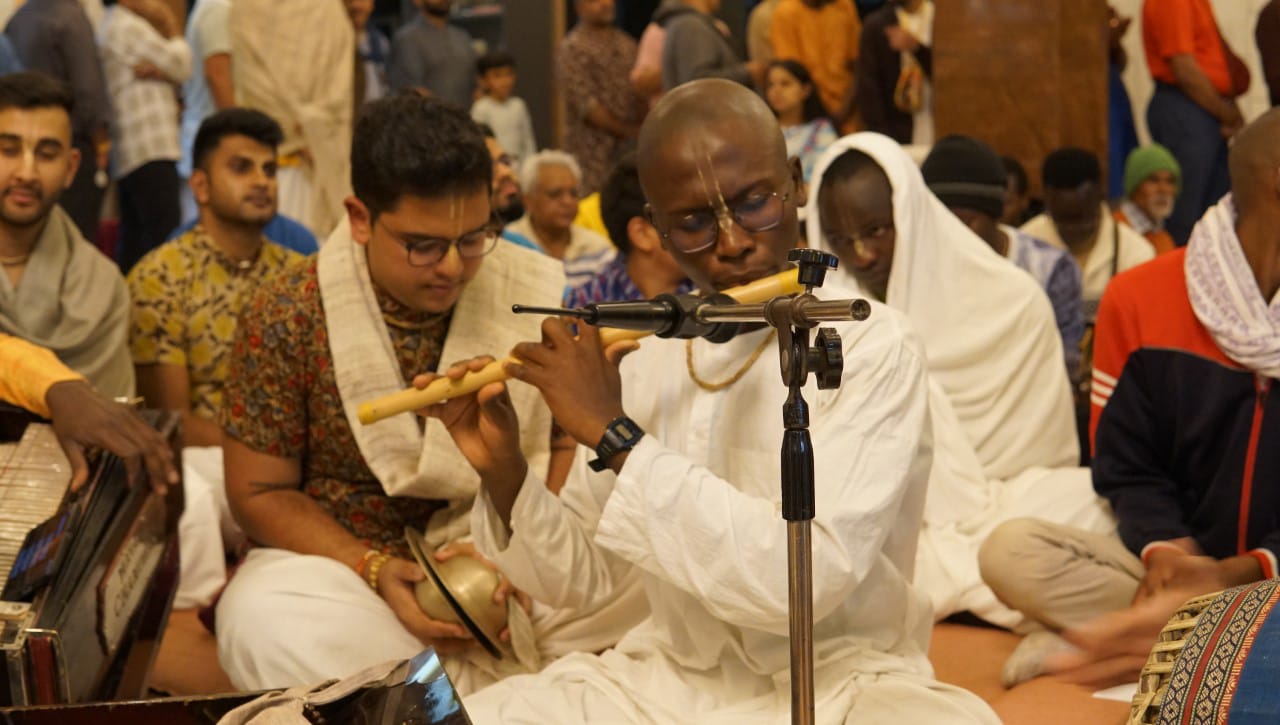
Bhakta Kamita Playing the Flute at a Festival in ISKCON Nairobi
Kamita Kamau, known online as Kamita_Kirtan, is a Nairobi-based, Kṛṣṇa-conscious content creator, musician, gṛhastha, and entrepreneur. Through his work, he documents both his inner spiritual cultivation and the outward manifestation of Kṛṣṇa consciousness within contemporary African society. His journey into bhakti commenced in the year 2020, during a period marked by introspection, inquiry, and a sincere search for meaning. Like many young people of his generation, Bhakta Kamita found himself dissatisfied with pursuits limited to professional ambition or social designation. “I was searching,” he reflected, “but I did not yet know what I was searching for.”
What most deeply impressed him was not philosophy in abstraction, but philosophy in practice. The daily chanting of the holy names, attentive hearing of Śrīmad-Bhāgavatam, and steady engagement in devotional service became the firm anchors of his life. “All I have to do is keep the holy name on my tongue, dance whenever the opportunity arises,” he reflected, “and share moments like these that speak solely of life’s ultimate purpose.” These practices, he explained, gradually bestowed clarity and steadiness at a time when many of his contemporaries experienced confusion and disorientation.
Choosing the Āśrama Path
This growing clarity impelled Kamita to make a decisive commitment: he entered the brahmacārī āśrama at ISKCON Nairobi. Temple life, as he recalled, was at once challenging and deeply transformative. Each day began before sunrise, illuminated by the gentle glow of temple lamps, accompanied by the sound of karatālas and the congregational chanting of the mahā-mantra resonating throughout the temple hall. “One learns very quickly the condition of one’s own mind,” he remarked. “In the āśrama, one cannot hide from oneself.”
The discipline was exacting. There were moments of uncertainty, exhaustion, and inner resistance. Yet these very trials became instruments of purification and growth. “There is still hope for a wretch like me,” Kamita admitted with candor, describing how humility and perseverance gradually supplanted youthful idealism. Over time, the āśrama bestowed upon him what he had not previously encountered elsewhere: a life of structure, accountability, and purposeful belonging.
A Broader World, a Clearer Sense of Duty
After some months in Nairobi, Kamita spent time at Bhaktivedanta Manor in London, England. This experience introduced him to a wider international community of devotees and to varied modes of devotional service. “I wanted to observe how Kṛṣṇa consciousness was practiced in other parts of the world,” he explained. The scale, diversity, and organizational maturity of the UK yātrā broadened his vision considerably.
At the same time, this exposure deepened his sense of responsibility toward his homeland. “Being there made me realize how important it was for me to return,” he reflected. Kenya was not merely his place of origin; it was the field where he felt his contribution would be most significant. Upon returning to Nairobi, Kamita carried with him both a global outlook and a renewed local commitment, seeking to harmonize the discipline of temple training with meaningful engagement in wider society.

Graduating from music school.

LtoR: Securing UK passport to serve at the Bhaktivedanta Manor in 2022; Kamita at the Manor.

Kaminta (center) sharing spiritual literature in the UK.

Emmersed in japa in the early days of Krishna Consciousness
Family, Marriage, and Transition
Naturally, his spiritual decisions had an impact upon his family relationships. His entrance into temple life raised concerns and questions, yet through patience, consistency, and open communication, many of these tensions gradually eased. A particularly formative moment occurred during a conversation with a family member who questioned his prospects beyond the āśrama. Rather than responding defensively, Kamita listened attentively. “That discussion compelled me to seriously consider the question of responsibility,” he recalled.
As with any sincere spiritual journey, a time came when a clear choice had to be made. After careful reflection and consultation with senior devotees, Kamita understood that the path most suitable to his circumstances was the gṛhastha āśrama. This realization ultimately led him to accept married life.
Far from constituting a departure from bhakti, his marriage represented its natural extension. “Temple life prepared me far more than I had realized,” he observed. The discipline, introspection, and service attitude cultivated during his brahmacārī training became essential foundations for household life. While acknowledging that transitions from celibate life can sometimes be accompanied by misunderstanding or stigma, Kamita spoke with sobriety and confidence about accepting responsibility with maturity and steadiness.
Creativity and Conscious Content Creation
Parallel to his spiritual maturation, Kamita’s creative expression steadily blossomed. Music, visual media, and storytelling emerged as his principal instruments of outreach and preaching. His content is youthful, vivid, and immersive, portraying kīrtanas, harināmas, festivals, and the daily devotional life within ISKCON Nairobi. “My heart is a temple,” he remarked poetically, “or at least it is meant to be.”
Kamita is acutely aware that much devotional media tends to circulate primarily within established devotee communities. “As devotees,” he observed, “we can see that much of what we produce is directed mainly toward ourselves.” Yet he has also received encouraging messages from individuals unfamiliar with Kṛṣṇa consciousness, who were drawn not by technique, but by sincerity and authenticity. His long-term aspiration is to gently transcend this enclosed sphere, employing creativity as a bridge rather than a barrier.
Entrepreneurship and Applied Bhakti
In recent times, Kamita has also entered the realm of entrepreneurship, initiating a wellness-centered venture grounded in principles of conscious living. This decision arose from a frank appraisal of practical responsibility. “I need to properly organize my finances,” he stated openly, mindful of his duties as a husband and future family man. Nevertheless, he remains clear that financial gain is not his ultimate aim. “Higher than this,” he explained, “is service to humanity at large. When a divine purpose is served, material provision follows naturally as its effect.”
The endeavor to balance commercial responsibility with spiritual integrity remains an ongoing discipline. Kamita depends upon regulated sādhana, thoughtful reflection, and devotional association to remain steady. “Business is a science,” he admitted, acknowledging both the steep learning curve and the moments of hesitation and self-doubt that accompany it. Support from both within the Vaiṣṇava community and beyond it has strengthened his conviction that bhakti can be meaningfully applied within the modern world.


Kamita with his newly-wedded wife Sharon.

Kamita playing at Harinam Utsava in Mumbai, Oct 2025. Photo by @kadam_dinesh_photography

Spending time in nature seeking inspiration to share with the world.
Looking Ahead: Youth, Africa, and Responsibility
Kamita situates his personal journey within the broader African context, particularly among young people confronted by unemployment, social unrest, and widespread disillusionment. “Peace of mind has become the rarest commodity,” he observed, noting how many seek temporary escape rather than genuine transformation. In contrast, he points to Kṛṣṇa consciousness as offering something far deeper: access to what he described as “an unlimited reservoir of happiness,” available to those who sincerely engage in devotional service.
Looking forward, Kamita envisions a future marked by creative collaboration, responsible leadership, and grounded preaching throughout the African continent. He believes that young African devotees must assume ownership of Śrīla Prabhupāda’s mission, expressing it authentically within their own cultural and social realities. His own life, still in the process of unfolding, stands as a living illustration of how devotion, creativity, and responsibility may be harmoniously integrated in service to a higher purpose.
Readers who wish to follow Kamita Kamau’s ongoing journey or explore opportunities for creative collaboration may visit his Instagram profile, where he regularly shares insights into his music, devotional activities, and community initiatives.
Deepen your Bhakti-yoga practice, harmonize relationships, and receive guided coaching — all at Vedavarsity.com