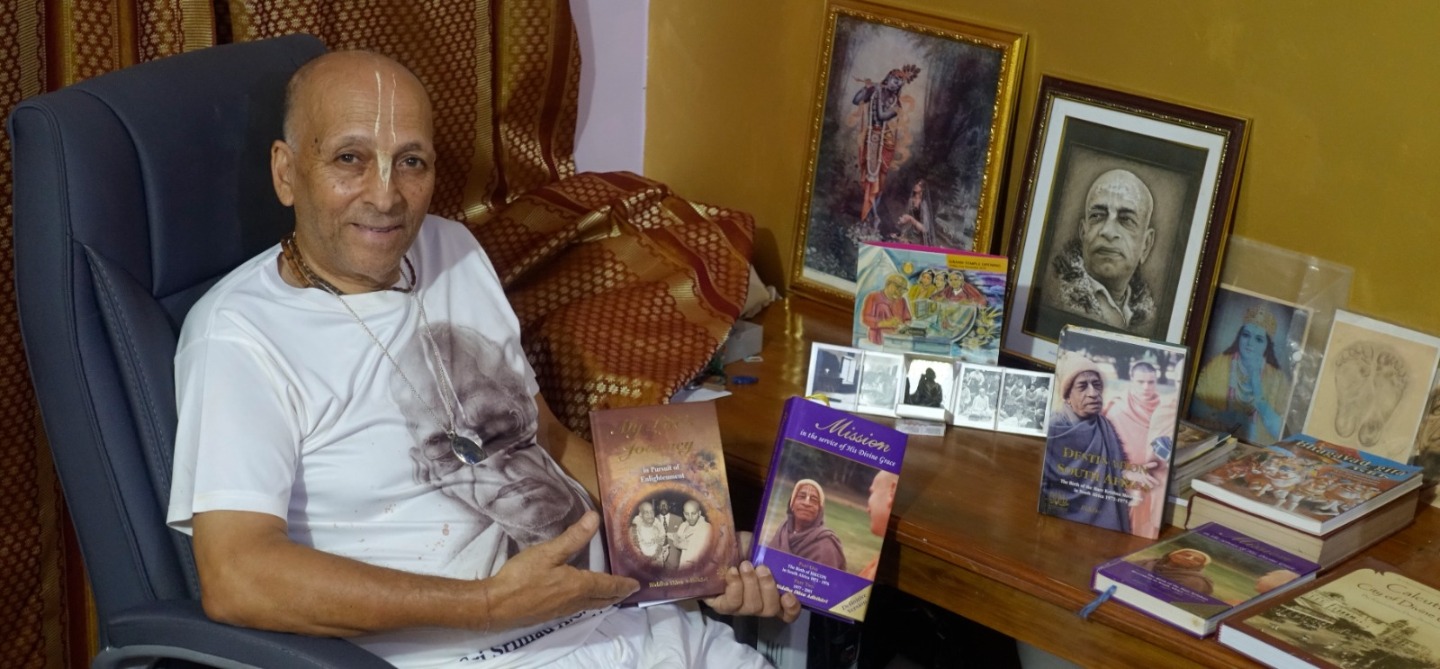
Riddha dāsa at his writing desk, holding copies of his published works chronicling the formative years of ISKCON in South Africa.
In the year 1975, a small yet resolute group of devotees residing in apartheid-era South Africa undertook what appeared to be an almost insurmountable endeavor: to invite His Divine Grace A. C. Bhaktivedanta Swami Prabhupāda to their land. Now, fifty years hence, as ISKCON South Africa commemorates the golden jubilee of that momentous visit, one of the movement’s earliest pioneers, Riddha dāsa, reflects upon the trials, the divine arrangements, and the abundant mercy that shaped the earliest foundations of Kṛṣṇa consciousness in the nation.
Born in Durban in 1949, Riddha left South Africa in early childhood when his parents fled the oppressive injustices of apartheid to settle in England. Educated in London, he distinguished himself in the arts and drama before embarking upon a journey that would transform the course of his life. “I first came in contact with the devotees in the late 1960s,” he recalled. “I saw them while traveling on an ocean liner, in both Montreal and London. By the time I returned to Canada, I was exhausted with material life—only twenty years old—and praying earnestly for direction. Then the devotees entered my life.”
He joined the Vancouver temple in 1972 and received formal initiation from Śrīla Prabhupāda in 1973. Soon thereafter, he became a member of the Bhaktivedanta Book Trust’s Traveling Saṅkīrtana Party, distributing Śrīla Prabhupāda’s books throughout North America and the Pacific region. “I was always praying that people would accept the books for what they truly are,” he said. “Not through trickery, but by the inherent merit of the books themselves.”
That same sincere spirit of devotional service would ultimately lead him back to his homeland, now burdened by the rigid laws of apartheid, to assist in establishing ISKCON’s presence and to welcome Śrīla Prabhupāda himself.
A Visa Against All Odds
To return to South Africa during the mid-1970s was by no means a simple affair. The nation’s severe racial segregation policies extended even to matters of visas and public assemblies. “Bringing Śrīla Prabhupāda to South Africa was an uneasy task,” Riddha dāsa explained. “He had already been denied a visa once. When they applied again, numerous conditions were imposed—medical certifications, chest X-rays, a deposit of five hundred rand, and a non-refundable ticket with fixed dates. And even then, Prabhupāda was unwell before his arrival.”
After years of prayer, perseverance, and patient endeavor, permission was finally granted. “It was a dream that had come true,” he said softly. “When Prabhupāda finally arrived, we all felt that every hardship had been worthwhile.”
A Land of Suspicion and Spiritual Courage
South Africa during the apartheid era was saturated with fear and mistrust, especially toward foreign spiritual movements. “The government did not directly harass us,” Riddha recalled, “but they were always observing. They sent informants disguised as devotees—spies attempting to ascertain what we were doing. Even on morning walks, we noticed three white men wearing identical sunglasses. It felt as though there were microphones hidden within them. They were monitoring every word Śrīla Prabhupāda spoke.”
Yet the devotees continued their service with faith, patience, and tact. “Eventually they understood that we were not political agitators, but spiritual practitioners,” he said. “When Prabhupāda met Professor Olivier—who was married to the widow of the former Prime Minister—it marked a turning point. The professor became friendly and was convinced of Śrīla Prabhupāda’s genuine intentions. That single meeting had a profound effect. Thereafter, the authorities did not trouble us as much.”
Durban: The Night the Heavens Opened
When Śrīla Prabhupāda arrived in Durban, it was already late at night. “He was wearing a saffron woolen hat,” Riddha remembered. “As soon as he entered, I offered my daṇḍavats. The life members were pressing forward, eager to be the first to garland him. But I said, ‘Let this child garland Prabhupāda—he is not motivated.’ The child placed the garland around him, and Prabhupāda smiled so sweetly.”
That night, the small Durban temple became sanctified with transcendental joy. “After we washed Śrīla Prabhupāda’s feet, he retired to his room and began chanting softly on his harmonium,” Riddha said. “It was exceedingly sweet to hear him singing to Kṛṣṇa late into the night. The next thing I remember is Gokulendra and I drinking the caraṇāmṛta from that bowl. We were intoxicated with bliss. Sleep was impossible. We were spiritually exhilarated until about one in the morning. It was divine.”
Johannesburg: The Lion’s Roar
If Durban was sweet and intimate, Johannesburg was bold and uncompromising. “At the Wits Great Hall, Prabhupāda roared like a lion,” Riddha recalled. “He changed the topic from the Bhagavad-gītā to the Fifth Canto of Śrīmad-Bhāgavatam, speaking on Lord Ṛṣabhadeva, austerity, and purification. Then he declared, ‘This black-and-white business is nonsense.’ We all began sweating, wondering whether the police would raid us! But he continued speaking. And afterward, everyone began purchasing books—thousands of rands’ worth. His words were so powerful that the books practically distributed themselves.”
That event, broadcast on South Africa’s newly launched color television system, became a landmark in the nation’s spiritual history. “To this day, I do not know where that footage has gone,” he said wistfully. “But I will never forget how he stood there, fearlessly proclaiming the truth in a hall filled with uncertainty.”

Riddha Das offers the first garland to Srila Prabhupada upon his historic arrival at the King Shaka Airport in Durban, SA.

Riddha Das guides Srila Prabhupada through a sea of joyful well-wishers at the airport.
A Voice Against Injustice
Beyond his early pioneering service in ISKCON, Riddha dāsa later emerged as a staunch advocate for religious freedom and social justice. After returning abroad in the 1990s, he became involved in international campaigns defending the rights of devotees and played a key role in the successful movement to protect Bhaktivedanta Manor, ISKCON’s headquarters in the United Kingdom, from government closure. “His timely intervention with South African Head of State Nelson Mandela proved instrumental in safeguarding the temple,” his biographical records note.
As an international correspondent for India Link International, he exposed instances of religious persecution and intolerance, later appearing on SABC Radio and Radio Lotus in South Africa to advocate for the freedom of faith-based communities. “Whether through writing or activism,” he said, “we must stand for what is right, because truth and justice are also expressions of devotion.”
Preserving a Sacred Legacy
Riddha’s devotion to Śrīla Prabhupāda’s mission found expression not only through preaching and activism but also through his authorship of Destination South Africa and Mission in the Service of His Divine Grace, two foundational works documenting ISKCON’s early history in the country. “If it is not recorded, we lose everything,” he said. “Kṛṣṇa gave me the facility to document it. Otherwise, Prabhupāda’s legacy might have faded.”

Mission in the Service of His Divine Grace is Riddha Das’s chronicle of Srila Prabhupada’s 1975 visit and the birth of ISKCON South Africa.

My Life’s Journey is Riddha Das’s personal account of faith, perseverance, and service.
Now, at seventy-six years of age, Riddha continues to write, teach, and inspire. His life’s work—marked by perseverance amid injustice and devotion amidst adversity—stands as a living testimony to Śrīla Prabhupāda’s transformative mercy. “Performing devotional service to Śrīla Prabhupāda is exceedingly rare,” he said. “We have received the gem. We must honor it. I simply plunged into devotional service and never stopped.”
Then, with deep conviction, he added, “Śrīla Prabhupāda is not an ordinary man, nor is he a dead man. He is always present—simply in another realm. If you follow his instructions, you will feel his presence. Spiritual life is most sublime.”
Deepen your Bhakti-yoga practice, harmonize relationships, and receive guided coaching — all at Vedavarsity.com