The Seven Planets in the Bhagavatam occupy a central place in Vedic cosmology and sacred astronomy. The sun, moon, Mars, Mercury, Jupiter, Venus, and Saturn are described not merely as physical globes, but as luminous markers of divine order (ṛta), regulating time, karma, and destiny under the supreme will of Bhagavān.
In the Fifth Canto of the Srimad-Bhagavatam, these planets are presented within a sophisticated cosmological framework centered on Bhū-maṇḍala, the vast cosmic plane. Śrīla Prabhupāda consistently emphasized that Vedic descriptions must be understood through śāstra-cakṣuḥ—“seeing through the eyes of scripture.”
Thus, the Seven Planets in the Bhagavatam are to be studied not superficially, but philosophically and devotionally.
The Seven Planets in the Bhagavatam and Svargaloka
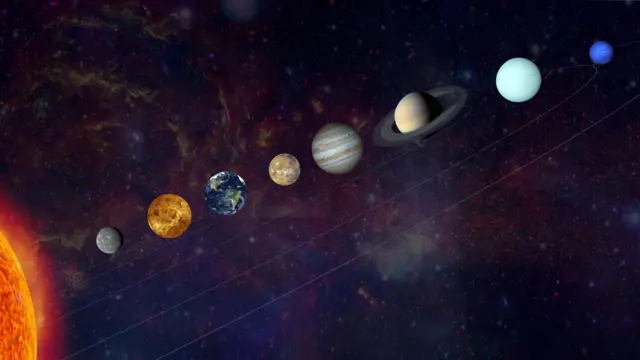
The seven traditional planets visible to human beings are:
- Sun (Sūrya)
- Moon (Candra)
- Mars (Maṅgala)
- Mercury (Budha)
- Jupiter (Bṛhaspati)
- Venus (Śukra)
- Saturn (Śanaiścara)
Śrīla Prabhupāda explains that the moon belongs to Svargaloka—the heavenly planetary system. Although planetary systems are described as layered vertically, he clarified in a 1968 letter that different types of planets—heavenly, earthly, and hellish—may exist within the same horizontal layer.
He compared the arrangement to lotus petals in layers, with Brahmaloka at the summit. Thus, the earth and the moon may share the same layer dimensionally, yet differ categorically—one being madhyama-loka (middle planetary system), the other svarga-loka (heavenly realm).
This nuanced understanding prevents simplistic literalism when studying the Seven Planets in the Bhagavatam.
Heights Above Bhū-maṇḍala: A Sacred Geometry
The Bhāgavatam provides specific heights for the planets above Bhū-maṇḍala:
- Sun – 800,000 miles
- Moon – 1,600,000 miles
- Venus – 4,800,000 miles
- Mercury – 6,400,000 miles
- Mars – 8,000,000 miles
- Jupiter – 9,600,000 miles
- Saturn – 11,200,000 miles
At first glance, critics claim these figures contradict modern astronomy. However, these distances are vertical heights above the plane of Bhū-maṇḍala—not linear distances from the Earth globe.
If one assumes vast horizontal distances along the cosmic plane, the apparent discrepancy diminishes. Indeed, modern astronomy observes that all planets move close to the ecliptic—the great celestial circle corresponding to the sun’s apparent path.
One compelling interpretation suggests that the “height” of the Seven Planets in the Bhagavatam describes their deviation from this celestial plane.
Ecliptic Motion and Higher-Dimensional Imagery
Modern astronomical data shows that planets move slightly above and below the ecliptic due to orbital inclinations.
For example:
- Moon deviates about 5°
- Mercury deviates about 7°
- Saturn deviates about 2.5°
These deviations produce maximum vertical distances consistent in order with the Bhāgavatam’s hierarchy.
A possible reconciliation is that the Fifth Canto employs three-dimensional imagery to describe a higher-dimensional reality perceived by devas (demigods), ṛṣis (sages), and perfected yogīs.
Thus, the “height” of the Seven Planets in the Bhagavatam may represent a metaphysical attribute reflected through visible astronomical motion.
Planetary Motion in the Srimad-Bhagavatam
The Bhāgavatam describes the sun as moving at three speeds:
- Fast (southern course)
- Slow (northern course)
- Moderate (at equinoxes)
Modern astronomy confirms that the sun’s apparent motion along the ecliptic varies due to Earth’s elliptical orbit. The Earth moves faster at perihelion (near January) and slower at aphelion (near July).
Similarly, the Bhāgavatam gives remarkably accurate orbital periods:
- Jupiter: one sign per Parivatsara (≈ 4,320 days)
- Saturn: one revolution in 30 Anuvatsaras (≈ 10,800 days)
Modern values differ by less than half a percent.
Such precision indicates that the Seven Planets in the Bhagavatam were not described through primitive guesswork, but through refined astronomical tradition.
The Moon and the Nakṣatras
The moon passes through 27 nakṣatras (lunar mansions), completing a sidereal orbit in approximately 27 days.
Modern value: 27.321 days
Sūrya-siddhānta: 27.322 days
The Bhāgavatam gives 27 days—an excellent approximation.
The waxing and waning of the moon are described as creating day and night for specific classes of celestial beings. This illustrates the relativity of time in Vedic cosmology.
Thus, the Seven Planets in the Bhagavatam function not only astronomically but cosmologically, linking time to consciousness.
Mars, Jupiter, and Saturn: Striking Accuracy
The Bhāgavatam states that Mars crosses one zodiac sign in three fortnights (45 days), yielding a speed of 2/3 degree per day.
Modern calculations confirm that Mars spends much of its orbital time near this rate, excluding retrograde motion.
Similarly:
- Jupiter’s orbital period differs from modern data by about 0.3%
- Saturn’s differs by about 0.38%
Such close correspondence suggests deep astronomical sophistication embedded within sacred narrative.
The Days of the Week and Planetary Order
The seven-day week derives from the seven traditional planets.
| Sanskrit Name | English Day | Latin Name |
|---|---|---|
| Āditya-vāra | Sunday | Solis dies |
| Soma-vāra | Monday | Lunae dies |
| Maṅgala-vāra | Tuesday | Martis dies |
| Budha-vāra | Wednesday | Mercurii dies |
| Bṛhaspati-vāra | Thursday | Jovis dies |
| Śukra-vāra | Friday | Veneris dies |
| Śanaiścara-vāra | Saturday | Saturni dies |
This sequence arises mathematically from the planetary rulership of 30-day months described in the Sūrya-siddhānta.
Western historians attribute this system to Greek influence. However, given India’s ancient astronomical heritage, it is equally plausible that this calendrical science originated within Vedic civilization.
The Seven Planets in the Bhagavatam thus influence not only cosmology but the very structure of human timekeeping.
Reconciling Apparent Contradictions
Some object that planets move on both sides of the ecliptic, whereas the Bhāgavatam assigns fixed heights.
Yet Śrīla Prabhupāda spoke of Bhū-maṇḍala as a system of globes floating in space. He also affirmed that different planetary types may mix within layers.
The solution may lie in understanding that the Fifth Canto provides a simplified descriptive model of a higher-dimensional reality.
Just as modern physics employs curved spacetime imagery to describe gravity, Vedic cosmology may employ vertical height imagery to describe metaphysical positioning.
Thus, the Seven Planets in the Bhagavatam reflect both observable astronomy and transcendental cosmography.
Conclusion: The Seven Planets in the Bhagavatam and Divine Order
The Seven Planets in the Bhagavatam reveal a universe governed not by blind mechanism but by conscious design. Their heights, motions, and cycles regulate time, seasons, karma, and ritual observance.
Far from being naive, the Bhāgavatam’s astronomical descriptions display notable accuracy when properly interpreted. Its language is devotional, yet mathematically structured.
Through śāstra-cakṣuḥ we understand that these planetary systems operate under the supervision of the Supreme Lord, who declares in Bhagavad-gītā that He is the light of the sun and the moon.
Therefore, the study of the Seven Planets in the Bhagavatam is not merely scientific—it is spiritual. It reveals a cosmos harmonized by divine intelligence, inviting humanity to align its life with the eternal order of dharma.
Hare Kṛṣṇa.
Deepen your Bhakti-yoga practice, harmonize relationships, and receive guided coaching — all at Vedavarsity.com