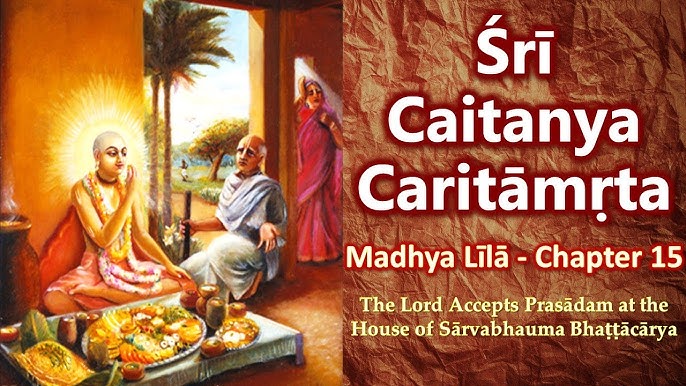
At this time the Bhaṭṭācārya had a son- in- law named Amogha, who was the husband of his daughter Ṣāṭhī. Although born in an aristocratic brāhmaṇa family, Amogha was a great faultfinder and blasphemer. (245) Amogha wanted to see Śrī Caitanya Mahāprabhu eat, but he was not allowed to enter. Indeed, the Bhaṭṭācārya guarded the threshold of his house with a stick in his hand. (246) However, as soon as the Bhaṭṭācārya began distributing prasādam and was a little inattentive, Amogha came in. Seeing the quantity of food, he began to blaspheme. (247) “This much food is sufficient to satisfy ten or twelve men, but this sannyāsī alone is eating so much!” (248) As soon as Amogha said this, Sārvabhauma Bhaṭṭācārya turned his eyes upon him. Seeing the Bhaṭṭācārya’s attitude, Amogha immediately left. (249)
The Bhaṭṭācārya ran after him to strike him with a stick, but Amogha fled so fast that the Bhaṭṭācārya could not catch him. (250) The Bhaṭṭācārya then began to curse his son- in- law and call him ill names. When the Bhaṭṭācārya returned, he saw that Śrī Caitanya Mahāprabhu was laughing to hear him criticize Amogha. (251) When Ṣāṭhī’s mother, the Bhaṭṭācārya’s wife, heard of this incident, she immediately began to strike her head and chest, saying again and again, “Let Ṣāṭhī become a widow!” (252) Seeing the lamentation of both husband and wife, Śrī Caitanya Mahāprabhu tried to pacify them. According to their desire, He ate the prasādam and was very satisfied. (253) After Śrī Caitanya Mahāprabhu finished eating, the Bhaṭṭācārya poured water for the Lord to wash His mouth, hands and legs and offered Him flavored spices, tulasī- mañjarīs, cloves and cardamom. (254)
The Bhaṭṭācārya then placed a flower garland over Śrī Caitanya Mahāprabhu and smeared His body with sandalwood pulp. After offering obeisances, the Bhaṭṭācārya submitted the following humble statement. (255) “I brought You to my home just to have You blasphemed. This is a great offense. Please excuse me. I beg Your pardon.” (256) Śrī Caitanya Mahāprabhu said, “What Amogha has said is correct; therefore it is not blasphemy. What is your offense?” (257) After saying this, Śrī Caitanya Mahāprabhu left and returned to His residence. Sārvabhauma Bhaṭṭācārya followed Him. (258) Falling down at the Lord’s feet, Sārvabhauma Bhaṭṭācārya said many things in self- reproach. The Lord then pacified him and sent him back to his home. (259) After returning to his home, Sārvabhauma Bhaṭṭācārya consulted with his wife, the mother of Ṣāṭhī. After personally condemning himself, he began to speak as follows.(260)
“If the man who blasphemed Śrī Caitanya Mahāprabhu is killed, his sinful action may be atoned.” (261) Sārvabhauma Bhaṭṭācārya continued, “Or, if I give up my own life, this sinful action may be atoned. However, neither of these ideas is befitting because both bodies belong to brāhmaṇas. (262) “Instead, I shall never see the face of that blasphemer. I reject him and give up my relationship with him. I shall never even speak his name. (263) “Inform my daughter Ṣāṭhī to abandon her relationship with her husband because he has fallen down. When the husband falls down, it is the wife’s duty to relinquish the relationship. (264)
“‘When a husband is fallen, one’s relationship with him must be given up.’” (265) That night Amogha, Sārvabhauma Bhaṭṭācārya’s son- in- law, fled, and in the morning he immediately fell sick with cholera. (266) When the Bhaṭṭācārya heard that Amogha was dying of cholera, he thought, “It is the favor of Providence that He is doing what I want to do. (267) “When one offends the Supreme Personality of Godhead, karma immediately takes effect.” After saying this, he recited two verses from the revealed scripture. (268) “‘What we have had to arrange with great endeavor by collecting elephants, horses, chariots and infantry soldiers has already been accomplished by the Gandharvas.’ (269) “‘When a person mistreats great souls, his life span, opulence, reputation, religion, possessions and good fortune are all destroyed.’ (270)
At this time, Gopīnātha Ācārya went to see Śrī Caitanya Mahāprabhu, and the Lord asked him about the events taking place in Sārvabhauma Bhaṭṭācārya’s house. (271) Gopīnātha Ācārya informed the Lord that both the husband and the wife were fasting and that their son- in- law, Amogha, was dying of cholera. (272) As soon as Caitanya Mahāprabhu heard that Amogha was going to die, He immediately ran to him in great haste. Placing His hand on Amogha’s chest, He spoke as follows. (273) “The heart of a brāhmaṇa is by nature very clean; therefore it is a proper place for Kṛṣṇa to sit. (274) “Why have you allowed the caṇḍāla of jealousy to sit here also? In this way you have contaminated a most purified place, your heart. (275) “However, due to the association of Sārvabhauma Bhaṭṭācārya, all your contamination is now vanquished. When a person’s heart is cleansed of all contamination, he is able to chant the mahā- mantra, Hare Kṛṣṇa. (276)
“Therefore, Amogha, get up and chant the Hare Kṛṣṇa mahā- mantra! If you do so, Kṛṣṇa will unfailingly bestow mercy upon you.” (277) After hearing Śrī Caitanya Mahāprabhu and being touched by Him, Amogha, who was on his deathbed, immediately stood up and began to chant the holy name of Kṛṣṇa. Thus he became mad with ecstatic love and began to dance emotionally. (278) While Amogha danced in ecstatic love, he manifested all the ecstatic symptoms—trembling, tears, jubilation, trance, perspiration and a faltering voice. Seeing these waves of ecstatic emotion, Śrī Caitanya Mahāprabhu began to laugh. (279) Amogha then fell before the Lord’s lotus feet and submissively said, “O merciful Lord, please excuse my offense.” (280) Not only did Amogha beg the Lord’s pardon, but he also began slapping his own cheeks, saying, “By this mouth I have blasphemed You.” (281) Indeed, Amogha continued slapping his face over and over until his cheeks were swollen. Finally Gopīnātha Ācārya stopped him by catching hold of his hands. (282)
After this, Śrī Caitanya Mahāprabhu pacified Amogha by touching his body and saying, “You are the object of My affection because you are the son- in- law of Sārvabhauma Bhaṭṭācārya. (283) “Everyone in Sārvabhauma Bhaṭṭācārya’s house is very dear to Me, including his maids and servants and even his dog. And what to speak of his relatives? (284) “Amogha, always chant the Hare Kṛṣṇa mahā- mantra and do not commit any further offenses.” After giving Amogha this instruction, Śrī Caitanya Mahāprabhu went to Sārvabhauma’s house. (285) Upon seeing the Lord, Sārvabhauma Bhaṭṭācārya immediately caught hold of His lotus feet. The Lord embraced him and then sat down. (286) Śrī Caitanya Mahāprabhu pacified Sārvabhauma, saying, “After all, Amogha, your son- in- law, is a child. So what is his fault? Why are you fasting, and why are you angry? (287)
“Just get up and take your bath and go see the face of Lord Jagannātha. Then return here to eat your lunch. In this way I shall be happy. (288) “I shall stay here until you return to take Lord Jagannātha’s remnants for your lunch.” (289) Catching hold of Śrī Caitanya Mahāprabhu’s lotus feet, the Bhaṭṭācārya said, “Why did You bring Amogha back to life? It would have been better had he died.” (290) Śrī Caitanya Mahāprabhu said, “Amogha is a child and your son. The father does not take the faults of his son seriously, especially when he is maintaining him. (291)
“Now that he has become a Vaiṣṇava, he is offenseless. You can bestow your mercy upon him without hesitation.” (292) Sārvabhauma Bhaṭṭācārya said, “Please go, my Lord, to see Lord Jagannātha. After taking my bath, I shall go there and then return.” (293) Śrī Caitanya Mahāprabhu then told Gopīnātha, “Stay here and inform Me when Sārvabhauma Bhaṭṭācārya has taken his prasādam.” (294) After saying this, Śrī Caitanya Mahāprabhu went to see Lord Jagannātha. Sārvabhauma Bhaṭṭācārya completed his bath, went to see Lord Jagannātha and then returned to his house to accept food. (295) Thereafter, Amogha became an unalloyed devotee of Śrī Caitanya Mahāprabhu. He danced in ecstasy and peacefully chanted the holy name of Lord Kṛṣṇa. (296) In this way, Śrī Caitanya Mahāprabhu performed His various pastimes. Whoever sees them or hears them recounted becomes truly astonished. (297)
Thus Śrī Caitanya Mahāprabhu enjoyed eating in Sārvabhauma Bhaṭṭācārya’s house. Within that one pastime, many wonderful pastimes were manifested. (298) These are the peculiar characteristics of Śrī Caitanya Mahāprabhu’s pastimes. Thus the Lord ate in Sārvabhauma Bhaṭṭācārya’s house, and in this way Sārvabhauma’s love for the Lord has become very well known. (299) Thus I have related the ecstatic love of Sārvabhauma’s wife, who is known as the mother of Ṣāṭhī. I have also related Śrī Caitanya Mahāprabhu’s great mercy, which He manifested by excusing Amogha’s offense. He did so due to Amogha’s relationship with a devotee. (300) Whoever hears these pastimes of Śrī Caitanya Mahāprabhu with faith and love will attain the shelter of the Lord’s lotus feet very soon. (301) Praying at the lotus feet of Śrī Rūpa and Śrī Raghunātha, always desiring their mercy, I, Kṛṣṇadāsa, narrate Śrī Caitanya- caritāmṛta, following in their footsteps. (302)
Deepen your Bhakti-yoga practice, harmonize relationships, and receive guided coaching — all at Vedavarsity.com