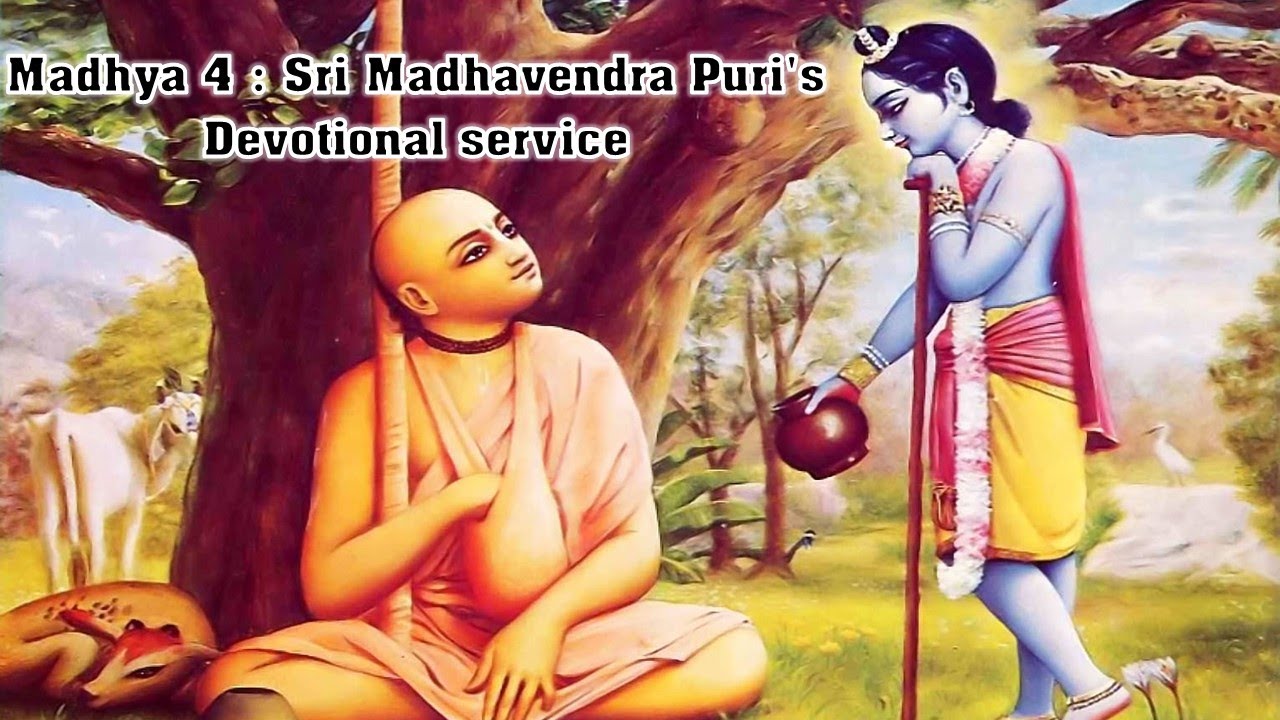
Mādhavendra Purī avoided begging. He was completely unattached and indifferent to material things. If, without his begging, someone offered him some food, he would eat; otherwise he would fast. (123) A paramahaṁsa like Mādhavendra Purī is always satisfied in the loving service of the Lord. Material hunger and thirst cannot impede his activities. When he desired to taste a little sweet rice offered to the Deity, he considered that he had committed an offense by desiring to eat what was being offered to the Deity. (124) Mādhavendra Purī left the temple and sat down in the village marketplace, which was vacant. Sitting there, he began to chant. In the meantime, the temple priest laid the Deity down to rest. (125) Finishing his daily duties, the priest went to take rest. In a dream he saw the Gopīnātha Deity come to talk to him, and He spoke as follows. (126)
“O priest, please get up and open the door of the temple. I have kept one pot of sweet rice for the sannyāsī Mādhavendra Purī. (127) “This pot of sweet rice is just behind My cloth curtain. You did not see it because of My tricks. (128) “A sannyāsī named Mādhavendra Purī is sitting in the vacant marketplace. Please take this pot of sweet rice from behind Me and deliver it to him.” (129) Awaking from the dream, the priest immediately rose from bed and thought it wise to take a bath before entering the Deity’s room. He then opened the temple door. (130) According to the Deity’s directions, the priest found the pot of sweet rice behind the cloth curtain. He removed the pot and mopped up the place where it had been kept. He then went out of the temple. (131) Closing the door of the temple, he went to the village with the pot of sweet rice. He called out in every stall in search of Mādhavendra Purī. (132)
Holding the pot of sweet rice, the priest called, “Will he whose name is Mādhavendra Purī please come and take this pot! Gopīnātha has stolen this pot of sweet rice for you!” (133) The priest continued, “Would the sannyāsī whose name is Mādhavendra Purī please come and take this pot of sweet rice and enjoy the prasādam with great happiness! You are the most fortunate person within these three worlds!” (134) Hearing this invitation, Mādhavendra Purī came out and identified himself. The priest then delivered the pot of sweet rice and offered his obeisances, falling flat before him. (135) When the story about the pot of sweet rice was explained to him in detail, Śrī Mādhavendra Purī at once became absorbed in ecstatic love of Kṛṣṇa. (136)
Upon seeing the ecstatic loving symptoms manifest in Mādhavendra Purī, the priest was struck with wonder. He could understand why Kṛṣṇa had become so much obliged to him, and he saw that Kṛṣṇa’s action was befitting. (137) The priest offered his obeisances to Mādhavendra Purī and returned to the temple. Then, in ecstasy, Mādhavendra Purī ate the sweet rice offered to him by Kṛṣṇa. (138) After this, Mādhavendra Purī washed the pot and broke it into pieces. He then bound all the pieces in his outer cloth and kept them nicely. (139) Each day, Mādhavendra Purī would eat one piece of that earthen pot, and after eating it he would immediately be overwhelmed with ecstasy. These are wonderful stories. (140) Having broken the pot and bound the pieces in his cloth, Mādhavendra Purī began to think, “The Lord has given me a pot of sweet rice, and when the people hear of this tomorrow morning, there will be great crowds.” (141) Thinking this, Śrī Mādhavendra Purī offered his obeisances to Gopīnātha on the spot and left Remuṇā before morning. (142)
Walking and walking, Mādhavendra Purī finally reached Jagannātha Purī, which is also known as Nīlācala. There he saw Lord Jagannātha and was overwhelmed with loving ecstasy. (143) When Mādhavendra Purī was overwhelmed in the ecstasy of love of Godhead, he sometimes stood up and sometimes fell to the ground. Sometimes he laughed, danced and sang. In this way he enjoyed transcendental bliss by seeing the Jagannātha Deity. (144) When Mādhavendra Purī came to Jagannātha Purī, people were aware of his transcendental reputation. Therefore crowds of people came and offered him all sorts of respect in devotion. (145) Even though one may not like it, reputation, as ordained by providence, comes to him. Indeed, one’s transcendental reputation is known throughout the entire world. (146)
Being afraid of his reputation [pratiṣṭhā], Mādhavendra Purī fled from Remuṇā. But the reputation brought by love of Godhead is so sublime that it goes along with the devotee, as if following him. (147) Mādhavendra Purī wanted to leave Jagannātha Purī because the people were honoring him as a great devotee; however, this threatened to hinder his collecting sandalwood for the Gopāla Deity. (148) Śrī Mādhavendra Purī told all the servants of Lord Jagannātha and all the great devotees there the story of the appearance of Śrī Gopāla. (149) When all the devotees at Jagannātha Purī heard that the Gopāla Deity wanted sandalwood, in great pleasure they all endeavored to collect it. (150) Those who were acquainted with government officers met with them and begged for camphor and sandalwood, which they collected. (151)
One brāhmaṇa and one servant were given to Mādhavendra Purī just to carry the sandalwood. He was also given the necessary traveling expenses. (152) To get past the toll collectors along the way, Mādhavendra Purī was supplied with the necessary release papers from government officers. The papers were placed in his hand. (153) In this way Mādhavendra Purī started for Vṛndāvana with the burden of sandalwood, and after some days he again reached the village of Remuṇā and the Gopīnātha temple there. (154) When Mādhavendra Purī reached the temple of Gopīnātha, he offered his respectful obeisances many times at the lotus feet of the Lord. In the ecstasy of love, he began to dance and sing without cessation. (155) When the priest of Gopīnātha saw Mādhavendra Purī again, he offered all respects to him and, giving him the sweet rice prasādam, made him eat. (156)
Mādhavendra Purī took rest that night in the temple, but toward the end of the night he had another dream. (157) Mādhavendra Purī dreamed that Gopāla came before him and said, “O Mādhavendra Purī, I have already received all the sandalwood and camphor. (158) “Now just grind all the sandalwood together with the camphor and then smear the pulp on the body of Gopīnātha daily until it is finished. (159) “There is no difference between My body and Gopīnātha’s body. They are one and the same. Therefore if you smear the sandalwood pulp on the body of Gopīnātha, you will naturally also smear it on My body. Thus the temperature of My body will be reduced. (160) “You should not hesitate to act according to My order. Believing in Me, just do what is needed.” (161) After giving these instructions, Gopāla disappeared, and Mādhavendra Purī awoke. He immediately called for all the servants of Gopīnātha, and they came before him. (162)
Mādhavendra Purī said, “Smear the body of Gopīnātha with this camphor and sandalwood I have brought for Gopāla in Vṛndāvana. Do this regularly every day. (163) “If the sandalwood pulp is smeared over the body of Gopīnātha, then Gopāla will be cooled. After all, the Supreme Personality of Godhead is completely independent; His order is all- powerful.” (164) The servants of Gopīnātha became very pleased to hear that in the summer all the sandalwood pulp would be used to anoint the body of Gopīnātha. (165) Mādhavendra Purī said, “These two assistants will regularly grind the sandalwood, and you should also get two other people to help. I shall pay their salaries.” (166) In this way Gopīnāthajī was supplied ground sandalwood pulp daily. The servants of Gopīnātha were very pleased with this. (167) In this way the sandalwood pulp was smeared over the body of Gopīnātha until the whole stock was finished. Mādhavendra Purī stayed there until that time. (168)
Deepen your Bhakti-yoga practice, harmonize relationships, and receive guided coaching — all at Vedavarsity.com