


After seeing the bathing ceremony of Lord Jagannātha, Śrī Caitanya Mahāprabhu washed and cleaned Śrī Guṇḍicā temple with the assistance of many devotees. (133) After this, Lord Caitanya Mahāprabhu and all the devotees saw the Ratha- yātrā, the car festival ceremony. Caitanya Mahāprabhu Himself danced in front of the car, and after dancing He entered a garden. (134) In that garden, Lord Caitanya Mahāprabhu bestowed His mercy upon King Pratāparudra. Afterwards, when the Bengali devotees were about to return home, the Lord gave separate orders to almost every one of them. (135)
Śrī Caitanya Mahāprabhu desired to meet all the devotees of Bengal every year. Therefore He ordered them to come to see the Ratha- yātrā festival every year. (136) Śrī Caitanya Mahāprabhu was invited to dine at the house of Sārvabhauma Bhaṭṭācārya. While He was eating sumptuously, the son- in- law of Sārvabhauma Bhaṭṭācārya [the husband of his daughter Ṣāṭhī] criticized Him. Because of this, Ṣāṭhī’s mother cursed him by praying that Ṣāṭhī would become a widow. In other words, she cursed her son- in- law to die. (137) At the end of the year, all the devotees from Bengal, headed by Advaita Ācārya, again came to see the Lord. Indeed, there was a great rush of devotees to Jagannātha Purī. (138) When all the devotees from Bengal arrived, Śrī Caitanya Mahāprabhu allotted them residential quarters, and Śivānanda Sena was put in charge of their maintenance. (139)
A dog accompanied Śivānanda Sena and the devotees, and that dog was so fortunate that after seeing the lotus feet of Lord Caitanya Mahāprabhu, it was liberated and went back home, back to Godhead. (140) Everyone met Sārvabhauma Bhaṭṭācārya on his way to Vārāṇasī. (141) After arriving at Jagannātha Purī, all the Vaiṣṇavas met with Śrī Caitanya Mahāprabhu. Later, Śrī Caitanya Mahāprabhu sported in the water, taking all the devotees with Him. (142) First the Lord washed the temple of Guṇḍicā very thoroughly. Then everyone saw the Ratha- yātrā festival and the Lord’s dancing before the car. (143) In the garden along the road from the Jagannātha temple to Guṇḍicā, Lord Caitanya Mahāprabhu performed various pastimes. A brāhmaṇa named Kṛṣṇadāsa performed the bathing ceremony of Lord Śrī Caitanya Mahāprabhu. (144) After dancing in the Guṇḍicā temple, the Lord sported in the water with His devotees, and on Herā- pañcamī day they all saw the activities of the goddess of fortune, Lakṣmīdevī. (145)
On Janmāṣṭamī, Lord Kṛṣṇa’s birthday, Śrī Caitanya Mahāprabhu dressed Himself as a cowherd boy. At that time He carried a balance with pots of yogurt and wheeled a rod about. (146) After this, Śrī Caitanya Mahāprabhu bade farewell to all the devotees from Gauḍa- deśa [Bengal] and continued chanting with His intimate devotees who constantly remained with Him. (147) To visit Vṛndāvana, the Lord went to Gauḍa- deśa [Bengal]. On the way, King Pratāparudra performed a variety of services to please the Lord. (148) On the way to Vṛndāvana via Bengal, there was an incident wherein some cloth was exchanged with Purī Gosāñi. Śrī Rāmānanda Rāya accompanied the Lord as far as the city of Bhadraka. (149) When Śrī Caitanya Mahāprabhu reached Vidyānagara, Bengal, on the way to Vṛndāvana, He stopped at the house of Vidyā- vācaspati, who was the brother of Sārvabhauma Bhaṭṭācārya. When Lord Caitanya Mahāprabhu suddenly arrived at his house, great crowds of people gathered. (150)
For five consecutive days all the people gathered to see the Lord, and still there was no rest. Out of fear of the crowd, Lord Caitanya Mahāprabhu left at night and went to the town of Kuliyā [present- day Navadvīpa]. (151) Hearing of the Lord’s arrival in Kuliyā- grāma, many hundreds of thousands of people came to see Him. (152) The specific acts performed by Śrī Caitanya Mahāprabhu at this time were His showing favor to Devānanda Paṇḍita and excusing the brāhmaṇa known as Gopāla Cāpala from the offense he had committed at the lotus feet of Śrīvāsa Ṭhākura. (153) Many atheists and blasphemers came and fell at the lotus feet of the Lord, and the Lord in return excused them and gave them love of Kṛṣṇa. (154) When Śrī Nṛsiṁhānanda Brahmacārī heard that Lord Caitanya Mahāprabhu would go to Vṛndāvana, he became very pleased and mentally began decorating the way there. (155)
First Nṛsiṁhānanda Brahmacārī contemplated a broad road starting from the city of Kuliyā. He bedecked the road with jewels, upon which he then laid a bed of stemless flowers. (156) He mentally decorated both sides of the road with bakula flower trees, and at intervals on both sides he placed lakes of a transcendental nature. (157) These lakes had bathing places constructed with jewels, and they were filled with blossoming lotus flowers. There were various birds chirping, and the water was exactly like nectar. (158) The entire road was surcharged with many cool breezes, which carried the fragrances from various flowers. He carried the construction of this road as far as Kānāi Nāṭaśālā. (159) Within the mind of Nṛsiṁhānanda Brahmacārī, the road could not be constructed beyond Kānāi Nāṭaśālā. He could not understand why the road’s construction could not be completed, and thus he was astonished. (160)
With great assurance he then told the devotees that Lord Caitanya would not go to Vṛndāvana at that time. (161) Nṛsiṁhānanda Brahmacārī said, “The Lord will go to Kānāi Nāṭaśālā and then will return. All of you will come to know of this later, but I now say this with great assurance.” (162) When Lord Caitanya Mahāprabhu began to proceed from Kuliyā toward Vṛndāvana, thousands of men were with Him, and all of them were devotees. (163) Wherever the Lord visited, crowds of innumerable people came to see Him. When they saw Him, all their unhappiness and lamentation disappeared. (164) Wherever the Lord touched the ground with His lotus feet, people immediately came and gathered the dirt. Indeed, they gathered so much that many holes were created in the road. (165) Lord Caitanya Mahāprabhu eventually arrived at a village named Rāmakeli. This village is situated on the border of Bengal and is very exquisite. (166)
While performing saṅkīrtana in Rāmakeli- grāma, the Lord danced and sometimes lost consciousness due to love of God. While at Rāmakeli- grāma, an unlimited number of people came to see His lotus feet. (167) When the Muslim king of Bengal heard of Caitanya Mahāprabhu’s influence in attracting innumerable people, he became very much astonished and began to speak as follows. (168) Such a person, who is followed by so many people without giving them charity, must be a prophet. I can surely understand this fact.” (169) The Muslim King ordered the magistrate, “Do not disturb this Hindu prophet out of jealousy. Let Him do His own will wherever He likes.” (170) When the Muslim King asked his assistant, Keśava Chatrī, for news of the influence of Śrī Caitanya Mahāprabhu, Keśava Chatrī, although knowing everything about Caitanya Mahāprabhu, tried to avoid the conversation by not giving any importance to Caitanya Mahāprabhu’s activities. (171) Keśava Chatrī informed the Muslim King that Caitanya Mahāprabhu was a mendicant touring different places of pilgrimage and that, as such, only a few people came to see Him. (172)
Keśava Chatrī said, “Out of jealousy your Muslim servant plots against Him. I think that you should not be very interested in Him, for there is no profit in it. Rather, there is simply loss.” (173) After pacifying the King in this way, Keśava Chatrī sent a brāhmaṇa messenger to Lord Caitanya Mahāprabhu, requesting Him to leave without delay. (174) In private, the King inquired from Dabira Khāsa [Śrīla Rūpa Gosvāmī], who began to speak about the glories of the Lord. (175) Śrīla Rūpa Gosvāmī said, “The Supreme Personality of Godhead, who gave you this kingdom and whom you accept as a prophet, has taken birth in your country due to your good fortune. (176) “This prophet always desires your good fortune. By His grace, all your business is successful. By His blessings, you will attain victory everywhere. (177) “Why are you questioning me? Better that you question your own mind. Because you are the King of the people, you are the representative of the Supreme Personality of Godhead. Therefore you can understand this better than I.” (178)
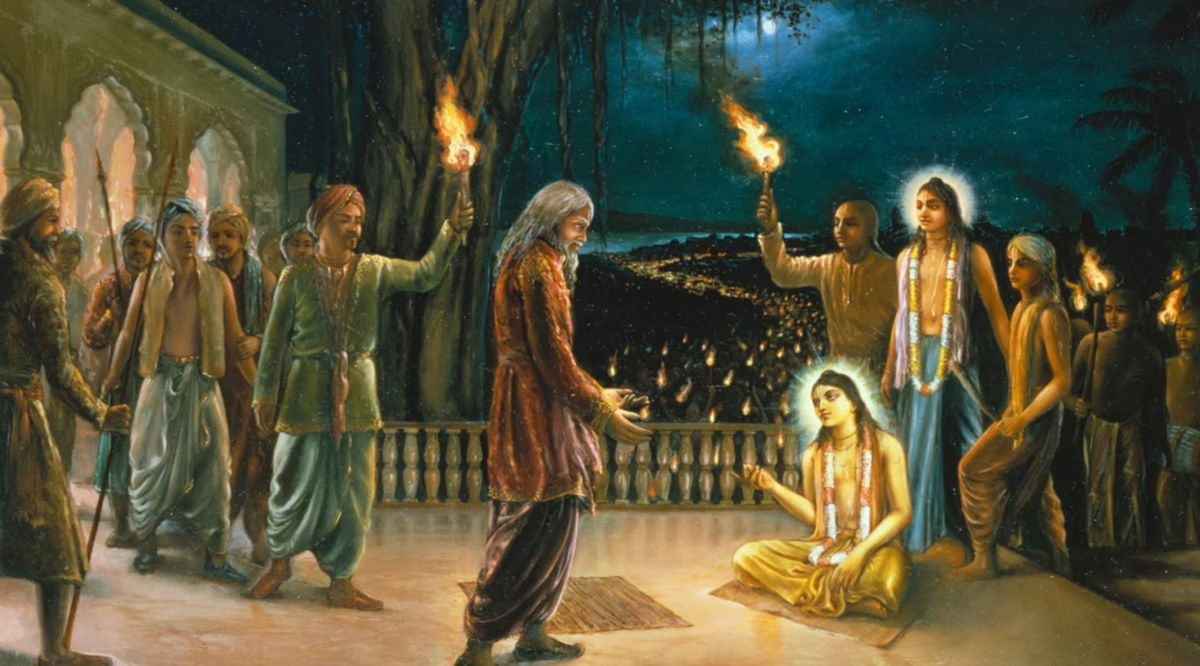
Thus Śrīla Rūpa Gosvāmī informed the King about his mind as a way of knowing Śrī Caitanya Mahāprabhu. He assured the King that whatever occurred in his mind could be considered evidence. (179) The King replied, “I consider Śrī Caitanya Mahāprabhu to be the Supreme Personality of Godhead. There is no doubt about it.” (180) After having this conversation with Rūpa Gosvāmī, the King entered his private house. Rūpa Gosvāmī, then known as Dabira Khāsa, also returned to his residence. (181) After returning to his residence, Dabira Khāsa and his brother decided after much consideration to go see the Lord incognito. (182) Thus in the dead of night the two brothers, Dabira Khāsa and Sākara Mallika, went to see Śrī Caitanya Mahāprabhu incognito. First they met Nityānanda Prabhu and Haridāsa Ṭhākura. (183) Śrī Nityānanda Prabhu and Haridāsa Ṭhākura told Lord Caitanya Mahāprabhu that two personalities—Śrī Rūpa and Sanātana—had come to see Him. (184) In great humility, both brothers took bunches of straw between their teeth and, each binding a cloth around his neck, fell down like rods before the Lord.(185)
Upon seeing Lord Caitanya Mahāprabhu, the two brothers were overwhelmed with joy, and out of humility they began to cry. Lord Caitanya Mahāprabhu asked them to get up and assured them of all good fortune. (186) The two brothers got up, and again taking straw between their teeth, they humbly offered their prayers with folded hands. (187) “All glories to Śrī Kṛṣṇa Caitanya Mahāprabhu, the most merciful savior of the fallen souls! All glories to the Supreme Personality! (188) “Sir, we belong to the lowest class of men, and our associates and employment are also of the lowest type. Therefore we cannot introduce ourselves to You. We feel very much ashamed, standing here before You. (189) “‘Dear Lord, let us inform you that no one is more sinful than us, nor is there any offender like us. Even if we wanted to mention our sinful activities, we would immediately become ashamed. And what to speak of giving them up!’” (190)
The two brothers submitted, “Dear Lord, You have incarnated to deliver the fallen souls. You should consider that in this world there is none so fallen as us. (191) “You have delivered the two brothers Jagāi and Mādhāi, but to deliver them You did not have to exert Yourself very much. (192) “The brothers Jagāi and Mādhāi belonged to the brāhmaṇa caste, and their residence was in the holy place of Navadvīpa. They never served low- class persons, nor were they instruments to abominable activities. (193) “Jagāi and Mādhāi had but one fault—they were addicted to sinful activity. However, volumes of sinful activity can be burned to ashes simply by a dim reflection of the chanting of Your holy name. (194) “Jagāi and Mādhāi uttered Your holy name by way of blaspheming You. Fortunately, that holy name became the cause of their deliverance. (195) “We two are millions and millions of times inferior to Jagāi and Mādhāi. We are more degraded, fallen and sinful than they. (196) “Actually we belong to the caste of meat- eaters because we are servants of meat- eaters. Indeed, our activities are exactly like those of the meat- eaters. Because we always associate with such people, we are inimical toward the cows and brāhmaṇas.” (197)
The two brothers, Sākara Mallika and Dabira Khāsa, very humbly submitted that due to their abominable activities they were now bound by the neck and hands and had been thrown into a ditch filled with abominable, stoollike objects of material sense enjoyment. (198) “No one within the three worlds is sufficiently powerful to deliver us. You are the only savior of the fallen souls; therefore there is no one but You. (199) “If You simply deliver us by Your transcendental strength, then certainly Your name will be known as Patita- pāvana, the savior of the fallen souls. (200) “Let us speak one word that is very true. Plainly hear us, O merciful one. There is no other object of mercy within the three worlds but us. (201) “We are the most fallen; therefore by showing us Your mercy, Your mercy is most successful. Let the power of Your mercy be exhibited throughout the entire universe! (202)
“‘Let us submit one piece of information before You, dear Lord. It is not at all false but is full of meaning. It is this: If You are not merciful upon us, then it will be very, very difficult to find more suitable candidates for Your mercy.’ (203) “We are very depressed at being unfit candidates for Your mercy. Yet since we have heard of Your transcendental qualities, we are very much attracted to You. (204) “Indeed, we are like a dwarf who wants to capture the moon. Although we are completely unfit, a desire to receive Your mercy is awakening within our minds. (205) “‘By serving You constantly, one is freed from all material desires and is completely pacified. When shall I engage as Your permanent eternal servant and always feel joyful to have such a fitting master?’” (206) After hearing the prayer of Dabira Khāsa and Sākara Mallika, Śrī Caitanya Mahāprabhu said, “My dear Dabira Khāsa, you two brothers are My old servants. (207)
“My dear Sākara Mallika, from this day your names will be changed to Śrīla Rūpa and Śrīla Sanātana. Now please abandon your humility, for My heart is breaking to see you so humble. (208) “You have written several letters showing your humility. I can understand your behavior from those letters. (209) “By your letters, I could understand your heart. Therefore, in order to teach you, I sent you one verse, which reads as follows. (210) “‘If a woman is attached to a man other than her husband, she will appear very busy in carrying out her household affairs, but within her heart she is always relishing feelings of association with her paramour.’ (211) “I really had no business in coming to Bengal, but I have come just to see you two brothers. (212) “Everyone is asking why I have come to this village of Rāmakeli. No one knows My intentions. (213) “It is very good that you two brothers have come to see Me. Now you can go home. Do not fear anything. (214) “Birth after birth you have been My eternal servants. I am sure that Kṛṣṇa will deliver you very soon.” (215)
The Lord then placed His two hands on the heads of both of them, and in return they immediately placed the lotus feet of the Lord on their heads. (216) After this, the Lord embraced both of them and requested all of the devotees present to be merciful upon them and deliver them. (217) When all of the devotees saw the mercy of the Lord upon the two brothers, they were very much gladdened, and they began to chant the holy name of the Lord, “Hari! Hari!” (218) All the Vaiṣṇava associates of the Lord were present, including Nityānanda Prabhu, Haridāsa Ṭhākura, Śrīvāsa Ṭhākura, Gadādhara Paṇḍita, Mukunda, Jagadānanda, Murāri and Vakreśvara. (219) In accordance with the instructions of Śrī Caitanya Mahāprabhu, the two brothers, Rūpa and Sanātana, immediately touched the lotus feet of these Vaiṣṇavas, who all became very happy and congratulated the two brothers for having received the mercy of the Lord. (220)
After begging the permission of all the Vaiṣṇavas present, the two brothers, at the time of their departure, humbly submitted something at the lotus feet of the Lord. (221) They said, “Dear Lord, although the King of Bengal, Nawab Hussain Shah, is very respectful toward You, You have no other business here. Kindly depart from this place. (222) “Although the King is respectful toward You, he still belongs to the yavana class and should not be believed. We think that there is no need for such a great crowd to accompany You on Your pilgrimage to Vṛndāvana. (223) “Dear Lord, You are going to Vṛndāvana with hundreds and thousands of people following You, and this is not a fitting way to go on a pilgrimage.” (224) Although Śrī Caitanya Mahāprabhu was Śrī Kṛṣṇa Himself, the Supreme Lord, and was therefore not at all fearful, He still acted like a human being to teach neophytes how to act. (225) Having spoken thus, the two brothers offered prayers to the lotus feet of the Lord and returned to their homes. Lord Caitanya Mahāprabhu then desired to leave that village. (226)
Deepen your Bhakti-yoga practice, harmonize relationships, and receive guided coaching — all at Vedavarsity.com