


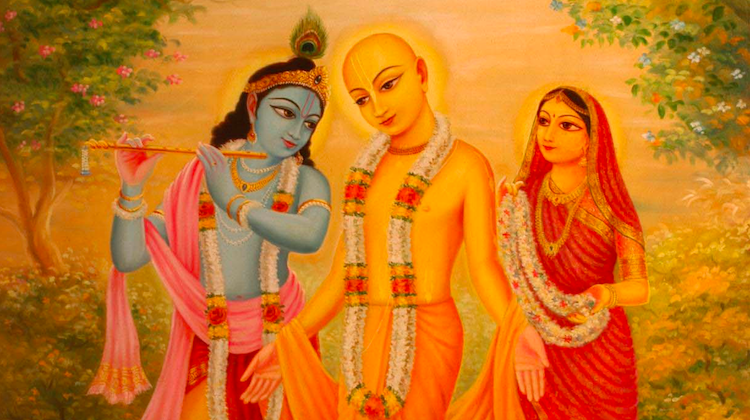
My dear devotees of Lord Caitanya, let me now write the codes of the Adi-lila in brief because it is not possible to describe these pastimes in full. (51) To fulfill a particular desire within His mind, Lord Kṛṣṇa, Vrajendra- kumāra, decided to descend to this planet after mature contemplation. (52) Lord Kṛṣṇa therefore first allowed His family of superiors to descend to the earth. I shall try to describe them in brief because it is not possible to describe them fully. (53)
Lord Śrī Kṛṣṇa, before appearing as Lord Caitanya, requested these devotees to precede Him: Śrī Śacīdevī, Jagannātha Miśra, Mādhavendra Purī, Keśava Bhāratī, Īśvara Purī, Advaita Ācārya, Śrīvāsa Paṇḍita, Ācāryaratna, Vidyānidhi and Ṭhākura Haridāsa. (54-55) There was also Śrī Upendra Miśra, a resident of the district of Śrīhaṭṭa. He was a great devotee of Lord Viṣṇu, a learned scholar, a rich man and a reservoir of all good qualities. (56)
Upendra Miśra had seven sons, who were all saintly and most influential: (1) Kaṁsāri, (2) Paramānanda, (3) Padmanābha, (4) Sarveśvara, (5) Jagannātha, (6) Janārdana and (7) Trailokyanātha. Jagannātha Miśra, the fifth son, decided to reside on the bank of the Ganges at Nadia.(57-58) Jagannātha Miśra was designated as Purandara. Exactly like Nanda Mahārāja and Vasudeva, he was an ocean of all good qualities. (59) His wife, Śrīmatī Śacīdevī, was a chaste woman highly devoted to her husband. Śacīdevī’s father’s name was Nīlāmbara, and his surname was Cakravartī. (60)
In Rāḍhadeśa, the part of Bengal where the Ganges is not visible, Nityānanda Prabhu, Gaṅgādāsa Paṇḍita, Murāri Gupta and Mukunda took birth. (61) Lord Kṛṣṇa, Vrajendra- kumāra, first caused countless devotees to appear, and at last He appeared Himself. (62) Before the appearance of Lord Caitanya Mahāprabhu, all the devotees of Navadvīpa used to gather in the house of Advaita Ācārya.(63) In these meetings of the Vaiṣṇavas, Advaita Ācārya used to recite the Bhagavad- gītā and Śrīmad- Bhāgavatam, decrying the paths of philosophical speculation and fruitive activity and establishing the superexcellence of devotional service. (64)
In all the revealed scriptures of Vedic culture, devotional service to Lord Kṛṣṇa is explained throughout. Therefore devotees of Lord Kṛṣṇa do not recognize the processes of philosophical speculation, mystic yoga, unnecessary austerity and so- called religious rituals. They do not accept any process but devotional service. (65) In the house of Advaita Ācārya, all the Vaiṣṇavas took pleasure in always talking of Kṛṣṇa, always worshiping Kṛṣṇa and always chanting the Hare Kṛṣṇa mahā- mantra. (66) But Śrī Advaita Ācārya Prabhu felt pained to see all the people without Kṛṣṇa consciousness simply merging in material sense enjoyment. (67) Seeing the condition of the world, He began to think seriously of how all these people could be delivered from the clutches of māyā. (68)
Śrīla Advaita Ācārya Prabhu thought, “If Kṛṣṇa Himself appears in order to distribute the cult of devotional service, then only will liberation be possible for all people.” (69) With this consideration, Advaita Ācārya Prabhu, promising to cause Lord Kṛṣṇa to descend, began to worship the Supreme Personality of Godhead, Kṛṣṇa, with tulasī leaves and water of the Ganges. (70) By loud cries He invited Kṛṣṇa to appear, and this repeated invitation attracted Lord Kṛṣṇa to descend. (71) Before the birth of Lord Caitanya Mahāprabhu, eight daughters took birth one after another from the womb of Śacīmātā, the wife of Jagannātha Miśra. But just after their birth, they all died. (72)
Jagannātha Miśra was very unhappy at the death of his children one after another. Therefore, desiring a son, he worshiped the lotus feet of Lord Viṣṇu. (73) After this, Jagannātha Miśra got a son of the name Viśvarūpa, who was most powerful and highly qualified because He was an incarnation of Baladeva. (74) The expansion of Baladeva known as Saṅkarṣaṇa in the spiritual world is the ingredient and immediate cause of this material cosmic manifestation. (75) The gigantic universal form is called the Viśvarūpa incarnation of Mahā- saṅkarṣaṇa. Thus we do not find anything within this cosmic manifestation except the Lord Himself. (76)
“As the threads in a cloth spread both lengthwise and breadthwise, so the Supreme Personality of Godhead exists directly and indirectly within everything we see in this cosmic manifestation. This is not very wonderful for Him.” (77) Because Mahā- saṅkarṣaṇa is the ingredient and efficient cause of the cosmic manifestation, He is present in every detail of it. Lord Caitanya therefore called Him His elder brother. The two brothers are known as Kṛṣṇa and Balarāma in the spiritual world, but at the present moment they are Caitanya and Nitāi. Therefore the conclusion is that Nityānanda Prabhu is the original Saṅkarṣaṇa, Baladeva. (78)
The husband and wife [Jagannātha Miśra and Śacīmātā], having gotten Viśvarūpa as their son, were very pleased within their minds. Because of their pleasure, they specifically began to serve the lotus feet of Govinda. (79) In the month of January in the year 1406 of the Śaka Era (A.D. 1485), Lord Kṛṣṇa entered the bodies of both Jagannātha Miśra and Śacī. (80) Jagannātha Miśra said to Śacīmātā, “I see wonderful things! Your body is effulgent, and it appears as if the goddess of fortune were now staying personally in my home. (81) “Anywhere and everywhere I go, all people offer me respect. Even without my asking, they voluntarily give me riches, clothing and paddy.” (82)
Śacīmātā told her husband, “I see wonderfully brilliant human beings appearing in outer space, as if offering prayers.” (83) Jagannātha Miśra then replied, “In a dream I saw the effulgent abode of the Lord enter my heart. (84) “From my heart it entered your heart. I therefore understand that a great personality will soon take birth.” (85) After this conversation, both husband and wife were very jubilant, and together they rendered service to the household śālagrāma- śilā. (86)In this way the pregnancy approached its thirteenth month, but still there was no sign of the delivery of the child. Thus Jagannātha Miśra became greatly apprehensive. (87)
Nīlāmbara Cakravartī [the grandfather of Śrī Caitanya Mahāprabhu] then did an astrological calculation and said that in that very month, taking advantage of an auspicious moment, the child would take birth. (88) Thus in the year 1407 of the Śaka Era [A.D. 1486], in the month of Phālguna [February March], in the evening of the full- moon day, the desired auspicious moment arrived. (89)[According to the Jyotir- veda, or Vedic astrology, the auspicious birth moment is described as follows:] The moon was in Leo [the figure of the lion in the zodiac], Leo was the ascendant, several planets were strongly positioned, and the ṣaḍ- varga and aṣṭa- varga showed all- auspicious influences. (90)
When the spotless moon of Caitanya Mahāprabhu became visible, what would be the need for a moon full of black marks on its body? (91) Considering this, Rāhu, the black planet, covered the full moon, and immediately vibrations of “Kṛṣṇa! Kṛṣṇa! Hari!” inundated the three worlds. (92) All people thus chanted the Hare Kṛṣṇa mahā- mantra during the lunar eclipse, and their minds were struck with wonder. (93) When the whole world was thus chanting the holy name of the Supreme Personality of Godhead, Kṛṣṇa in the form of Gaurahari advented Himself on the earth. (94)
The whole world was pleased. While the Hindus chanted the holy name of the Lord, the non- Hindus, especially the Muslims, jokingly imitated the words. (95) While all the ladies vibrated the holy name of Hari on earth, in the heavenly planets dancing and music were going on, for the demigods were very curious. (96) In this atmosphere, all the ten directions became jubilant, as did the waves of the rivers. Moreover, all beings, moving and nonmoving, were overwhelmed with transcendental bliss. (97)
Thus by His causeless mercy the full moon, Gaurahari, rose in the district of Nadia, which is compared to Udayagiri, where the sun first becomes visible. His rising in the sky dissipated the darkness of sinful life, and thus the three worlds became joyful and chanted the holy name of the Lord. (98) At that time Śrī Advaita Ācārya Prabhu, in His own house at Śāntipura, was dancing in a pleasing mood. Taking Haridāsa Ṭhākura with Him, He danced and loudly chanted Hare Kṛṣṇa. But why they were dancing, no one could understand. (99)
Deepen your Bhakti-yoga practice, harmonize relationships, and receive guided coaching — all at Vedavarsity.com