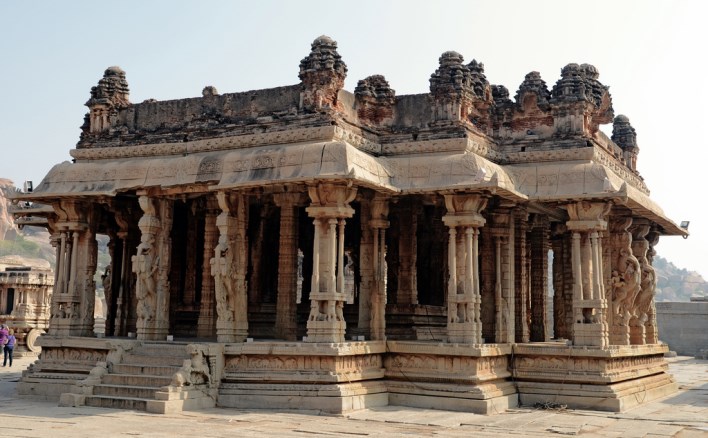
The most splendid of temples at Vijayanagar is the Vitthala temple, near the Tungabhadra river. It is considered to be the most ornate of the Vijayanagar temples.
Hampi, now in ruins is the site of the ancient city of Vijayanagar, capital of the Vijayanagar empire (founded under the spiritual guidance of Vidyaranya of sringeri in early (14th century) which brought about a renaissance of indigenous art and culture, as it defended the region against the plundering armies from elsewhere.
Much of Vijayanagar is now in ruins, as when the rulers were defeated at the hands of the invaders at the battle of Talikota in the 16th century, most of the marvelous structures and edifices were systematically destroyed.
Vitthala – Vishnu is enshrined in this temple. The mahamandapam of this temple, in front of the sanctum – enclosed in the inner courtyard is of great beauty. It’s base is chiseled with friezes of the swan, the horse and the warrior. At intervals, there are projections with bas reliefs portraying the deification of the ten avatars of vishnu.
The steps on the east of the mahamandapam are flanked by an elephant balustrade. The facades are lined with forty pillars, each over 10 feet in height. Each group of pillars has a central pillar with slender shafts around. The center of the Mahamandapam has sixteen pillars decorated with Narasimha and Yali, forming a rectangular court. The ceiling of the Mahamandapam is also covered with sculptural work.
The stone chariot in this temple is of great fame. Its stone wheels, each shaped in the form of a lotus, are capable of revolving. It represents the sprakling creativity of the artistes of the fifteenth century. Temple chariots are often mobile reproductions of a temple. The stone chariot here is in turn a static version of the mobile temple chariot.
Deepen your Bhakti-yoga practice, harmonize relationships, and receive guided coaching — all at Vedavarsity.com