



Recently, the Walk for Peace group crossed the Edmund Pettus Bridge in Selma, Alabama—historically known as the site of a grievous assault upon a peaceful civil rights march in 1965. The Walk for Peace, a group of Buddhist monks under the leadership of Venerable Bhikkhu Pannakara, commenced their spiritual journey in October from the Vipassana Bhavana Center in Fort Worth, Texas. Their pilgrimage, extending over 2,300 miles, is scheduled to conclude in Washington, D.C., sometime in February.
Venerable Bhikkhu spoke about the purpose of their journey, explaining, “We walk not to protest, but to awaken the peace that already resides within each of us.” The Walk for Peace press release further declares, “Peace is not a destination; it is a practice.” As America faces numerous challenges, this sacred pilgrimage toward the nation’s capital carries a simple yet profound message—that peace begins within the heart of each individual and radiates outward to encompass all beings.
The monks observe rigorous ascetic vows. They partake of only one meal a day and rest at night beneath trees or in very simple accommodations. One of the monks expressed that their mission conveys “a message of peace, loving-kindness, and compassion across America and throughout the world.” In response, a supporter on social media wrote, “This moment stands as a testament to what is possible when compassion leads the way.”
The Christmas season, from time immemorial, has signified peace and goodwill among all. In the Book of Isaiah (9.6), the awaited Savior is described as the Prince of Peace. And in the following chapter (10.1–2), a divine warning is issued: “Woe to those who make unjust laws, to those who issue oppressive decrees, to deprive the poor of their rights, and withhold justice from the oppressed among My people.”
Similarly, in the Vedic tradition, many Sanskrit prayers and benedictions conclude with the invocation oṁ śāntiḥ śāntiḥ śāntiḥ. The word śānti, meaning peace, is a blessing invoked upon the world, and it is uttered three times to emphasize its supreme importance. Every member of society seeks peace and prosperity, yet few truly understand the process by which such conditions may be attained.
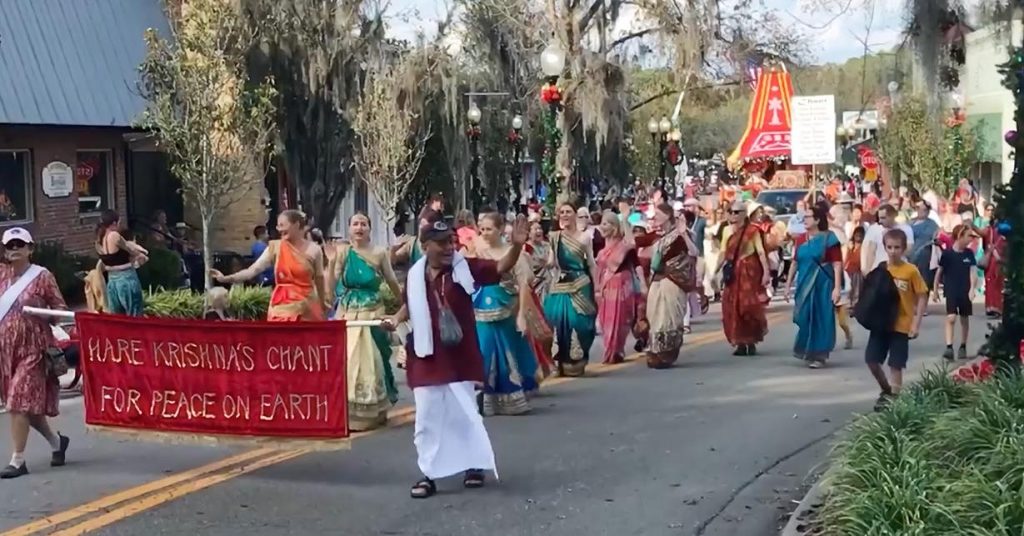
Śrīla Prabhupāda, the revered founder-ācārya of the International Society for Krishna Consciousness, frequently spoke of “peace and prosperity.” He explained that when the people of the world recognize the significance of chanting the holy names of the Lord (kīrtana), the world will experience genuine peace and prosperity, instead of confusion and despair under ineffectual governments. Śrīla Prabhupāda observed that when governance becomes weak, rogues and thieves emerge to exploit society, thereby transforming human civilization into a miserable state unfit for honorable persons to live in. Thus, lasting peace and prosperity can only be realized under qualified and spiritually guided leadership.

A “Merry Christmas” confined to a few is insufficient; peace must reach all living beings without discrimination. For this, a certain portion of humanity must become situated at least in the mode of goodness (sattva-guṇa), adhering to the universal principles of dharma—truthfulness, compassion, internal and external purity, and the spirit of self-sacrifice. Upon this spiritual foundation alone can we expect harmony in human society. As Śrīla Prabhupāda has stated, “Then there is the possibility for peace and prosperity all over the world.”
A holiday, in truth, should mean a “holy day.” Such days are meant for introspection—to reflect deeply upon what peace implies for us personally and collectively, and how this peace and prosperity may be fostered within and without. None should be excluded from this endeavor. To uplift the hearts of the general populace, there is a great necessity for increased gatherings, interfaith exchanges, and congregational kīrtanas that transcend social, religious, and cultural boundaries, thereby manifesting true religious freedom and cultural harmony.
The Walk for Peace press release concludes with a statement by Dr. Bajracharya, Secretary of the Nepalese Buddhist Association in Texas: “Walk for Peace invites all people, regardless of faith, culture, or background, to come together in the spirit of compassion, mutual respect, and understanding.” Amen, Namo Buddhāya, and Hare Kṛṣṇa.
Deepen your Bhakti-yoga practice, harmonize relationships, and receive guided coaching — all at Vedavarsity.com