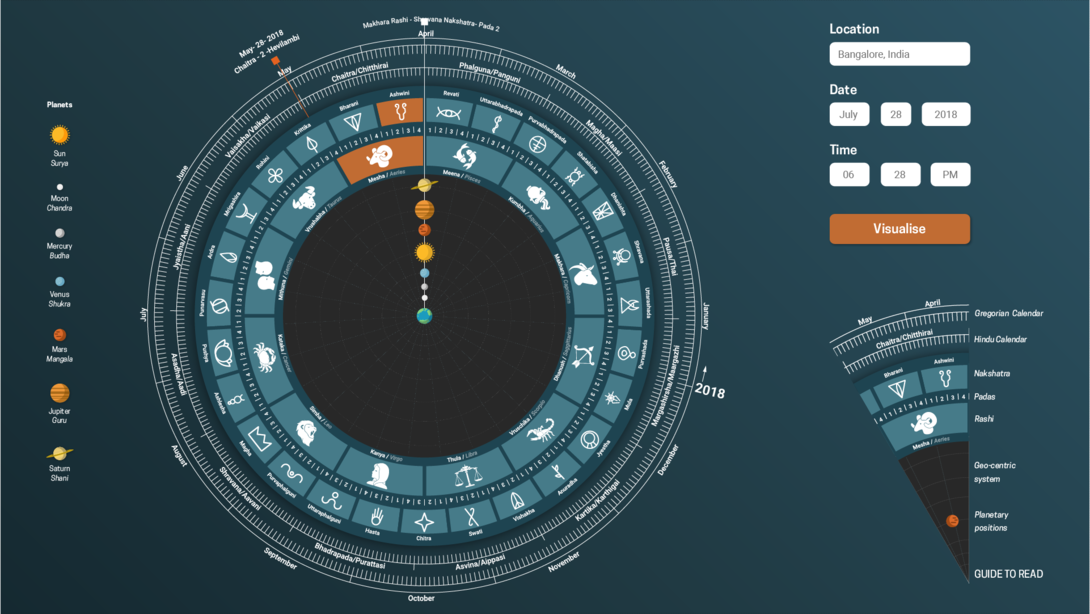
In this subsection we will present some evidence from Śrīla Prabhupāda’s books suggesting that astronomical computations of the kind presented in the astronomical siddhāntas were used in Vedic times. As we have pointed out, many of the existing astronomical siddhāntas were written by recent Indian astronomers. But if the Vedic culture indeed dates back thousands of years, as the Śrīmad-Bhāgavatam describes, then this evidence suggests that methods of astronomical calculation as sophisticated as those of the astronomical siddhāntas were also in use in India thousands of years ago. Consider the following passage from the Śrīmad-Bhāgavatam:
One should perform the śrāddha ceremony on the Makara-saṅkrānti or on the Karkaṭa-saṅkrānti. One should also perform this ceremony on the Meṣa-saṅkrānti day and the Tulā-saṅkrānti day, in the yoga named Vyatīpāta, on that day in which three lunar tithis are conjoined, during an eclipse of either the moon or the sun, on the twelfth lunar day, and in the Śravaṇa-nakṣatra. One should perform this ceremony on the Akṣaya-tṛtīyā day, on the ninth lunar day of the bright fortnight of the month of Kārttika, on the four aṣṭakās in the winter season and cool season, on the seventh lunar day of the bright fortnight of the month of Māgha, during the conjunction of Māgha-nakṣatra and the full-moon day, and on the days when the moon is completely full, or not quite completely full, when these days are conjoined with the nakṣatras from which the names of certain months are derived.
One should also perform the śrāddha ceremony on the twelfth lunar day when it is in conjunction with any of the nakṣatras named Anurādhā, Śravaṇa, Uttara-phalgunī, Uttarāṣādhā, or Uttara-bhādrapadā. Again, one should perform this ceremony when the eleventh lunar day is in conjunction with either Uttara-phalgunī, Uttarāṣādhā, or Uttara-bhādrapadā. Finally, one should perform this ceremony on days conjoined with one’s own birth star [janma-nakṣatra] or with Śravaṇa-nakṣatra [SB 7.14.20-23].
This passage indicates that to observe the śrāddha ceremony properly one would need the services of an expert astronomer. The Sūrya-siddhānta contains rules for performing astronomical calculations of the kind required here, and it is hard to see how these calculations could be performed without some computational system of equal complexity. For example, in the Sūrya-siddhānta the Vyatīpāta yoga is defined as the time when “the moon and sun are in different ayanas, the sum of their longitudes is equal to 6 signs (nearly) and their declinations are equal” (SS, p. 72). One could not even define such a combination of planetary positions without considerable astronomical sophistication.
Similar references to detailed astronomical knowledge are scattered throughout the Bhāgavatam. For example, the Vyatīpāta yoga is also mentioned in SB 4.12.49-50. And KB p. 693 describes that in Kṛṣṇa’s time, people from all over India once gathered at Kurukṣetra on the occasion of a total solar eclipse that had been predicted by astronomical calculation. Also, SB 10.28.7p recounts how Nanda Mahārāja once bathed too early in the Yamunā River-and was thus arrested by an agent of Varuṇa-because the lunar day of Ekādaśī ended at an unusually early hour on that occasion. We hardly ever think of astronomy in our modern day-to-day lives, but it would seem that in Vedic times daily life was constantly regulated in accordance with astronomical considerations.
The role of astrology in Vedic culture provides another line of evidence for the existence of highly developed systems of astronomical calculation in Vedic times. The astronomical siddhāntas have been traditionally used in India for astrological calculations, and astrology in its traditional form would be impossible without the aid of highly accurate systems of astronomical computation. Śrīla Prabhupāda has indicated that astrology played an integral role in the karma-kāṇḍa functions of Vedic society. A few references indicating the importance of astrology in Vedic society are SB 1.12.12p, 1.12.29p, 1.19.10p, 6.2.26p, 9.18.23p, 9.20.37p, and 10.8.5, and also CC AL 13.89-90 and 17.104.
These passages indicate that the traditions of the Vaiṣṇavas are closely tied in with the astronomical siddhāntas. Western scholars will claim that this close association is a product of processes of “Hindu syncretism” that occurred well within the Christian era and were carried out by unscrupulous brāhmaṇas who misappropriated Greek astronomical science and also concocted scriptures such as the Śrīmad-Bhāgavatam. However, if the Vaiṣṇava tradition is indeed genuine, then this association must be real, and must date back for many thousands of years.
Deepen your Bhakti-yoga practice, harmonize relationships, and receive guided coaching — all at Vedavarsity.com