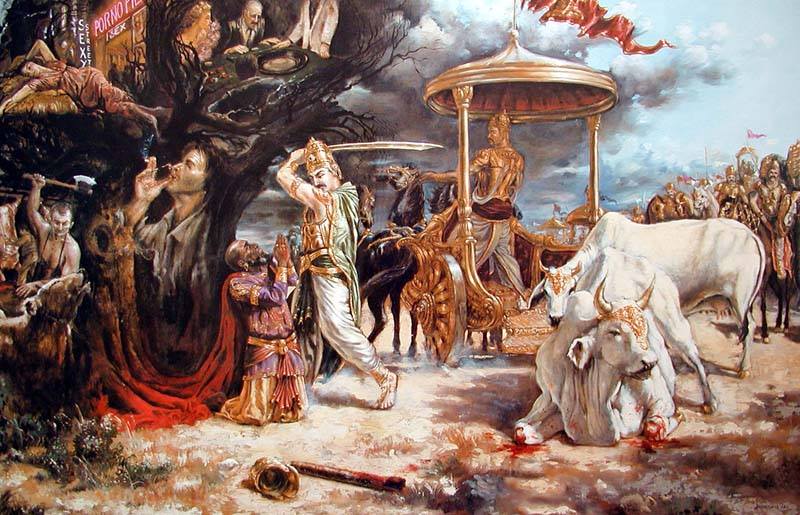
Imagine the following scene: It is midnight on the meridian of Ujjain in India on February 18, 3102 B.C. The seven planets, including the sun and moon, cannot be seen since they are all lined up in one direction on the other side of the earth. Directly overhead the dark planet Rāhu hovers invisibly in the blackness of night.
According to the jyotiṣa śāstras, this alignment of the planets actually occurred on this date, which marks the beginning of the Kali-yuga. In fact, in the Sūrya-siddhānta, time is measured in days since the start of Kali-yuga, and it is assumed that the positions of the seven planets in their two cycles are all aligned with the star Zeta Piscium at day zero. This star, which is known as Revatī in Sanskrit, is used as the zero point for measuring celestial longitudes in the jyotiṣa śāstras. The position of Rāhu at day zero is also assumed to be 180 degrees from this star. Nearly identical assumptions are made in other astronomical siddhāntas. (In some systems, such as that of Āryabhaṭa, it is assumed that Kali-yuga began at sunrise rather than at midnight. In others, a close alignment of the planets is assumed at this time, rather than an exact alignment.)
In the Caitanya-caritāmṛta AL 3.9-10, the present date in this day of Brahmā is defined as follows: (1) The present Manu, Vaivasvata, is the seventh, (2) 27 divya-yugas of his age have passed, and (3) we are in the Kali-yuga of the 28th divya-yuga. The Sūrya-siddhānta also contains this information, and its calculations of planetary positions require knowledge of the ahargana, or the exact number of elapsed days in Kali-yuga. The Indian astronomer Āryabhaṭa wrote that he was 23 years old when 3,600 years of Kali-yuga had passed (BJS, part 2, p. 55). Since Āryabhaṭa is said to have been born in Śaka 398, or A.D. 476, this is in agreement with the standard ahargana used today for the calculations of the Sūrya-siddhānta.
For example, October 1, 1965, corresponds to day 1,850,569 in Kali-yuga. On the basis of this information one can calculate that the Kali-yuga began on February 18, 3102 B.C., according to the Gregorian calendar. It is for this reason that Vaiṣṇavas maintain that the pastimes of Kṛṣṇa with the Pāṇḍavas in the battle of Kurukṣetra took place about 5,000 years ago.
Of course, it comes as no surprise that the standard view of Western scholars is that this date for the start of Kali-yuga is fictitious. Indeed, these scholars maintain that the battle of Kurukṣetra itself is fictitious, and that the civilization described in the Vedic literature is simply a product of poetic imagination. It is therefore interesting to ask what modern astronomers have to say about the positions of the planets on February 18, 3102 B.C.
TABLE 5
The Celestial Longitudes of the Planets
at the Start of Kali-yuga
Planet Modern Mean Longitude Modern True Longitude
Moon -6;04 -1;14
Sun -5;40 -3;39
Mercury -38;09 -19;07
Venus 27;34 8;54
Mars -17;25 -6;59
Jupiter 11;06 10;13
Saturn -25;11 -27;52
Rāhu -162;44 -162;44
This table shows the celestial longitudes of the planets relative to the star Zeta Piscium (Revatī in Sanskrit) at sunrise of February 18, 3102 B.C., the beginning of Kali-yuga. Each longitude is expressed as degrees; minutes.
Table 5 lists the longitudes of the planets relative to the reference star Zeta Piscium at the beginning of Kali-yuga. The figures under “Modern True Longitude” represent the true positions of the planets at this time according to modern calculations. (These calculations were done with computer programs published by Duffett-Smith (DF).) We can see that, according to modern astronomy, an approximate alignment of the planets did occur at the beginning of Kali-yuga. Five of the planets were within 10Ṭ of the Vedic reference star, exceptions being Mercury, at -19Ṭ, and Saturn, at -27Ṭ. Rāhu was also within 18Ṭ of the position opposite Zeta Piscium.
The figures under “Modern Mean Longitude” represent the mean positions of the planets at the beginning of Kali-yuga. The mean position of a planet, according to modern astronomy, is the position the planet would have if it moved uniformly at its average rate of motion. Since the planets speed up and slow down, the true position is sometimes ahead of the mean position and sometimes behind it. Similar concepts of true and mean positions are found in the Sūrya-siddhānta, and we note that while the Sūrya-siddhānta assumes an exact mean alignment at the start of Kali-yuga, it assumes only an approximate true alignment.
Planetary alignments such as the one in Table 5 are quite rare. To find out how rare they are, we carried out a computer search for alignments by computing the planetary positions at three-day intervals from the start of Kali-yuga to the present. We measured the closeness of an alignment by averaging the absolute values of the planetary longitudes relative to Zeta Piscium. (For Rāhu, of course, we used the absolute value of the longitude relative to a point 180Ṭ from Zeta Piscium.) Our program divided the time from the start of Kali-yuga to the present into approximately 510 ten-year intervals. In this entire period we found only three ten-year intervals in which an alignment occurred that was as close as the one occurring at the beginning of Kali-yuga.
We would suggest that the dating of the start of Kali-yuga at 3102 B.C. is based on actual historical accounts, and that the tradition of an unusual alignment of the planets at this time is also a matter of historical fact. The opinion of the modern scholars is that the epoch of Kali-yuga was concocted during the early medieval period. According to this hypothesis, Indian astronomers used borrowed Greek astronomy to determine that a near planetary alignment occurred in 3102 B.C. After performing the laborious calculations needed to discover this, they then invented the fictitious era of Kali-yuga and convinced the entire subcontinent of India that this era had been going on for some three thousand years. Subsequently, many different Purāṇas were written in accordance with this chronology, and people all over India became convinced that these works, although unknown to their forefathers, were really thousands of years old.
One might ask why anyone would even think of searching for astronomical alignments over a period of thousands of years into the past and then redefining the history of an entire civilization on the basis of a particular discovered alignment. It seems more plausible to suppose that the story of Kali-yuga is genuine, that the alignment occurring at its start is a matter of historical recollection, and that the Purāṇas really were written prior to the beginning of this era.
We should note that many historical records exist in India that make use of dates expressed as years since the beginning of Kali-yuga. In many cases, these dates are substantially less than 3102-that is, they represent times before the beginning of the Christian era. Interesting examples of such dates are given in the book Ādi Śaṅkara (AS), edited by S. D. Kulkarni, in connection with the dating of Śaṅkarācārya. One will also find references to such dates in Age of Bhārata War (ABW), a series of papers on the date of the Mahābhārata, edited by G. C. Agarwala. The existence of many such dates from different parts of India suggests that the Kali era, with its 3102 B.C. starting date, is real and not a concoction of post-Ptolemaic medieval astronomers. (Some references will give 3101 B.C. as the starting date of the Kali-yuga. One reason for this discrepancy is that in some cases a year 0 is counted between A.D. 1 and 1 B.C., and in other cases this is not done.)
At this point the objection might be raised that the alignment determined by modern calculation for the beginning of Kali-yuga is approximate, whereas the astronomical siddhāntas generally assume an exact alignment. This seems to indicate a serious defect in the jyotiṣa śāstras.
In reply, we should note that although modern calculations are quite accurate for our own historical period, we know of no astronomical observations that can be used to check them prior to a few hundred years B.C. It is therefore possible that modern calculations are not entirely accurate at 3102 B.C. and that the planetary alignment at that date was nearly exact. Of course, if the alignment was as inexact as Table 5 indicates, then it would be necessary to suppose that a significant error was introduced into the jyotiṣa śāstras, perhaps in fairly recent times. However, even this hypothesis is not consistent with the theory that 3102 B.C. was selected by Ptolemaic calculations, since these calculations also indicate that a very rough planetary alignment occurred at this date.
Apart from this, we should note that the astronomical siddhāntas do not show perfect accuracy over long periods of time. This is indicated by the Sūrya-siddhānta itself in the following statement, which a representative of the sun-god speaks to the asura Maya:
O Maya, hear attentively the excellent knowledge of the science of astronomy which the sun himself formerly taught to the great saints in each of the yugas.
I teach you the same ancient science…. But the difference between the present and the ancient works is caused only by time, on account of the revolution of the yugas (SS, p. 2).
According to the jyotiṣa śāstras themselves, the astronomical information they contain was based on two sources: (1) revelation from demigods, and (2) human observation. The calculations in the astronomical siddhāntas are simple enough to be suitable for hand calculation, but as a result they tend to lose accuracy over time. The above statement by the sun’s representative indicates that these works were updated from time to time in order to keep them in agreement with celestial phenomena.
We have made a computer study comparing the Sūrya-siddhānta with modern astronomical calculations. This study suggests that the Sūrya-siddhānta was probably updated some time around A.D. 1000, since its calculations agree most closely with modern calculations at that time. However, this does not mean that this is the date when the Sūrya-siddhānta was first written. Rather, the parameters of planetary motion in the existing text may have been brought up to date at that time. Since the original text was as useful as ever once its parameters were updated, there was no need to change it, and thus it may date back to a very remote period.
A detailed discussion concerning the date and origin of Āryabhaṭa’s astronomical system is found in Appendix 2. There we observe that the parameters for this astronomical system were probably determined by observation during Āryabhaṭa’s lifetime, in the late 5th and early 6th centuries A.D. Regarding his theoretical methods, Āryabhaṭa wrote, “By the grace of Brahmā the precious sunken jewel of true knowledge has been brought up by me from the ocean of true and false knowledge by means of the boat of my own intellect” (VW, p. 213). This suggests that Āryabhaṭa did not claim to have created anything new. Rather, he simply reclaimed old knowledge that had become confused in the course of time.
In general, we would suggest that revelation of astronomical information by demigods was common in ancient times prior to the beginning of Kali-yuga. In the period of Kali-yuga, human observation has been largely used to keep astronomical systems up to date, and as a result, many parameters in existing works will tend to have a fairly recent origin. Since the Indian astronomical tradition was clearly very conservative and was mainly oriented towards fulfilling customary day-to-day needs, it is quite possible that the methods used in these works are extremely ancient.
As a final point, we should consider the objection that Indian astronomers have not given detailed accounts of how they made observations or how they computed their astronomical parameters on the basis of these observations. This suggests to some that a tradition of sophisticated astronomical observation never existed in India.
One answer to this objection is that there is abundant evidence for the existence of elaborate programs of astronomical observation in India in recent centuries. The cover of this book depicts an astronomical instrument seen in Benares in 1772 by an Englishman named Robert Barker; it was said to be about 200 years old at that time. About 20 feet high, this structure includes two quadrants, divided into degrees, which were used to measure the position of the sun. It was part of an observatory including several other large stone and brass instruments designed for sighting the stars and planets (PR, pp. 31-33).
Similar instruments were built in Agra and Delhi. The observatory at Delhi was built by Rajah Jayasingh in 1710 under the auspices of Mohammed Shah, and it can still be seen today. Although these observatories are quite recent, there is no reason to suppose that they first began to be built a few centuries ago. It is certainly possible that over a period of thousands of years such observatories were erected in India when needed.
The reason we do not find elaborate accounts of observational methods in the jyotiṣa śāstras is that these works were intended simply as brief guides for calculators, not as comprehensive textbooks. Textbooks were never written, since it was believed that knowledge should be disclosed only to qualified disciples. This is shown by the following statement in the Sūrya-siddhānta: “O Maya, this science, secret even to the Gods, is not to be given to anybody but the well-examined pupil who has attended one whole year” (SS, p. 56). Similarly, after mention of a motor based on mercury that powers a revolving model of the universe, we find this statement: “The method of constructing the revolving instrument is to be kept a secret, as by diffusion here it will be known to all” (SS, p. 90). The story of the false disciple of Droṇācārya in the Mahābhārata shows that this restrictive approach to the dissemination of knowledge was standard in Vedic culture.
Deepen your Bhakti-yoga practice, harmonize relationships, and receive guided coaching — all at Vedavarsity.com