



By Dr. T. D. Singh (Bhaktisvarüpa Dämodara Swami)
The Sūrya-siddhānta treats the earth as a globe fixed in space, and it describes the seven traditional planets (the sun, the moon, Mars, Mercury, Jupiter, Venus, and Saturn) as moving in orbits around the earth. It also describes the orbit of the planet Rāhu, but it makes no mention of Uranus, Neptune, and Pluto. The main function of the Sūrya-siddhānta is to provide rules allowing us to calculate the positions of these planets at any given time. Given a particular date, expressed in days, hours, and minutes since the beginning of Kali-yuga, one can use these rules to compute the direction in the sky in which each of the seven planets will be found at that time. All of the other calculations described above are based on these fundamental rules.
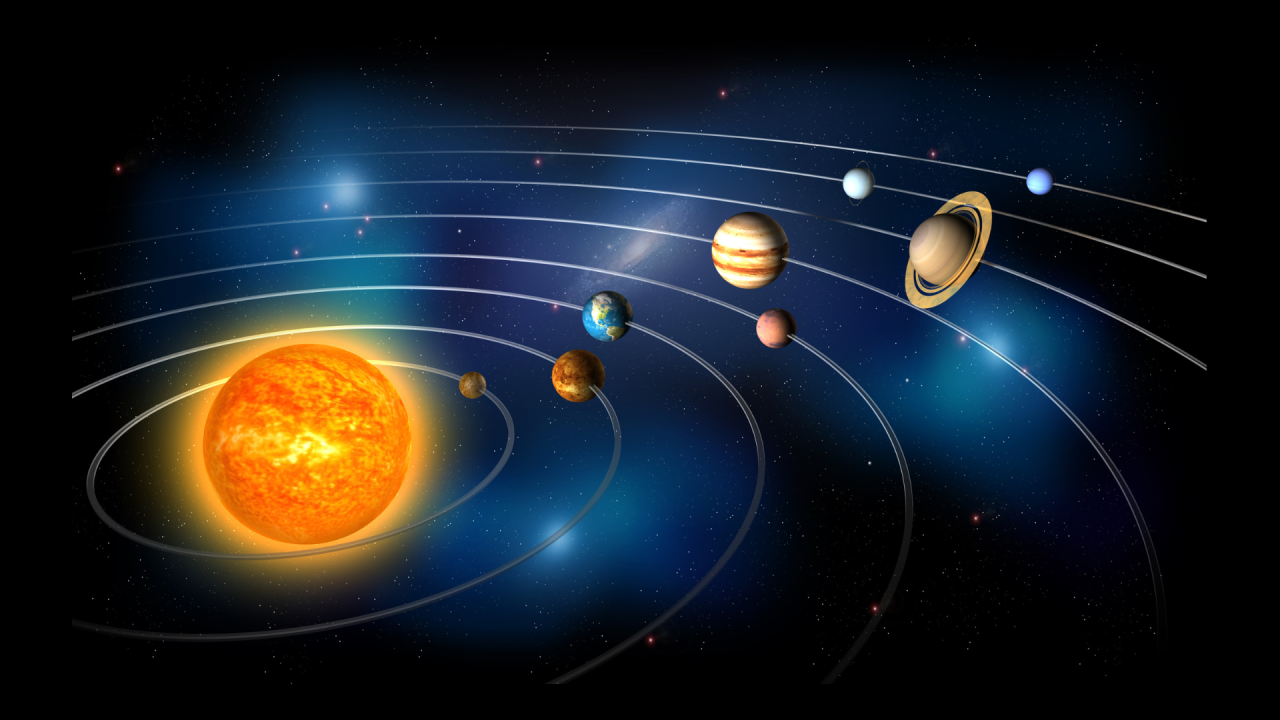
The basis for these rules of calculation is a quantitative model of how the planets move in space. This model is very similar to the modern Western model of the solar system. In fact, the only major difference between these two models is that the Sūrya-siddhānta’s is geocentric, whereas the model of the solar system that forms the basis of modern astronomy is heliocentric.
To determine the motion of a planet such as Venus using the modern heliocentric system, one must consider two motions: the motion of Venus around the sun and the motion of the earth around the sun. As a crude first approximation, we can take both of these motions to be circular. We can also imagine that the earth is stationary and that Venus is revolving around the sun, which in turn is revolving around the earth. The relative motions of the earth and Venus are the same, whether we adopt the heliocentric or geocentric point of view.
In the Sūrya-siddhānta the motion of Venus is also described, to a first approximation, by a combination of two motions, which we can call cycles 1 and 2. The first motion is in a circle around the earth, and the second is in a circle around a point on the circumference of the first circle. This second circular motion is called an epicycle.
It so happens that the period of revolution for cycle 1 is one earth year, and the period for cycle 2 is one Venusian year, or the time required for Venus to orbit the sun according to the heliocentric model. Also, the sun is located at the point on the circumference of cycle 1 which serves as the center of rotation for cycle 2. Thus we can interpret the Sūrya-siddhānta as saying that Venus is revolving around the sun, which in turn is revolving around the earth (see Figure 1). According to this interpretation, the only difference between the Sūrya-siddhānta model and the modern heliocentric model is one of relative point of view.
Table 1
Planetary Years, Distances, and Diameters,
According to Modern Western Astronomy
Planet Length of year Mean Distance from Sun Mean Distance from Earth Diameter
Sun – 0. 1.00 865,110
Mercury 87.969 .39 1.00 3,100
Venus 224.701 .72 1.00 7,560
Earth 365.257 1.00 0. 7,928
Mars 686.980 1.52 1.52 4,191
Jupiter 4,332.587 5.20 5.20 86,850
Saturn 10,759.202 9.55 9.55 72,000
Uranus 30,685.206 19.2 19.2 30,000
Neptune 60,189.522 30.1 30.1 28,000
Pluto 90,465.38 39.5 39.5 ?
Years are equal to the number of earth days required for the planet to revolve once around the sun. Distances are given in astronomical units (AU), and 1 AU is equal to 92.9 million miles, the mean distance from the earth to the sun. Diameters are given in miles. (The years are taken from the standard astronomy text TSA, and the other figures are taken from EA.)
In Tables 1 and 2 we list some modern Western data concerning the sun, the moon, and the planets, and in Table 3 we list some data on periods of planetary revolution taken from the Sūrya-siddhānta. The periods for cycles 1 and 2 are given in revolutions per divya-yuga. One divya-yuga is 4,320,000 solar years, and a solar year is the time it takes the sun to make one complete circuit through the sky against the background of stars. This is the same as the time it takes the earth to complete one orbit of the sun according to the heliocentric model.
TABLE 2
Data pertaining to the Moon,
According to Modern Western Astronomy
Siderial Period 27.32166 days
Synodic Period 29.53059 days
Nodal Period 27.2122 days
Siderial Period of Nodes -6,792.28 days
Mean Distance from Earth 238,000 miles = .002567 AU
Diameter 2,160 miles
The sidereal period is the time required for the moon to complete one orbit against the background of stars. The synodic period, or month, is the time from new moon to new moon. The nodal period is the time required for the moon to pass from ascending node back to ascending node. The sidereal period of the nodes is the time for the ascending node to make one revolution with respect to the background of stars. (This is negative since the motion of the nodes is retrograde.) (EA)
For Venus and Mercury, cycle 1 corresponds to the revolution of the earth around the sun, and cycle 2 corresponds to the revolution of the planet around the sun. The times for cycle 1 should therefore be one revolution per solar year, and, indeed, they are listed as 4,320,000 revolutions per divya-yuga.
The times for cycle 2 of Venus and Mercury should equal the modern heliocentric years of these planets. According to the Sūrya-siddhānta, there are 1,577,917,828 solar days per divya-yuga. (A solar day is the time from sunrise to sunrise.) The cycle-2 times can be computed in solar days by dividing this number by the revolutions per divya-yuga in cycle 2. The cycle-2 times are listed as “SS [Sūrya-siddhānta] Period,” and they are indeed very close to the heliocentric years, which are listed as “W [Western] Period” in Table 3.
For Mars, Jupiter, and Saturn, cycle 1 corresponds to the revolution of the planet around the sun, and cycle 2 corresponds to the revolution of the earth around the sun. Thus we see that cycle 2 for these planets is one solar year (or 4,320,000 revolutions per divya-yuga). The times for cycle 1 in solar days can also be computed by dividing the revolutions per divya-yuga of cycle 1 into 1,577,917,828, and they are listed under “SS Period.” We can again see that they are very close to the corresponding heliocentric years.
For the sun and moon, cycle 2 is not specified. But if we divide 1,577,917,828 by the numbers of revolutions per divya-yuga for cycle 1 of the sun and moon, we can calculate the number of solar days in the orbital periods of these planets. Table 3 shows that these figures agree well with the modern values, especially in the case of the moon. (Of course, the orbital period of the sun is simply one solar year.)
TABLE 3
Planetary Periods According to the Sūrya-siddhānta
Planet Cycle 1 Cycle 2 SS Period W Period
Moon 57,753,336 * 27.322 27.32166
Mercury 4,320,000 17,937,000 87.97 87.969
Venus 4,320,000 7,022,376 224.7 224.701
Sun 4,320,000 * 365.26 365.257
Mars 2,296,832 4,320,000 687.0 686.980
Jupiter 364,220 4,320,000 4,332.3 4,332.587
Saturn 146,568 4,320,000 10,765.77 10,759.202
Rāhu -232,238 * -6,794.40 -6,792.280
The figures for cycles 1 and 2 are in revolutions per divya-yuga. The “SS Period” is equal to 1,577,917,828, the number of solar days in a yuga cycle, divided by one of the two cycle figures (see the text). This should give the heliocentric period for Mercury, Venus, the earth (under sun) Mars, Jupiter, and Saturn, and it shold give the geocentric period for the moon and Rāhu. These periods can be compared with the years in Table 1 and the sidereal periods of the moon and its nodes in Table 2. These quantities have been reproduced from Tables 1 and 2 in the column labeled “W Period.”
In Table 3 a cycle-1 value is also listed for the planet Rāhu. Rāhu is not recognized by modern Western astronomers, but its position in space, as described in the Sūrya-siddhānta, does correspond with a quantity that is measured by modern astronomers. This is the ascending node of the moon.
From a geocentric perspective, the orbit of the sun defines one plane passing through the center of the earth, and the orbit of the moon defines another such plane. These two planes are slightly tilted with respect to each other, and thus they intersect on a line. The point where the moon crosses this line going from celestial south to celestial north is called the ascending node of the moon. According to the Sūrya-siddhānta, the planet Rāhu is located in the direction of the moon’s ascending node.
From Table 3 we can see that the modern figure for the time of one revolution of the moon’s ascending node agrees quite well with the time for one revolution of Rāhu. (These times have minus signs because Rāhu orbits in a direction opposite to that of all the other planets.)
TABLE 4
Heliocentric Distances of Planets, According to the Sūrya-siddhānta
Planet Cycle 1 Cycle 2 SS Distance W Distance
Mercury 360 133 132 .368 .39
Venus 360 262 260 .725 .72
Mars 360 235 232 1.54 1.52
Jupiter 360 70 72 5.07 5.20
Saturn 360 39 40 9.11 9.55
These are the distances of the planets from the sun. The mean heliocentric distance of Mercury and Venus in AU should be given by its mean cycle-2 circumference divided by its cycle-1 circumference. (The cycle-2 circumferences vary between the indicated limits, and we use their average values.) For the other planets the mean heliocentric distance should be the reciprocal of this (see the text). These figures are listed as “SS Distance,” and the corresponding modern Western heliocentric distances are listed under “W Distance.”
If cycle 1 for Venus corresponds to the motion of the sun around the earth (or of the earth around the sun), and cycle 2 corresponds to the motion of Venus around the sun, then we should have the following equation:
circumference of cycle 2 = Venus-to-Sun distance
circumference of cycle 1 Earth-to-Sun distance
Here the ratio of distances equals the ratio of circumferences, since the circumference of a circle is 2 pi times its radius. The ratio of distances is equal to the distance from Venus to the sun in astronomical units (AU), or units of the earth-sun distance. The modern values for the distances of the planets from the sun are listed in Table 1. In Table 4, the ratios on the left of our equation are computed for Mercury and Venus, and we can see that they do agree well with the modern distance figures. For Mars, Jupiter, and Saturn, cycles 1 and 2 are switched, and thus we are interested in comparing the heliocentric distances with the reciprocal of the ratio on the left of the equation. These quantities are listed in the table, and they also agree well with the modern values. Thus, we can conclude that the Sūrya-siddhānta presents a picture of the relative motions and positions of the planets Mercury, Venus, Earth, Mars, Jupiter, and Saturn that agrees quite well with modern astronomy.
Deepen your Bhakti-yoga practice, harmonize relationships, and receive guided coaching — all at Vedavarsity.com