



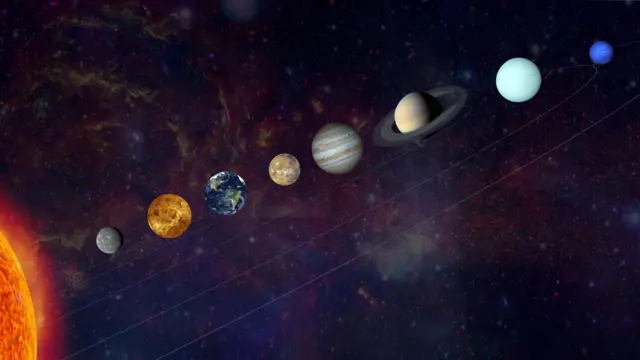
There are seven traditional planets in the sky that are readily visible to human beings. These are the sun, the moon, Venus, Mercury, Mars, Jupiter, and Saturn. Of these, Śrīla Prabhupāda has specifically said that the moon belongs to Svargaloka, or “the third status of the upper planetary system,” and the same is presumably true of the others (SB 2.5.40p). The moon and the sun are given a distinctive position among the planets of Svargaloka in SB 3.11.29-30, where it is said that after the three worlds are annihilated at the end of Brahmā’s day, the sun and moon continue to exist. Śrīla Prabhupāda has pointed out that although the different planetary systems are described as lying in successive layers, like phonograph records in a stack, actually the planets of different types are mixed together:
Regarding your question of the planetary systems, the planets are arranged in each universe in layers like the petals of a lotus. But in each layer there is mixed both heavenly, hellish, and middle planets. On the outside layer there are these three kinds of planets, on the middle layer there are the three kinds of planets, and on the innermost layer there are found these three kinds of planets. Above these layers, in the center, is the Brahmaloka, where Lord Brahmā, the creator, is residing. So the earth planet and the moon planet are both in the same layer, but the earth is a middle planet and the moon is a heavenly planet” [letter to Rūpānuga dāsa, December 20, 1968].
This letter indicates that the moon is a heavenly planet, but suggests that it can occupy the same level in the vertical direction as the earth.
In the Bhāgavatam there are many stories that take place in Svargaloka, but these are rarely (if ever) set specifically on one of the seven planets. However, these planets played an important role in Vedic society because their visible motions were understood to be indicators of the course of events on the earth, both on the level of individuals and on the level of society as a whole. This, of course, is the subject matter of astrology, and we have already pointed out (in Chapter 1) that since astrology was regarded as very important in Vedic society, astronomy, and specifically the study of the motions of the seven planets, was also regarded as very important.
Although the Bhāgavatam gives a fairly detailed account of the movements of the sun, it gives only a relatively brief description of the movements of the other planets. The only information given about the positions of the planets is a list of their heights above Bhū-maṇḍala. Their horizontal positions over the plane of Bhū-maṇḍala are not mentioned. This list is given in Table 8.
The two most striking features of this list of planetary distances are (1) that the moon is listed as being higher than the sun, and (2) that the distances for the planets other than the moon are all much smaller than the values given to them by modern astronomers (see Table 1). To many people, this would seem to indicate that the Bhāgavatam is giving an extremely unrealistic account of the positions of the planets. However, this is not necessarily so.
The key point to consider here is that these distances are all heights of the planets above the plane of Bhū-maṇḍala. They are not distances along the line of sight from the earth to the planets. Let us therefore suppose that the distances of the planets from this earth along the plane of Bhū-maṇḍala might be much larger than the figures in Table 8.
TABLE 8
The Heights of the Planets Above Bhū-maṇḍala
Planet Height above
Bhū-maṇḍala
Sun 800,000
Moon 1,600,000
Venus 4,800,000
Mercury 6,400,000
Mars 8,000,000
Jupiter 9,600,000
Saturn 11,200,000
These figures, which are based on 8 miles per yojana, were obtained by using the planet-to-planet intervals from SB 5.22, plus the earth-to-sun distance given in SB 5.23.9p. The planetary heights listed in the verse translations in Chapter 22 are 800,000 miles higher than the figures in this table.
This is true in the case of the sun, since the distance from Jambūdvīpa to Mount Mānasottara is about 126,000,000 miles, using 8 miles per yojana. Using our smaller figure from Sūrya-siddhānta of 5 miles per yojana, this distance comes to 78,750,000 miles. Thus the modern figure of 93,000,000 miles for the distance from the earth globe to the sun is bracketed by the Bhāgavatam figures obtained using our two standard values for the length of a yojana.
If the planets do lie at great distances from us along the plane of Bhū-maṇḍala, then from our point of view the planets must always lie very close to the great circle on the celestial sphere corresponding to this plane. (We argued this for the sun in Section 3.d.) Now, is it true that the planets all tend to lie very close to some particular celestial great circle? The answer is yes. The orbits of all of the planets are observed to lie very close to the great circle, called the ecliptic, which is the geocentric orbit of the sun.
TABLE 9
The Maximum distances the Planets Move
from the Plane of the Ecliptic
Planet Orbital
Radius Orbital Inclination Maximum distance
from the Ecliptic
Sun 1.00 AU 0.000 0.
Moon 238,000 miles 5.150 21,364.
Venus .72 AU 3.400 3,971,000.
Mercury .39 AU 7.167 4,525,000.
Mars 1.52 AU 1.850 4,564,000.
Jupiter 5.20 AU 1.317 11,115,000.
Saturn 9.55 AU 2.480 38,431,000.
Here modern Western data (EA) is used to compute the maximum distance in miles that each planet travels form the plane of the ecliptic in the course of its orbit. This is the average radius of the orbit times the sine of the inclination of the orbit to the ecliptic. Geocentric orbits were used for the sun and moon, and heliocentric orbits were used for the other planets. (1 AU = 93,000,000 miles.)
In Table 9 there is a list of the maximum distances of the planets from the ecliptic, according to modern astronomical data. These distances agree only roughly with the heights in Table 8, but they give the same order for the relative distance of the planets, and some are of the same order of magnitude. (According to modern astronomy, Mercury should lie between Venus and Mars in this table because of the large inclination of its heliocentric orbit.)
One possible interpretation of Tables 8 and 9 is as follows: In accordance with the first hypothesis discussed in Section 3.d, the projection of the plane of Bhū-maṇḍala on the celestial sphere is the ecliptic. The Bhāgavatam is giving a qualitative description of how far the planets move from the ecliptic in the course of their orbits. In this description, the moon is higher than the sun because the sun always remains on the ecliptic whereas the moon moves away from it. Likewise, Venus is higher than the moon because it moves still further from the ecliptic.
One drawback of this interpretation is that the planets do not stay on one side of the ecliptic. In the course of their orbits they move equal distances on either side, following characteristic looping paths. This may seem to be in strong disagreement with the statements of the Bhāgavatam, which simply specify fixed heights for the planets. However, we have seen that Śrīla Prabhupāda has spoken of the disc of Bhū-maṇḍala as a system of globes floating in space, and we have also argued that this earth is a globe and was regarded as such in Vedic times. Furthermore, Śrīla Prabhupāda has said that planets belonging to different layers in the vertical direction can mix together in one layer. This may also seem contrary to the Bhāgavatam.
We propose that such apparent contradictions can be reconciled by the idea that the Bhāgavatam is using simple, three-dimensional imagery to describe a higher-dimensional situation that is directly experienced and understood by demigods, ṛṣis, and great yogīs. In this case, we suggest that the image of perpendicular height above a plane provides a simple way to describe how the demigods view the actual, higher-dimensional situation: The height of a planet is an important higher-dimensional feature of that planet; this feature is reflected in the planet’s visible motions away from the plane of the ecliptic and is described in simple terms in the Fifth Canto as height above the plane of Bhū-maṇḍala.
TABLE 10
The Days of the Week
Planet Day of the Week
SANSKRIT ENGLISH LATIN
Sun Āditya-bara Sunday Solis dies
Moon Soma-bara Monday Lunae dies
Mars Maṅgala-bara Tuesday Martis dies
Mercury Budha-bara Wednesday Mercurii dies
Jupiter Bṛhaspati-bara Thursday Jovis dies
Venus Śukra-bara Friday Veneris dies
Saturn Śanaiścara-bara Saturday Saturni dies
The days of the week in Europe and India are named after the seven traditional planets.
A final point concerning the seven planets is that the days of the week are named after these planets in both Europe and India. In Table 10 the names for the days of the week in English, Latin, and Sanskrit are given. These sets of names all refer to the seven planets in the order Sun, Moon, Mars, Mercury, Jupiter, Venus, and Saturn. Although this is not the order of the planets as given in Table 8, it does derive from Vedic astronomy.
In the Sūrya-siddhānta the planets are listed as follows in order of distance from the earth globe: Moon, Mercury, Venus, Sun, Mars, Jupiter, and Saturn. This list differs from the one in Table 8 since it refers to distance from the earth globe rather than distance from the plane of Bhū-maṇḍala. According to the Sūrya-siddhānta, the successive months of 30 days are ruled cyclically by the planets in this order. (According to modern astronomy, the planets are sometimes aligned in the Sūrya-siddhānta order of distance from the earth, with the exception that Mercury and Venus must be switched.)
The successive days are ruled by the seven planets in such a way that the ruler of the first day of a month is always the same as the ruler of that month. If one places successive 7-day weeks next to successive 30-day months, one sees that if the first day of month 1 lines up with the first day of week 1, then the first day of month 2 lines up with the 3rd day of a week. Likewise, the first day of month 3 lines up with the 5th day of a week, and so on. This means that the days must be named after the planets according to the pattern shown in Table 11.
TABLE 11
The Order of the Planetary Names
of the Days of the Week
Order in Week N Remainder of
(30N)/7 Order from Earth
in the Sūrya-siddhānta
Sun 1 2 Moon
Moon 2 4 Mercury
Mars 3 6 Venus
Mercury 4 1 Sun
Jupiter 5 3 Mars
Venus 6 5 Jupiter
Saturn 7 7 Saturn
The rule given in the Sūrya-siddhānta is that the names of the 30-day months must match the names of their first days. The months are named cyclically in the order shown on the right, and the days must be named as shown on the left for the proper matching to occur.
According to the dictionary, the English names for the days originated when the Latin names were translated into various Germanic dialects in about the third century A.D. Modern Western scholars trace the Latin names back to the Greeks, and as we might expect, they maintain that the Greeks originated these names. They also assert that Indian mathematical astronomy and astrology originated with the Greeks, and that the Sanskrit names for the days were translated from Greek at the time when this body of knowledge was imported into India. However, the history of this development is not known, and one can also argue that the system for assigning planetary names to divisions of the calendar is indigenous to India. After all, it is one thing for the Romans, who started their empire within the Greek sphere of influence, to have borrowed this system from the Greeks, and it is another thing for the long-established and highly conservative civilization of India to have done so
Planetary Motion in the Bhāgavatam
In this subsection we will discuss the rates of orbital motion of the seven planets, as given in the Śrīmad-Bhāgavatam. In SB 5.21.3, 5.22.7, and 5.22.12 it is mentioned that the sun travels at three speeds: fast, slow, and moderate. These occur when the sun is in the south, in the north, and at the equator, respectively. These periods also correspond to the northern winter, when days are shorter than nights, the northern summer, when the opposite is true, and the time of the vernal and autumnal equinoxes. (Note that the word equator refers to the equinoxes, or times when day and night are equal.)
Some have interpreted these three Bhāgavatam verses to mean that days are shorter in the winter because in this season the sun moves across the sky faster during the day and slower during the night. However, the text of the Bhāgavatam does not say this, and at least two other interpretations are possible. The first of these assumes that the verses refer to the sun’s daily motion. SB 5.23.3 compares the motion of the planets and stars around the polestar to yoked bulls walking around a central post threshing rice. Just as the bulls must walk faster the further they are from the post, so one can say that the sun’s daily motion is faster the farther it is from the polestar. One can represent this mathematically by mapping the celestial sphere to a plane that is tangent to the north celestial pole.
The second interpretation assumes that the verses refer to the sun’s yearly motion against the starry background. This assumption is supported by SB 5.22.12, which says that Venus shares the three speeds of the sun. Although this verse could refer to the daily motion of Venus, it is a fact that since Mercury, Venus, Mars, Jupiter, and Saturn are not generally visible during the day, one seldom (if ever) sees references to their daily motion. Also the verses following SB 5.22.12 all refer to the motions of these planets relative to the stars.
According to modern astronomy, it is in fact true that the sun moves faster along the ecliptic during the northern winter than it does during the northern summer. The heliocentric theory explains this as being due to the fact that the earth reaches perihelion, or its point of closest approach to the sun, just a few days after the winter solstice. At this time it is moving at its fastest rate in its orbit, and it is moving at its slowest rate exactly half a year later at aphelion. The Sūrya-siddhānta also gives calculations for the varying speed of the sun during the course of a year.
SB 5.21.4 states that the length of the day changes at a rate of one ghaṭikā per 30-day month during the period between the solstices. (A ghaṭikā is 24 minutes.) If we take this to mean one ghaṭikā in both the morning and the evening, then this rule is identical to a rule found in the Vedāṅga-jyotiśa, a short astronomical text said to be “one of the six aṅgas [‘limbs’] of the Vedas” (VJ).
Some critics have scorned this rule as a crude approximation, and others have claimed that it works best at the latitude of Babylon, and is therefore Babylonian in origin. We programmed a computer to calculate the annual variation in the length of the day at various latitudes, using modern astronomy. We found that at the latitude of Delhi the Bhāgavatam rule works quite nicely, as long as one is about 20 days away from the solstices. The rule’s average error in the length of the day, over a full year period, is about 6.6 minutes at Delhi. In contrast, the average error at Babylon is about 9.1 minutes, and the rule doesn’t work well during any time of the year. One can argue that the rule is a practical approximation intended for use in northern India. Certainly it is simpler to apply than the modern calculations.
In SB 5.22.9 it is stated that the moon passes through each constellation in an entire day. These particular constellations are called nakṣatras, or lunar mansions; they are 27 in number, and are used to divide the ecliptic into 27 equal parts. In Section 6.e we discuss them in greater detail. In this verse the implication is that the moon completes one sidereal orbit (an orbit against the background of stars) in 27 days. This is an approximation. For comparison, the modern figure is 27.321, and the Sūrya-siddhānta gives 27.322.
This verse also states that the waxing and waning of the moon respectively creates day and night for the demigods, and night and day for the pītas, or forefathers. Since some demigods have a day of 360 earth days, this verse presumably refers specifically to the demigods living on the moon.
The simplest interpretation is that these demigods live on one side of the moon (the side facing us) and the pītas live on the other side. However, SB 5.26.5 places Pitṛloka in the region between the Garbhodaka Ocean and the lower planetary systems. It would seem that some connection must exist between Pitṛloka and the moon, but more research will be needed to determine exactly what it is.
SB 5.22.8 also gives the orbital period of the moon, but it is hard to interpret. Here we will give a tentative interpretation that may need to be corrected in the future. The verse states that (1) the distance covered by the sun in one year is covered by the moon in two fortnights; (2) the distance covered by the sun in one month is covered by the moon in 2.25 days; and (3) the distance covered by the sun in a fortnight is covered by the moon in one day. From SB 5.22.9 we know that distance (3) must be 1/27 of a circle, or 13-1/3 degrees. This makes sense, since distance (2) must be 30 degrees, or 2.25 times 13-1/3. degrees. This is because the sun travels 360 degrees in a year and 30 degrees in 1/12 of a year.
However, for (1) to be true, a fortnight must be 13.5 days, even though this period is normally 15 days. (The reason for this is that to go from the 13-1/3 degrees covered in one day to the 360 degrees covered in two fortnights, we must multiply by 27, or 2 x 13.5.) This conclusion is backed up by the fact that the sun should certainly travel more than 13-1/3 degrees in 15 days.
If we accept the 13.5-day fortnight and divide 13-1/3 by 13.5, we find that the sun travels .9876 degrees per day. For comparison, the modern figure is .9856 degrees per day. These rates of motion correspond to solar years of 364.5 days and the modern value of 365.257 days. The point we would like to make here is that the Bhāgavatam, with its 360-day year, may seem naive, but there is actually considerable sophistication behind its calculations.
They are simply expressed in a way that seems unusual from the Western point of view.
SB 5.22.14 states that Mars crosses each sign of the zodiac in three fortnights if it “does not travel in a crooked way.” This rate of motion is 30 degrees in 45 days, or 2/3 degrees per day. The crooked motion of Mars may be its retrograde motion, but it is hard to specify just when this begins and ends, since the path of Mars begins to curve before its motion actually reverses. Table 12 lists the percentage of time that Mars spends traveling at different speeds, calculated according to modern astronomy. From this table we can see that SB 5.22.14 is making a reasonable statement that must have been based on considerable knowledge of the movements of Mars.
TABLE 12
The Various Speeds of Mars
Degrees/Day Percentage
below .000 10.3%
.000 to .200 4.7%
.200 to .400 7.1%
.400 to .500 5.9%
.500 to .550 4.5%
.550 to .600 6.5%
.600 to .650 11.3%
.650 to .700 23.6%
.700 to .750 26.1%
above .750 .0%
This table lists the percentage of time that Mars spends traveling at various speeds, calculated according to modern astronomy. The columns on the left indicate a number of speed intervals for the motion of Mars. (A speed below zero corresponds to retrograde motion.) The column on the right gives the percentage of time that Mars spends in these speed intervals. Mars spends most of its time at speeds approximating .667, which is given in the Bhāgavatam.
SB 5.22.15 states that Jupiter travels through one sign of the zodiac in one Parivatsara. The names Saṁvatsara, Parivatsara, Iḍāvatsara, Anuvatsara, and Vatsara all refer to a year of 360 days (SB 5.22.7). This verse therefore indicates that Jupiter takes 4,320 days to complete one orbital revolution. The modern figure is 4,332.58 days, and differs by about .3 percent. Likewise, SB 5.22.16 states that Saturn makes one orbital revolution in 30 Anuvatsaras, which means that Saturn takes 10,800 days to complete one revolution. Here the modern figure is 10,759.2 days and differs by about .38 percent. It is rather remarkable that the Bhāgavatam can express orbital periods with such accuracy using simple expressions such as “one sign per Parivatsara.”