Overview
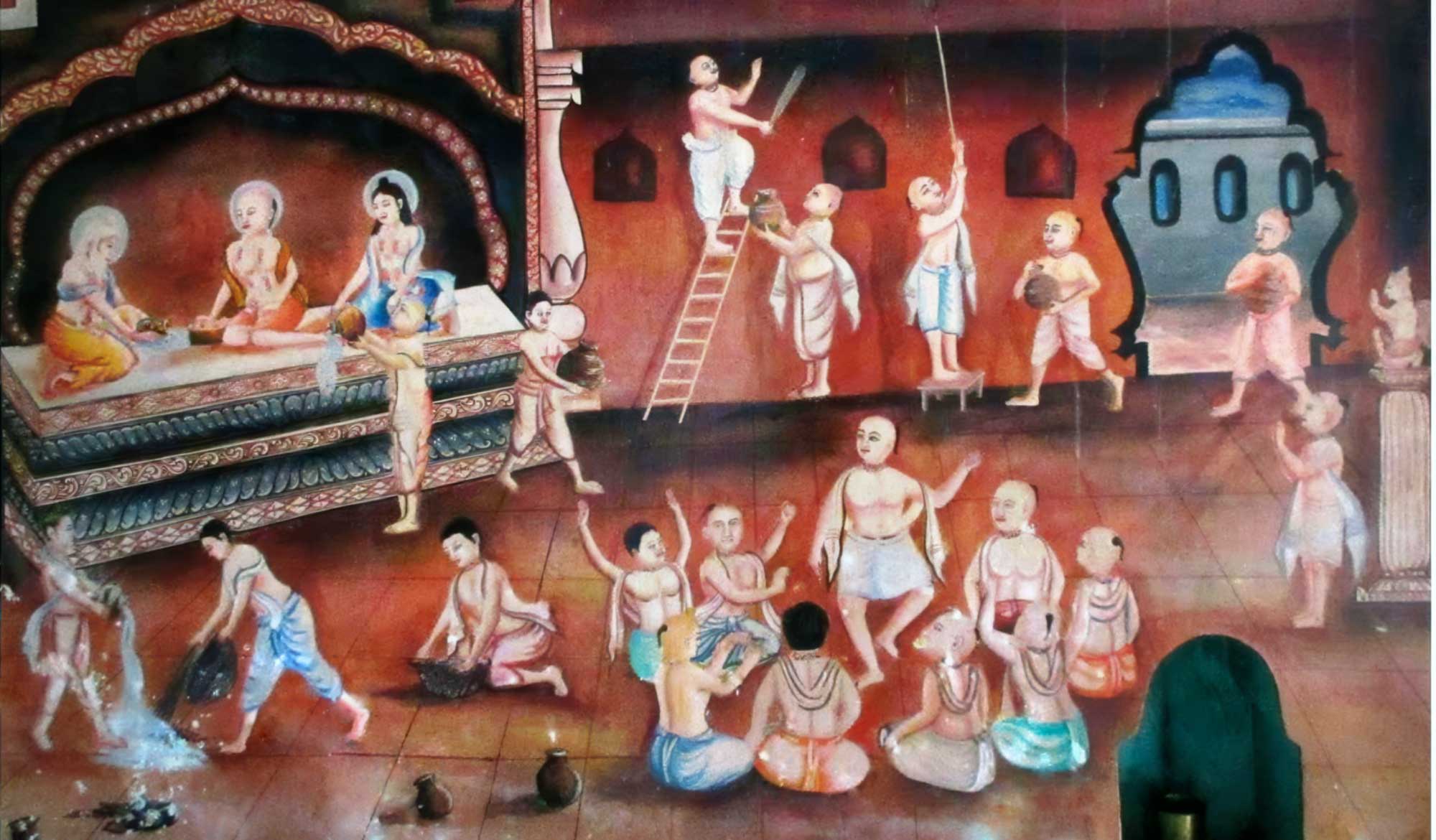
In his commentary on Caitanya-caritāmṛta, Madhya-līlā 12, Verse 135, Śrīla Bhaktisiddhānta Sarasvatī Ṭhākura Prabhupāda gives the hidden meaning behind Śrīman Mahāprabhu’s cleaning of the Guṇḍicā Temple in Jagannātha Purī and explains how the various types of garbage thrown out of the temple relate to the anarthas of the jīva.
Through this līlā, Mahāprabhu, the universal guru, teaches that if any fortunate jīva wishes to seat Śrī Kṛṣṇa on the throne of their heart, they must first cleanse all the impurities from their heart completely. The field of the heart must be made pure, tranquil, and radiant with bhakti. Even if only a few anarthas such as thorns, straw, weeds, dust, sand etc. remain in the field of the heart, one cannot seat the supremely worshipable Bhagavān there. Those impurities or garbage within the heart are nothing but endeavours for anyābhilāṣa (other material desires), karma, jṣāna, and yoga etc. are nothing but distractions. Śrīla Rūpa Gosvāmī Prabhu has said:
anyābhilāṣitā-śūnyaṁ jṣāna-karmādy-anāvṛtam
ānukūlyena kṛṣṇānuśīlanaṁ bhaktir uttamā
Superior bhakti is that which is favourable to the cultivation of service to Kṛṣṇa, which is free from other desires and not obscured by jṣāna, karma etc (Bhakti-rasāmṛta-sindhu 1.1.11)
Where the ātmā’s natural inclination towards bhakti has been covered by anyābhilāṣa, jṣāna, karma, yoga, or austerity, or by a mood which is unfavourable towards bhakti, then śuddha-bhakti does not exist there. Kṛṣna does not appear without śuddha-bhakti, which consists of śuddha-sattva.
Anyābhilāṣa means “As long as I live in this world, I will only indulge my own senses”—this kind of desire, like a sharp blade of grass, pierces the tender heart of a pure jīva, obstructing pure bhakti. Endeavours in karma means that through rituals, sacrifices, charity, austerities etc, I shall experience pleasure in this world and the higher planet such as Svarga etc. Such activities which are full of desire are just like dust. In the whirlwind of worldly activities, the dust-like particles of desires covers the pure and pristine mirror of our heart. Like countless particles of dust, desires from virtuous and non-virtuous actions have been contaminating the hearts of those averse to Hari through innumerable lifetimes, thus their karmic impressions are not easily removed. Jīvas who are averse to Hari think that through karma, one can mitigate the suffering inherent in karma itself (in other words, through karma one can remove the thorns of karma). However, this concept is wrong. Becoming subject to this way of thinking, they merely continue to deceive themselves. Just as an elephant, after bathing, still smears dust on its body, similarly, one cannot rid oneself of the subtle impressions of karma through karma. All the difficulties of the jīva are only removed by pure bhakti. Then that pure throne of the heart becomes a fit resting place for Śrī Bhagavān. In this way, a devotee-poet has sung, bhaktera hṛdaye sadā govinda viśrāma (‘Govinda always rests in the heart of a devotee’).
Endeavours in nirviśeṣa or kaivalya–yoga (yoga aiming at non-differentiated Brahman), or jṣāna-yoga etc. are just like sand. Through these, what to speak of Śrī Hari’s satisfaction or service, they are like attempting to pierce Śrī Hari’s body with a spear. Although at the initial stage of their quest for non-differentiated Brahman, those aspiring for liberation accept the names of Śrī Hari in an indirect way, yet at the stage of liberation or identifying themselves with Brahman, they do not accept its independent existence. Therefore, Bhagavān does not appear in the hearts of those unfortunate jīvas who identify themselves as liberated. That is why Śrī Gaurasundara did not keep straw, dust, dirt and garbage within the four walls of Bhagavān’s temple. But with his own outer-cloth, He threw it all outside, just in case, with the help of the wind, all the garbage would again come back into the temple.
Many times, endeavours in karma, jṣāna etc. are removed, yet very subtle impurities remain in the heart. These can be compared to kuṭināṭi, pratiṣṭhāśā, jīva-hiṁsā, niṣiddhācāra, lābha, pūjā etc. The word kuṭināṭi means deception.
The word pratiṣṭhāśā means, “Let those persons who are uneducated call me a great sādhu or a mahant due to my solitary bhajana or due to my old age.” In this way, one hopes for mundane respect, or gradually tries to fulfil his desires to enjoy objects of the senses by artificial displays of a semblance of bhāva in one’s hard heart, in order to be recognised as a ‘devotee’ or ‘avatāra’.
The word Jīva-hīmsā means a reluctance or meanness in propagating pure bhakti, favouring māyāvādīs, karmīs and anyābhilāṣīs, and speaking with sensitivity to their opinions.
The words lābha and pūjā means that in the name of dharma, one makes a living by using hari-nāma, mantras, Deities, or the Bhāgavata in order to gain wealth or respect.
The word niṣiddhācāra is understood to mean women and the company of non-devotees such as karmīs, jṣānīs, anyābhilāṣīs etc. In this way, after sweeping away the large amounts of sand, straw, dust etc. that had accumulated after many days, Śrī Gaurasundara thoroughly cleaned the entire temple a second time with water. If there were any fine spots, He rubbed them with the dry cloth He was wearing and began to clean the temple and the throne where Bhagavān would be placed.
After all the scrubbing, cleaning, and polishing, there was not even a trace of dust left in the temple, let alone a subtle stain. Not only was the temple as clear as crystal, but it was also extremely cool. In other words, the heart of the sādhaka is no longer the same as the blazing heat of a desert – this means that burning desires born from enjoying the objects of the senses, and the threefold material miseries (adhidaivika, adhyātmika, and adhibhautika) have been extinguished. Actually, when desires for enjoyment and liberation as well as the attempts for anyābhilāṣa, karma, jṣāna, yoga etc. are removed from his heart, and the ātmā’s tendency for śuddha-bhakti is revealed, the heart becomes tranquil and cool.
Many times, even after all desires and aspirations have been eliminated, there may still remain a subtle stain in some unknown corner of the heart which the ignorant jīva cannot comprehend. This is the desire for mukti. What to say of the Nirviśeṣavādīs desire for sāyujya-mukti, Śrīman Mahāprabhu cleaned the subtle stain of desiring the four kinds of liberation with His own cloth.
In this way, Śrī Gaurasundara, as the universal guru, accepting the identity of a jīva for the welfare of the jīvas, has instructed you to chant kṛṣṇa-nāma loudly with great enthusiasm for the sake of Kṛṣṇa, to please Kṛṣṇa’s senses, and in order to transform the sādhaka’s heart into a place resembling Vṛndāvana, where the independent Kṛṣṇa engages in carefree pastimes.
yadyapyanyā bhaktiḥ kalau kartavyā
tadā kīrtanākhya-bhakti-saṁyogenaiva
Although other processes of bhakti are to be performed in the age of Kali, they can all be accomplished through kīrtana. (Bhakti Sandarbha 273)
Mahāprabhu went to every devotee, took them by the hand, and taught them the service of cleaning the temple. Whoever did their work nicely, He commended them, and as the Lord who possesses the bhāva of Śrī Rādhā, the satisfaction of Kṛṣṇa’s desires personified, He gave some divine chastisement to those who were not up to His standard, took them by the hand and taught them the method to serve Kṛṣṇa. Not only that, He also ordered and inspired the pure-hearted devotees who were engaged in bhakti-yoga to the non-dual Absolute and had attained proficiency in bhajana according to the teachings of Śrī Caitanya to engage in the work of an ācārya for those jīvas who are averse to the Supreme.* (1) Moreover, those who are capable of becoming purified by removing inauspiciousness from the heart become dear to the Lord, and for those whom anartha-nivṛtti has only occurred to a small extent, He has specifically prescribed the discipline of service to Hari-Guru-Vaiṣṇava.
*(1)
tumi bhāla kariyāchha śikhāha anyere
ei-mata bhāla karma seho yena kare
The Lord said – “You have done nicely. Teach others so that they can also do nice work like this.” (Caitanya-caritāmṛta, Madhya-līlā 12.117)
(Translated into English by Swami Bhaktivijṣana Giri)
Deepen your Bhakti-yoga practice, harmonize relationships, and receive guided coaching — all at Vedavarsity.com