



Thus far, we have discussed Vedic references to phenomena and theoretical entities that do not fit into the rigorously defined theories of modern physics but that can be readily inserted into our ordinary picture of the world around us. In this book, however, we will be dealing with many things that do not seem to be at all compatible with that picture. We suggest that to accommodate these things, it is necessary for us to re-examine our basic ideas concerning the nature of space.
Modern physics and astronomy began with the idea that matter is made of tiny bits of substance, each of which has a location in three-dimensional space. According to this idea, which was strongly developed by Descartes and Newton, three-dimensional space can be seen as an absolute, pre-existing container in which all material events take place. This idea is quite consistent with the picture of the world provided by our own senses, and it tends to provide an unquestioned background for all of our thinking. However, many cultures have maintained quite different ideas about the nature of space, and this is also true of the Vedic culture.
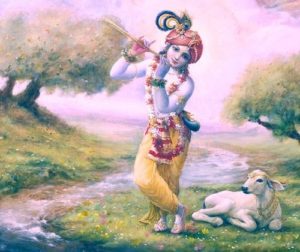
To understand the Vedic conception of space, it is necessary to consider the position of Kṛṣṇa as the absolute cause of all causes. Clearly we cannot regard the transcendental form of Kṛṣṇa as being composed of tiny bits of substance situated at different locations in three-dimensional space. Whether we regard the tiny bits as spiritual or material, such a form would certainly be limited and relative. The actual nature of Kṛṣṇa’s form is indicated by the following verses from the Brahma-saṁhitā:
I worship Govinda, the primeval Lord, whose transcendental form is full of bliss, truth, and substantiality and is thus full of the most dazzling splendor. Each of the limbs of that transcendental figure possesses in itself the full-fledged functions of all the organs, and He eternally sees, maintains, and manifests the infinite universes, both spiritual and mundane [SBS 5.32].
He is an undifferentiated entity, as there is no distinction between the potency and the possessor thereof. In His work of creation of millions of worlds, His potency remains inseparable. All the universes exist in Him, and He is present in His fullness in every one of the atoms that are scattered throughout the universe, at one and the same time. Such is the primeval Lord whom I adore [SBS 5.35].
These verses indicate that the form of Kṛṣṇa is made of many parts, but that each part is identical to the whole. Also, all space is within the form of Kṛṣṇa, but at the same time Kṛṣṇa is fully present within every atom. One implication of this is that the entire universe, which is within Kṛṣṇa, is fully present within every atom of the universe. Such a state of affairs cannot be visualized in three-dimensional terms, and indeed, it is not possible within three-dimensional space. The statement that reality is like this must simply be taken as an axiom describing the position of Kṛṣṇa as the Supreme Absolute Truth. Thus, the Vedic concept of space begins with a statement of Kṛṣṇa’s unified nature, rather than with the geometric axioms defining three-dimensional space.
Here we will introduce an idea of higher-dimensional space that may help us understand the ideas about space implicit in the Vedic literature. The term higher-dimensional is borrowed from modern mathematics; it does not appear directly in Vedic literature. It is part of an attempt to bridge the conceptual gap between modern thinking and the Vedic world view. Naturally, since the traditional followers of Vedic culture have not been confronted with such a gap, they have not been motivated to introduce ideas to bridge it.
The most fundamental feature of the Vedic idea of space is that many more things can be brought close together in this space than the geometric rules of three-dimensional space allow. In the course of this chapter we will give several examples from the Vedic literature illustrating this theme. Since the higher-dimensional spaces of mathematics also permit more things to be brought together than the rules of three-dimensional space allow, we have chosen the term higher-dimensional to refer to this feature of the Vedic view of reality.
Although Kṛṣṇa’s situation is very difficult for us to visualize, we can nonetheless understand from Vedic statements describing Kṛṣṇa that space must be higher-dimensional. Kṛṣṇa’s situation is that He has full access to every location simultaneously. In ordinary, three-dimensional space we have access, through the operation of our senses of action and perception, to locations within a limited neighborhood, and we can change that neighborhood by moving from one place to another. Thus our situation can be viewed as a restricted form of Kṛṣṇa’s situation. A higher-dimensional space corresponds to a situation in which access between locations is more restricted than it is for Kṛṣṇa but less restricted than it is for beings experiencing three-dimensional space.
This concept of higher-dimensional space is closely tied together with the idea of varying levels of sensory development in sentient beings. Access between locations depends on the operation of senses of action and senses of perception, and thus it should be possible in principle to enlarge the space of one’s experience by increasing the scope of one’s sensory powers.
These ideas about space and its relation to sense perception are implicit in the Vedic literature, and they can best be understood by giving some specific examples. The nature of Kṛṣṇa’s absolute position is nicely illustrated by the following story of a visit by Lord Brahmā to Kṛṣṇa in Dvārakā. In the story, Kṛṣṇa first responds to Brahmā’s request to see Him by having His secretary ask, “Which Brahmā wishes to see Me?” Brahmā later begins his conversation with Kṛṣṇa by asking why Kṛṣṇa made this inquiry:
“Why did you inquire which Brahmā had come see You? What is the purpose of such an inquiry? Is there any other Brahmā besides me within this universe?”
Upon hearing this, Śrī Kṛṣṇa smiled and immediately meditated. Unlimited Brahmās arrived instantly. These Brahmās had different numbers of heads. Some had ten heads, some twenty, some a hundred, some a thousand, some ten thousand, some a hundred thousand, some ten million, and others a hundred million. No one can count the number of faces they had.
There also arrived many Lord Śivas with various heads numbering one hundred thousand and ten million. Many Indras also arrived, and they had hundreds of thousands of eyes all over their bodies.
When the four-headed Brahmā of this universe saw all these opulences of Kṛṣṇa, he became very bewildered and considered himself a rabbit among many elephants.
All the Brahmās who came to see Kṛṣṇa offered their respects at His lotus feet, and when they did this, their helmets touched His lotus feet. No one can estimate the inconceivable potency of Kṛṣṇa. All the Brahmās who were there were resting in the one body of Kṛṣṇa. When all the helmets struck together at Kṛṣṇa’s lotus feet, there was a tumultuous sound. It appeared that the helmets themselves were offering prayers unto Kṛṣṇa’s lotus feet.
With folded hands, all the Brahmās and Śivas began to offer prayers unto Lord Kṛṣṇa, saying, “O Lord, You have shown me a great favor. I have been able to see Your lotus feet.”
Each of them then said, “It is my great fortune, Lord, that You have called me, thinking of me as Your servant. Now let me know what Your order is so that I may carry it on my heads.”
Lord Kṛṣṇa replied, “Since I wanted to see all of you together, I have called all of you here. All of you should be happy. Is there any fear of the demons?”
They replied, “By Your mercy, we are victorious everywhere. Whatever burden there was upon the earth You have taken away by descending on that planet.”
This is the proof of Dvārakā’s opulence: all the Brahmās thought, “Kṛṣṇa is now staying in my jurisdiction.” Thus the opulence of Dvārakā was perceived by each and every one of them. Although they were all assembled together, no one could see anyone but himself.
Lord Kṛṣṇa then bade farewell to all the Brahmās there, and after offering their obeisances, they all returned to their respective homes [CC ML 21.65-80].
In this story it is significant that each of the Brahmās remained within his own universe. This means that Kṛṣṇa was simultaneously manifesting His Dvārakā pastimes in all of those universes. Each Brahmā except ours thought that he was alone with Kṛṣṇa in Dvārakā within his own universe, but by Kṛṣṇa’s grace our Brahmā could simultaneously see all the others. This illustrates that Kṛṣṇa has access to all locations at once, and it also shows that, by Kṛṣṇa’s grace, different living beings can be given different degrees of spatial access, either permanently or temporarily.
Arjuna’s vision of Kṛṣṇa’s universal form on the battlefield of Kurukṣetra is another example of Kṛṣṇa’s expanding the sensory powers of a living being and giving him access to regions of the universe previously unknown to him.
Before revealing this form to Arjuna, Kṛṣṇa said,
O best of the Bhāratas, see here the different manifestations of Ādityas, Vasus, Rudras, Aśvinī-kumāras, and all the other demigods. Behold the many wonderful things that no one has ever seen or heard of before.
O Arjuna, whatever you want to see, behold at once in this body of Mine! This universal form can show you whatever you now desire to see and whatever you may want to see in the future. Everything-moving and nonmoving-is here completely, in one place [Bg 11.6-7].
Thus from one place Arjuna was able to see many different realms occupied by demigods and other kinds of living beings. To perceive such a vast variety of scenes simultaneously, Arjuna clearly had to transcend the limitations of three-dimensional space, and it is significant that Kṛṣṇa made this possible through the medium of His all-pervading universal form. The story of Mother Yaśodā’s seeing the entire universe (including herself and Kṛṣṇa) within Kṛṣṇa’s mouth is another example showing that Kṛṣṇa can reveal all locations through His all-encompassing form (see KB, pp. 83-84).
It is interesting to note that the Brahmās visiting Kṛṣṇa had varying numbers of heads, ranging from four to hundreds of millions. It is rather difficult to understand how millions of heads could be arranged on one body in three-dimensional space, and it is also difficult to see how millions of Brahmās could all be seen simultaneously within one room. We suggest that these things are made possible by the fact that the underlying space is not three-dimensional.
Similar observations could be made about the incident in which Bāṇāsura used 1,000 arms to work 500 bows and shoot 2,000 arrows at a time at Kṛṣṇa. In this case we are dealing with a materially embodied being living on the earth. One might wonder how 500 material arms could be mounted on one shoulder without interfering with one another. And if this is possible, how could they aim 500 bows in the same direction at once? (Did the bows pass through each other?) We suggest that stories of this kind implicitly require higher-dimensional conceptions of space.
We can sum up the idea of dimensionality of space by saying that the greater the degree of access between locations, the higher the dimensionality of the space. Since Kṛṣṇa has simultaneous access to all locations, He perceives space at the highest level of dimensionality. Different living beings will perceive space at different levels of dimensionality, and thus they will have access to different sets of locations (or lokas).
It is interesting to note that the idea of higher-dimensional access between locations is a key feature of quantum mechanics. The quantum mechanical atom cannot be represented in three-dimensional space. In fact, to represent something as commonplace as an atom of carbon, quantum mechanics makes use of a kind of infinite-dimensional space called Hilbert space. The three-dimensional bonding of carbon and other atoms is made possible by the higher-dimensional interactions within the atoms. Thus, although the idea of higher-dimensional realms may seem to be an extreme departure from accepted scientific thinking, it is possible to interpret modern physics as laying the groundwork for such an idea.
Deepen your Bhakti-yoga practice, harmonize relationships, and receive guided coaching — all at Vedavarsity.com