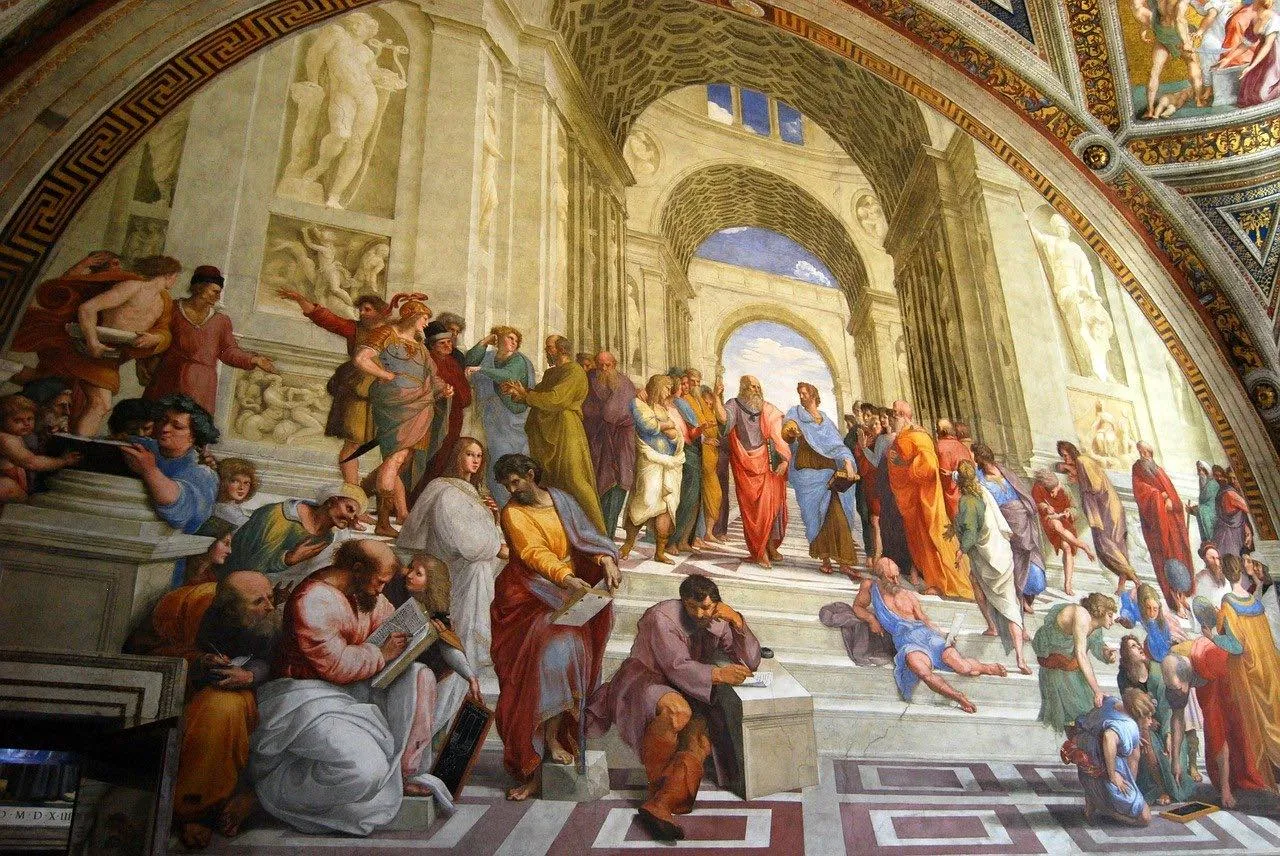
This agreement between Vedic and Western astronomy will seem surprising to anyone who is familiar with the cosmology described in the Fifth Canto of the Śrīmad-Bhāgavatam and in the other Purāṇas, the Mahābhārata, and the Rāmāyaṇa. The astronomical siddhāntas seem to have much more in common with Western astronomy than they do with Purāṇic cosmology, and they seem to be even more closely related with the astronomy of the Alexandrian Greeks.
Indeed, in the opinion of modern Western scholars, the astronomical school of the siddhāntas was imported into India from Greek sources in the early centuries of the Christian era. Since the siddhāntas themselves do not acknowledge this, these scholars claim that Indian astronomers, acting out of chauvinism and religious sentiment, Hinduized their borrowed Greek knowledge and claimed it as their own. According to this idea, the cosmology of the Purāṇas represents an earlier, indigenous phase in the development of Hindu thought, which is entirely mythological and unscientific.
This, of course, is not the traditional Vaiṣṇava viewpoint. The traditional viewpoint is indicated by our observations regarding the astronomical studies of Śrīla Bhaktisiddhānta Sarasvatī Ṭhākura, who founded a school for “teaching Hindu Astronomy nicely calculated independently of Greek and other European astronomical findings and calculations.”
The Bhāgavatam commentary of the Vaiṣṇava scholar Vaṁśīdhara also sheds light on the traditional understanding of the jyotiṣa śāstras. His commentary appears in the book of Bhāgavatam commentaries Śrīla Prabhupāda used when writing his purports. In Appendix 1 we discuss in detail Vaṁśīdhara’s commentary on SB 5.20.38. Here we note that Vaṁśīdhara declares the jyotiṣa śāstra to be the “eye of the Vedas,” in accord with verse 1.4 of the Nārada-saṁhitā, which says, “The excellent science of astronomy comprising siddhānta, saṁhitā, and horā as its three branches is the clear eye of the Vedas” (BJS, xxvi).
Vaiṣṇava tradition indicates that the jyotiṣa śāstra is indigenous to Vedic culture, and this is supported by the fact that the astronomical siddhāntas do not acknowledge foreign source material. The modern scholarly view that all important aspects of Indian astronomy were transmitted to India from Greek sources is therefore tantamount to an accusation of fraud. Although scholars of the present day do not generally declare this openly in their published writings, they do declare it by implication, and the accusation was explicitly made by the first British Indologists in the early nineteenth century.
John Bentley was one of these early Indologists, and it has been said of his work that “he thoroughly misapprehended the character of the Hindu astronomical literature, thinking it to be in the main a mass of forgeries framed for the purpose of deceiving the world respecting the antiquity of the Hindu people” (HA, p. 3). Yet the modern scholarly opinion that the Bhāgavatam was written after the ninth century A.D. is tantamount to accusing it of being a similar forgery. In fact, we would suggest that the scholarly assessment of Vedic astronomy is part of a general effort on the part of Western scholars to dismiss the Vedic literature as a fraud.
A large book would be needed to properly evaluate all of the claims made by scholars concerning the origins of Indian astronomy. In Appendix 2 we indicate the nature of many of these claims by analyzing three cases in detail. Our observation is that scholarly studies of Indian astronomy tend to be based on imaginary historical reconstructions that fill the void left by an almost total lack of solid historical evidence.
Here we will simply make a few brief observations indicating an alternative to the current scholarly view. We suggest that the similarity between the Sūrya-siddhānta and the astronomical system of Ptolemy is not due to a one-sided transfer of knowledge from Greece and Alexandrian Egypt to India. Due partly to the great social upheavals following the fall of the Roman Empire, our knowledge of ancient Greek history is extremely fragmentary. However, although history books do not generally acknowledge it, evidence does exist of extensive contact between India and ancient Greece. (For example, see PA, where it is suggested that Pythagoras was a student of Indian philosophy and that brāhmaṇas and yogīs were active in the ancient Mediterranean world.)
We therefore propose the following tentative scenario for the relations between ancient India and ancient Greece: SB 1.12.24p says that the Vedic king Yayāti was the ancestor of the Greeks, and SB 2.4.18p says that the Greeks were once classified among the kṣatriya kings of Bhārata but later gave up brahminical culture and became known as mlecchas. We therefore propose that the Greeks and the people of India once shared a common culture, which included knowledge of astronomy. Over the course of time, great cultural divergences developed, but many common cultural features remained as a result of shared ancestry and later communication. Due to the vicissitudes of the Kali-yuga, astronomical knowledge may have been lost several times in Greece over the last few thousand years and later regained through communication with India, discovery of old texts, and individual creativity. This brings us down to the late Roman period, in which Greece and India shared similar astronomical systems. The scenario ends with the fall of Rome, the burning of the famous library at Alexandria, and the general destruction of records of the ancient past.
According to this scenario, much creative astronomical work was done by Greek astronomers such as Hipparchus and Ptolemy. However, the origin of many of their ideas is simply unknown, due to a lack of historical records. Many of these ideas may have come from indigenous Vedic astronomy, and many may also have been developed independently in India and the West. Thus we propose that genuine traditions of astronomy existed both in India and the eastern Mediterranean, and that charges of wholesale unacknowledged cultural borrowing are unwarranted.
Deepen your Bhakti-yoga practice, harmonize relationships, and receive guided coaching — all at Vedavarsity.com