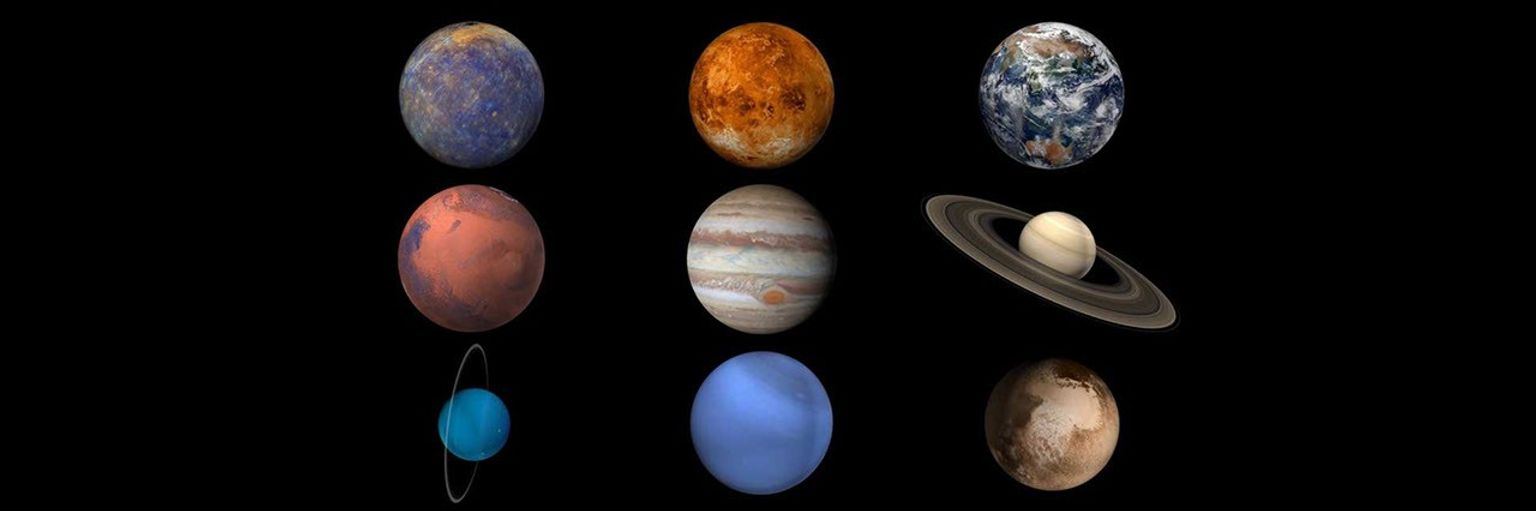
In Section 1.a we derived relative distances between the planets from the orbital data contained in the Sūrya-siddhānta. These distances are expressed in units of the earth-sun distance, or AU. In this section we will consider absolute distances measured in miles or yojanas and point out an interesting feature of the Sūrya-siddhānta: it seems that figures for the diameters of the planets are encoded in a verse in the seventh chapter of this text. These diameters agree quite well with the planetary diameters determined by modern astronomy. This is remarkable, since it is hard to see how one could arrive at these diameters by observation without the aid of powerful modern telescopes.
Absolute distances are given in the Sūrya-siddhānta in yojanas-the same distance unit used throughout the Śrīmad-Bhāgavatam. To convert such a unit into Western units such as miles or kilometers, it is necessary to find some distances that we can measure today and that have also been measured in yojanas. Śrīla Prabhupāda has used a figure of eight miles per yojana throughout his books, and this information is presumably based on the joint usage of miles and yojanas in India.
Since some doubt has occasionally been expressed concerning the size of the yojana, here is some additional information concerning the definition of this unit of length. One standard definition of a yojana is as follows: one yojana equals four krośas, where a krośa is the maximum distance over which a healthy man can shout and be heard by someone with good hearing (AA). It is difficult to pin down this latter figure precisely, but it surely could not be much over two miles. Another definition is that a yojana equals 8,000 nṛ, or heights of a man. Using 8 miles per yojana and 5,280 feet per mile, we obtain 5.28 feet for the height of a man, which is not unreasonable. In Appendix 1 we give some other definitions of the yojana based on the human body.
A more precise definition of a yojana can be obtained by making use of the figures for the diameter of the earth given by Indian astronomers. Āryabhaṭa gives a figure of 1,050 yojanas for the diameter of the earth (AA). Using the current figure of 7,928 miles for the diameter of the earth, we obtain 7,928/1,050 = 7.55 miles per yojana, which is close to 8. We also note that Alberuni (AL, p. 167) gives a figure of 8 miles per yojana, although it is not completely clear whether his mile is the same as ours.
In the Siddhānta-śiromaṇi of Bhāskarācārya, the diameter of the earth is given as 1,581 yojanas (SSB2, p. 83), and in the Sūrya-siddhānta a diameter of 1,600 yojanas is used (SS, p. 11). These numbers yield about 5 miles per yojana, which is too small to be consistent with either the 8 miles per yojana or the 8,000 nṛ per yojana standards. (At 5 miles per yojana we obtain 3.3 feet for the height of a man, which is clearly too short.) The Indian astronomer Parameśvara suggests that these works use another standard for the length of a yojana, and this is borne out by the fact that their distance figures are consistently 60% larger than those given by Āryabhaṭa. Thus, it seems clear that a yojana has traditionally represented a distance of a few miles, with 5 and approximately 8 being two standard values used by astronomers.
At this point it is worthwhile considering how early Indian astronomers obtained values for the diameter of the earth. The method described in their writings (GP, p. 84) is similar to the one reportedly used by the ancient Greek astronomer Eratosthenes. If the earth is a sphere, then the vertical directions at two different points should differ in angle by an amount equal to 360 times the distance between the points divided by the circumference of the earth. This angle can be determined by measuring the tilt of the noon sunlight from vertical at one place, and simultaneously measuring the same tilt at the other place (assuming that the sun’s rays at the two places run parallel to one another). At a separation of, say, 500 miles, the difference in tilt angles should be about 7 degrees, a value that can be easily measured and used to compute the earth’s circumference and diameter.
The Sūrya-siddhānta lists the diameter of the moon as 480 yojanas and the circumference of the moon’s orbit as 324,000 yojanas. If we convert these figures into miles by multiplying by the Sūrya-siddhānta value of 5 miles per yojana, we obtain 2,400 and 1,620,000. According to modern Western figures, the diameter of the moon is 2,160 miles, and the circumference of the moon’s orbit is 2ṇ times the earth-to-moon distance of 238,000 miles, or 1,495,000 miles. Thus the Sūrya-siddhānta agrees closely with modern astronomy as to the size of the moon and its distance from the earth.
TABLE 6
The Diameters of the Planets, According to the Sūrya-siddhānta
Planet Orbit Reduced Diameter SS
Yojanas Diameter
Miles W Diameter
Miles W/SS
Moon 324,000 480.00 480.00 2400.00 2,160. .90
Sun 4,331,500 486.21 6,500.00 32,500.0 865,110. 26.62
Mercury 4,331,500 45.00 601.60 3,008.0 3,100. 1.03
Venus 4,331,500 60.00 802.13 4,010.6 7,560. 1.89
Earth 0 – 1,600.00 8,000.0 7,928. .99
Mars 8,146,909 30.00 754.34 3,771.7 4,191. 1.11
Jupiter 51,375,764 52.50 8,324.80 41,624.0 86,850. 2.09
Saturn 127,668,255 37.50 14,776.00 73,882.0 72,000. .97
The first column lists the planetary orbital circumferences in yojanas (SS, p. 87). The second column lists the diameters of the planets in yojanas reduced to the orbit of the moon (SS, p, 59). The third column lists the corresponding actual diameters (in yojanas and miles). Except for the sun, moon, and earth (where figures are taken from SS, p. 41), these values are computed using the data in columns 1 and 2. The fourth column lists the current Western values for the planetary diameters, and the last column lists the ratios between the Western diameters and the diameters based on the Sūrya-siddhānta.
Table 6 lists some figures taken from the Sūrya-siddhānta giving the circumferences of the orbits of the planets (with the earth as center), and the diameters of the discs of the planets themselves. The orbital circumferences of the planets other than the moon are much smaller than they should be according to modern astronomy.
The diameter of the moon is also the only planetary diameter that seems, at first glance, to agree with modern data. Thus, the diameter given for the sun is 6,500 yojanas, or 32,500 miles, whereas the modern figure for the diameter of the sun is 865,110 miles. The diameter figures for Mercury, Venus, Mars, Jupiter, and Saturn are given in yojanas for the size of the planetary disc when projected to the orbit of the moon (see Figure 2).
These figures enable us to visualize how large the planets should appear in comparison with the full moon. On the average the figures are too large by a factor of ten, and they imply that we should easily be able to see the discs of the planets with the naked eye. Of course, without the aid of a telescope, we normally see these planets as starlike points.
The discs of the planets Mercury through Saturn actually range from a few seconds of arc to about 1′, and for comparison the disc of the full moon covers about 31.2′ of arc. This means that a planetary diameter projected to the orbit of the moon should be no greater than 15.4 yojanas. From the standpoint of modern thought, it is not surprising that an ancient astronomical work like the Sūrya-siddhānta should give inaccurate figures for the sizes of the planetary discs. In fact, it seems remarkable that ancient astronomers lacking telescopes could have seen that the planets other than the sun and moon actually have discs.
If we look more closely at the data in Table 6, however, we can make a very striking discovery. Since the diameters of Mercury through Saturn are projected on the orbit of the moon, their real diameters should be given by the formula:
projected diameter x orbital circumference
real diameter = —————————-
moon’s orbital circumference
If we compute the real diameters using this formula and the data in Table 6, we find that the answers agree very well with the modern figures for the diameters of the planets (see the last three columns of the table). Thus, the distance figures and the values for the projected (or apparent) diameters disagree with modern astronomy, but the actual diameters implied by these figures agree. This is very surprising indeed, considering that modern astronomers have traditionally computed the planetary diameters by using measured values of distances and apparent diameters.
We note that the diameters computed for Mercury, Mars, and Saturn using our formula are very close to the modern values, while the figures for Venus and Jupiter are off by almost exactly 1/2. This is an error, but we suggest that it is not simply due to ignorance of the actual diameters of these two planets. Rather, the erroneous factor of 1/2 may have been introduced when a careless copyist mistook “radius” for “diameter” when copying an old text that was later used in compiling the present Sūrya-siddhānta.
This explanation is based on the otherwise excellent agreement that exists between the Sūrya-siddhānta diameters and modern values, and on our hypothesis that existing jyotiṣa śāstras such as the Sūrya-siddhānta may be imperfectly preserved remnants of an older Vedic astronomical science. We suggest that accurate knowledge of planetary diameters existed in Vedic times, but that this knowledge was garbled at some point after the advent of Kali-yuga. However, this knowledge is still present in an encoded form in the present text of the Sūrya-siddhānta.
The circumferences of the planetary orbits listed in Table 6 are based on the theory of the Sūrya-siddhānta that all planets move through space with the same average speed. Using this theory, one can compute the average distances of the planets from their average apparent speeds, and this is how the circumferences listed in Table 6 were computed in the Sūrya-siddhānta.
The same theory concerning the motions of the planets can be found in other works of the siddhāntic school, but it is not mentioned in the Śrīmad-Bhāgavatam. This theory disagrees with that of modern astronomers, who maintain that the planets move more slowly the further they are from the sun.
We should emphasize that this theory applies only to the planets’ average speeds in circular motion around the earth. The actual speeds of the planets vary in the Sūrya-siddhānta, and a rule is given for computing the change in apparent diameter of the planets as their distance from the earth changes. The motions of the planets are said to be caused by the pravaha wind and by the action of reins of wind pulled by demigods.
Since the relative distances of the planets derived from the Sūrya-siddhānta in Section 1.a are not consistent with the orbital circumferences listed in Table 6, it would seem that the Sūrya-siddhānta contains material representing more than one theoretical viewpoint. This also makes sense if we suppose that the surviving jyotiṣa śāstras may represent the incompletely understood remnants of a body of knowledge that was more complete in the ancient past.
TABLE 7
Modern Values for Planetary Distances and Diameters
vs. Those of the Sūrya-siddhānta
Planet Mean Distance
from Earth Apparent
Diameter Real
Diameter
Moon agrees agrees agrees
Sun disagrees agrees disagrees
Mercury disagrees disagrees agrees
Venus disagrees disagrees off by 1/2
Earth – – agrees
Mars disagrees disagrees agrees
Jupiter disagrees disagrees off by 1/2
Saturn disagrees disagrees agrees
The entry “agrees” means that the Sūrya-siddhānta value falls within about 10% of the modern value. The cases that are “off by 1/2” fall within less than 7% of the modern values after being doubled.
Table 7 sums up our observations on the diameters and distances of the planets given in the Sūrya-siddhānta. At present we have no explanation of how diameters agreeing so closely with modern values were found, even though estimates of distances and apparent diameters disagree. According to current astronomical thinking, the real diameters can be obtained only by making measurements using powerful telescopes and then combining these results with accurate knowledge of the planetary distances. However, other methods may have been available in Vedic times.
We should note, by the way, that the numbers for planetary diameters can be found not only in our English translation of the Sūrya-siddhānta (SS), but also in Śrīla Bhaktisiddhānta Sarasvatī Ṭhākura’s Bengali translation. This strongly indicates that these numbers belong to the original Sūrya-siddhānta, and were not inserted as a hoax in recent times.
We should also consider the possibility that the planetary diameters given in the Sūrya-siddhānta were derived from Greek sources. It turns out that there is a medieval tradition regarding the distances and diameters of the planets that can be traced back to a book by Ptolemy entitled Planetary Hypotheses. In this book the apparent diameters of the planets are given as fractions of the sun’s apparent diameter. For the moon, Mercury, Venus, Mars, Jupiter, and Saturn, these apparent diameters are stated by Ptolemy to be, respectively, 1m, nn, nn, nn, nn, and nn (SW, p. 167). Corresponding apparent diameters can be computed from the Sūrya-siddhānta data by taking the diameters of the planets reduced to the moon’s orbit and dividing by 486.21, the diameter of the sun reduced to the moon’s orbit. The values obtained, however, are quite different from Ptolemy’s apparent diameters.
Ptolemy also computes actual diameters, expressed as multiples of the earth’s diameter, using his apparent diameters and his values for the average distances of the planets from the earth. We have converted his actual diameters into miles by multiplying them by 7,928 miles, our modern value for the diameter of the earth. The results for the moon, Mercury, Venus, Mars, Jupiter, and Saturn are 2,312, 294, 2,246, 9,061, 34,553, and 34,090, respectively. (See SW, p. 170.) Apart from the figure for the moon, these diameters show no relationship with either the modern planetary diameters or the diameters obtained from the Sūrya-s_ddhānta and listed in Table 6.
The only feature that the Sūrya-siddhānta and Ptolemy seem to share with regard to the diameters of the planets is that both give unrealistically large values for apparent diameters. If the planets actually had such large apparent diameters, they would appear to the naked eye as clearly visible discs rather than as stars. The ancient planetary diameters would therefore seem to be completely fictitious, were it not for the fact that in the case of the Sūrya-siddhānta, they correspond to realistic, actual diameters as seen from unrealistically short distances.
Deepen your Bhakti-yoga practice, harmonize relationships, and receive guided coaching — all at Vedavarsity.com