


King Parīkṣit said: My lord, Śukadeva Gosvāmī, you have elaborately described all the periods of the various Manus and, within those periods, the wonderful activities of the Supreme Personality of Godhead, who has un limited potency. I am fortunate to have heard all of this from you. (1) Satyavrata, the saintly king of Draviḍadeśa who received spiritual knowledge at the end of the last millennium by the grace of the Supreme, later became Vaivasvata Manu, the son of Vivasvān, in the next manvantara [period of Manu]. I have re ceived this knowledge from you. I also under stand that such kings as Ikṣvāku were his sons, as you have already explained. (2-3) O greatly fortunate Śukadeva Gosvāmī, O great brāhmaṇa, kindly describe to us separately the dynasties and characteristics of all those kings, for we are always eager to hear such topics from you. (4)
Kindly tell us about the abilities of all the celebrated kings born in the dynasty of Vaivasvata Manu, including those who have already passed, those who may appear in the fu ture, and those who exist at present. (5) Sūta Gosvāmī said: When Śukadeva Gosvāmī, the greatest knower of religious prin ciples, was thus requested by Mahārāja Parīkṣit in the assembly of all the scholars learned in Vedic knowledge, he then proceeded to speak. (6) Śukadeva Gosvāmī continued: O King, sub duer of your enemies, now hear from me in great detail about the dynasty of Manu. I shall explain as much as possible, although one could not say everything about it, even in hun dreds of years. (7)
The transcendental Supreme Person, the Supersoul of all living entities, who are in different statuses of life, high and low, existed at the end of the millennium, when nei ther this manifested cosmos nor anything else but Him existed. (8) O King Parīkṣit, from the navel of the Supreme Personality of Godhead was generated a golden lotus, on which the four-faced Lord Brahmā took his birth. (9) From the mind of Lord Brahmā, Marīci took birth, from the semen of Marīci, Kaśyapa ap peared, and from Kaśyapa, by the womb of Dakṣa’s daughter Aditi, Vivasvān took birth. (10) O King, best of the Bhārata dynasty, from Vivasvān, by the womb of Saṁjñā, Śrād dhadeva Manu was born. Śrāddhadeva Manu, having conquered his senses, begot ten sons in the womb of his wife, Śraddhā. The names of these sons were Ikṣvāku, Nṛga, Śaryāti, Diṣṭa, Dhṛṣṭa, Karūṣaka, Nariṣyanta, Pṛṣadhra, Nabhaga and Kavi. (11-12)
Manu at first had no sons. Therefore, in or der to get a son for him, the great saint Vasiṣṭha, who was very powerful in spiritual knowledge, performed a sacrifice to satisfy the demigods Mitra and Varuṇa. (13) During that sacrifice, Śraddhā, Manu’s wife, who was observing the vow of subsisting only by drinking milk, ap proached the priest offering the sacrifice, of fered obeisances to him and begged for a daughter. (14) Told by the chief priest “Now offer oblations,” the person in charge of obla tions took clarified butter to offer. He then re membered the request of Manu’s wife and per formed the sacrifice while chanting the word “vaṣaṭ.” (15) Manu had begun that sacrifice for the sake of getting a son, but because the priest was diverted by the request of Manu’s wife, a daughter named Ilā was born. Upon seeing the daughter, Manu was not very satisfied. Thus he spoke to his guru, Vasiṣṭha, as follows. (16)
My lord, all of you are expert in chanting the Vedic mantras. How then has the result been opposite to the one desired? This is a matter for lamentation. There should not have been such a reversal of the results of the Vedic mantras. (17) You are all self-controlled, well balanced in mind, and aware of the Absolute Truth. And because of austerities and penances you are completely cleansed of all material contamina tion. Your words, like those of the demigods, are never baffled. Then how is it possible that your determination has failed? (18) The most powerful great-grandfather Va siṣṭha, after hearing these words of Manu, un derstood the discrepancy on the part of the priest. Thus he spoke as follows to the son of the sun-god. (19)
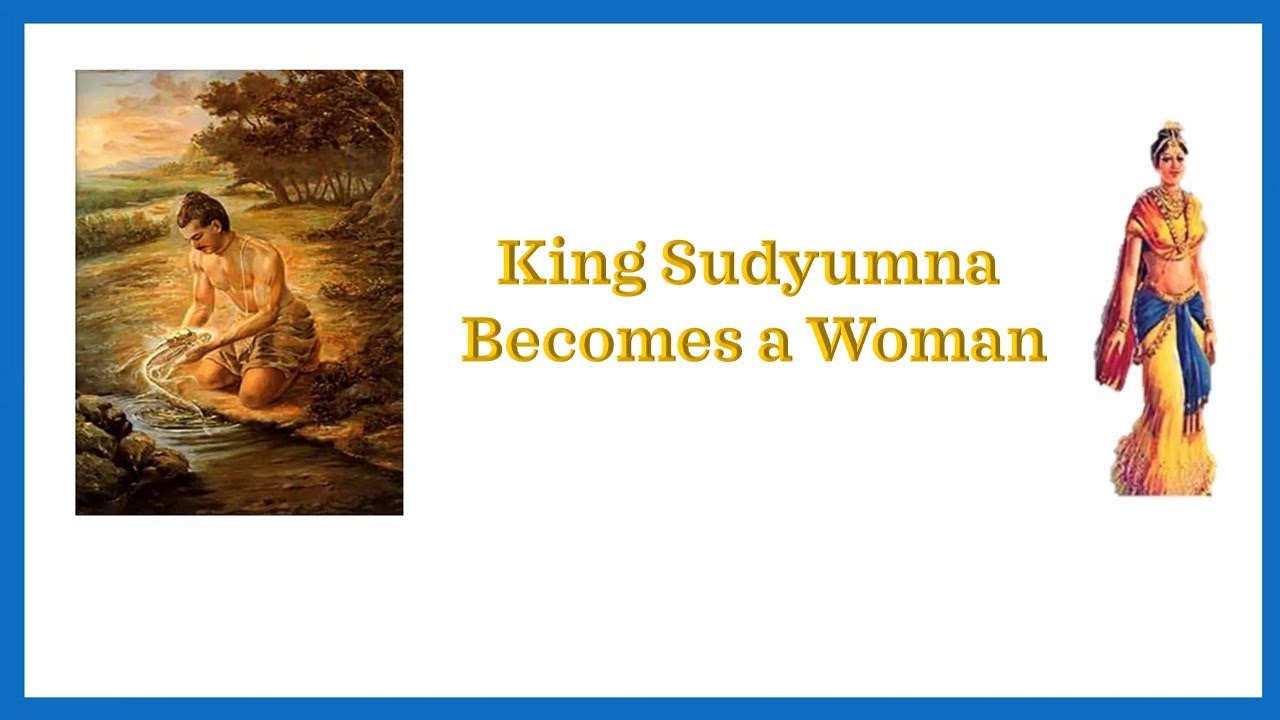
This discrepancy in the ob jective is due to your priest’s deviation from the original purpose. However, by my own prow ess I shall give you a good son. (20) Śukadeva Gosvāmī said: O King Parīkṣit, after the most famous and powerful Vasiṣṭha made this decision, he offered prayers to the Supreme Person, Viṣṇu, to transform Ilā into a male. (21) The Supreme Personality of God head, the supreme controller, being pleased with Vasiṣṭha, gave him the benediction he de sired. Thus Ilā was transformed into a very fine male named Sudyumna. (22)
O King Parīkṣit, that hero Sudyumna, ac companied by a few ministers and associates and riding on a horse brought from Sindhupra deśa, once went into the forest to hunt. He wore armor and was decorated with bows and ar rows, and he was very beautiful. While follow ing the animals and killing them, he reached the northern part of the forest. (23-24) There in the north, at the bottom of Mount Meru, is a forest known as Sukumāra where Lord Śiva always enjoys with Umā. Sudyumna entered that for est. (25) O King Parīkṣit, as soon as Sudyumna, who was expert in subduing ene mies, entered the forest, he saw himself trans formed into a female and his horse transformed into a mare. (26) When his followers also saw their identities transformed and their sex re versed, they were all very morose and just looked at one another. (27)
Mahārāja Parīkṣit said: O most powerful brāhmaṇa, why was this place so empowered, and who made it so powerful? Kindly answer this question, for I am very eager to hear about this. (28) Śukadeva Gosvāmī answered: Great saintly persons who strictly observed the spiritual rules and regulations and whose own effulgence dis sipated all the darkness of all directions once came to see Lord Śiva in that forest. (29) When the goddess Ambikā saw the great saintly per sons, she was very much ashamed because at that time she was naked. She immediately got up from the lap of her husband and tried to cover her breast. (30) Seeing Lord Śiva and Pārvatī engaged in sexual affairs, all the great saintly persons im mediately desisted from going further and de parted for the āśrama of Nara-Nārāyaṇa. (31)
Thereupon, just to please his wife, Lord Śiva said, “Any male entering this place shall imme diately become a female!” (32) Since that time, no male had entered that forest. But now King Sudyumna, having been transformed into a fe male, began to walk with his associates from one forest to another. (33) Sudyumna had been transformed into the best of beautiful women who excite sexual de sire and was surrounded by other women. Upon seeing this beautiful woman loitering near his āśrama, Budha, the son of the moon, immedi ately desired to enjoy her. (34) The beautiful woman also desired to accept Budha, the son of the king of the moon, as her husband. Thus Budha begot in her womb a son named Purūravā. (35) I heard from reliable sources that King Sudyumna, the son of Manu, having thus achieved femininity, remembered his fa milial spiritual master, Vasiṣṭha. (36)
Upon seeing Sudyumna’s deplorable condi tion, Vasiṣṭha was very much aggrieved. Desir ing for Sudyumna to regain his maleness, Va siṣṭha again began to worship Lord Śaṅkara [Śiva]. (37) O King Parīkṣit, Lord Śiva was pleased with Vasiṣṭha. Therefore, to satisfy him and to keep his own word to Pārvatī, Lord Śiva said to that saintly person, “Your disciple Sudyumna may remain a male for one month and a female for the next. In this way he may rule the world as he likes.” (38-39) Thus being favored by the spiritual master, according to the words of Lord Śiva, Sudyumna regained his desired maleness every alternate month and in this way ruled the kingdom, alt hough the citizens were not satisfied with this. (40) O King, Sudyumna had three very pious sons, named Utkala, Gaya and Vimala, who be came the kings of the Dakṣiṇā-patha. (41) Thereafter, when the time was ripe, when Sudyumna, the king of the world, was suffi ciently old, he delivered the entire kingdom to his son Purūravā and entered the forest. (42)
Deepen your Bhakti-yoga practice, harmonize relationships, and receive guided coaching — all at Vedavarsity.com