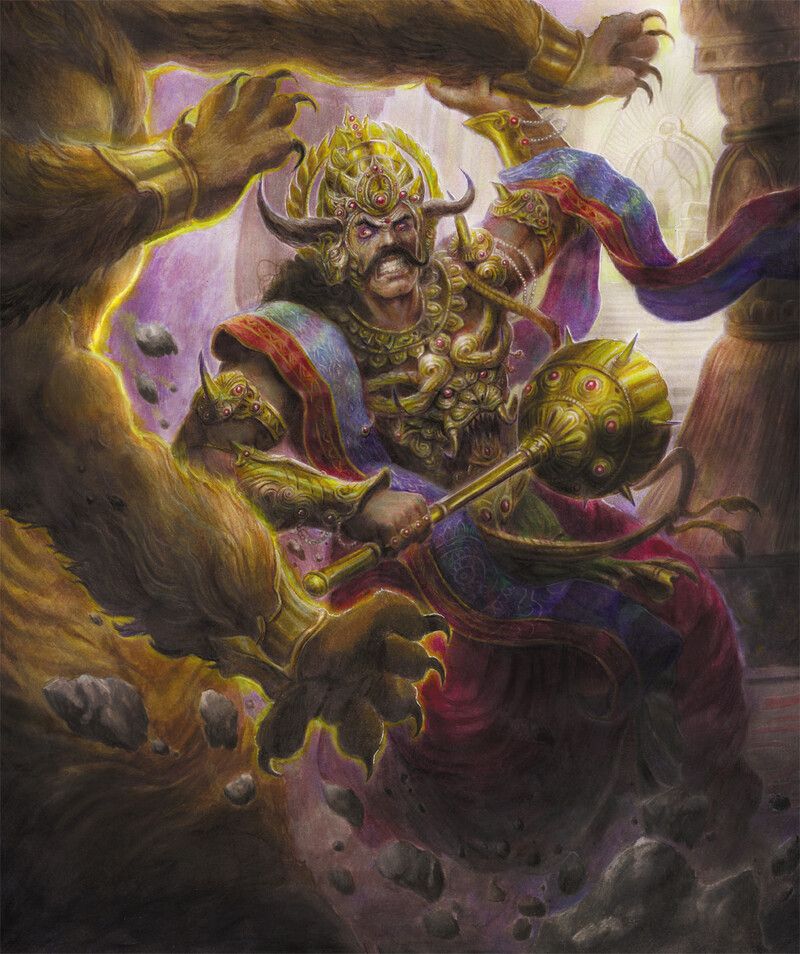
Śrī Nārada Muni said: My dear King Yudhiṣṭhira, when Lord Viṣṇu, in the form of Varāha, the boar, killed Hiraṇyākṣa, Hiraṇyākṣa’s brother Hiraṇyakaśipu was ex tremely angry and began to lament. (1) Filled with rage and biting his lips, Hiraṇyakaśipu gazed at the sky with eyes that blazed in anger, making the whole sky smoky. Thus he began to speak. (2) Exhibiting his terrible teeth, fierce glance and frowning eyebrows, terrible to see, he took up his weapon, a trident, and thus began speaking to his associates, the assembled de mons. (3) O Dānavas and Daityas! O Dvimūrdha, Tryakṣa, Śambara and Śatabāhu! O Hayagrīva, Namuci, Pāka and Ilvala! O Vipracitti, Puloman, Śakuna and other demons! All of you, kindly hear me attentively and then act according to my words without delay. (4 5)
My insignificant enemies the demigods have combined to kill my very dear and obedient well-wisher, my brother Hiraṇyākṣa. Although the Supreme Lord, Viṣṇu, is always equal to both of usnamely, the demigods and the demonsthis time, being devoutly worshiped by the demigods, He has taken their side and helped them kill Hiraṇyākṣa. (6) The Supreme Personality of Godhead has given up His natu ral tendency of equality toward the demons and demigods. Although He is the Supreme Person, now, influenced by māyā, He has assumed the form of a boar to please His devotees, the dem igods, just as a restless child leans toward someone. I shall therefore sever Lord Viṣṇu’s head from His trunk by my trident, and with the profuse blood from His body I shall please my brother Hiraṇyākṣa, who was so fond of suck ing blood. Thus shall I too be peaceful. (7-8)
When the root of a tree is cut and the tree falls down, its branches and twigs automatically dry up. Similarly, when I have killed this diplo matic Viṣṇu, the demigods, for whom Lord Viṣṇu is the life and soul, will lose the source of their life and wither away. (9) While I am engaged in the business of killing Lord Viṣṇu, go down to the planet earth, which is flourish ing due to brahminical culture and a kṣatriya government. These people engage in austerity, sacrifice, Vedic study, regulative vows, and charity. Destroy all the people thus engaged! (10) The basic principle of brahminical culture is to satisfy Lord Viṣṇu, the personification of sacrificial and ritualistic ceremonies. Lord Viṣṇu is the personified reservoir of all reli gious principles, and He is the shelter of all the demigods, the great pitās, and the people in general. When the brāhmaṇas are killed, no one will exist to encourage the kṣatriyas to perform yajñas, and thus the demigods, not being ap peased by yajña, will automatically die. (11)
Immediately go wherever there is good protec tion for the cows and brāhmaṇas and wherever the Vedas are studied in terms of the varṇāśrama principles. Set fire to those places and cut from the roots the trees there, which are the source of life. (12) Thus the demons, being fond of disastrous activities, took Hiraṇyakaśipu’s instructions on their heads with great respect and offered him obeisances. According to his directions, they engaged in envious activities directed against all living beings. (13) The demons set fire to the cities, villages, pasturing grounds, cowpens, gardens, agricultural fields and natu ral forests. They burned the hermitages of the saintly persons, the important mines that pro duced valuable metals, the residential quarters of the agriculturalists, the mountain villages, and the villages of the cow protectors, the cow herd men. They also burned the government capitals. (14)
Some of the demons took digging instruments and broke down the bridges, the protective walls and the gates [gopuras] of the cities. Some took axes and began cutting the important trees that produced mango, jackfruit and other sources of food. Some of the demons took firebrands and set fire to the residential quarters of the citizens. (15) Thus disturbed again and again by the unnatural occurrences caused by the followers of Hiraṇyakaśipu, all the people had to cease the activities of Vedic culture. Not receiving the results of yajña, the demigods also became disturbed. They left their residential quarters in the heavenly plan ets and, unobserved by the demons, began wan dering on the planet earth to see the disasters. (16) After performing the ritualistic observances for the death of his brother, Hiraṇyakaśipu, be ing extremely unhappy, tried to pacify his nephews. (17)
O King, Hiraṇyakaśipu was ex tremely angry, but since he was a great politi cian, he knew how to act according to the time and situation. With sweet words he began pac ifying his nephews, whose names were Śakuni, Śambara, Dhṛṣṭi, Bhūtasantāpana, Vṛka, Kālanābha, Mahānābha, Hariśmaśru and Ut kaca. He also consoled their mother, his sister in-law, Ruṣābhānu, as well as his own mother, Diti. He spoke to them all as follows. (18-19) Hiraṇyakaśipu said: My dear mother, sister in-law and nephews, you should not lament for the death of the great hero, for a hero’s death in front of his enemy is glorious and desirable. (20) My dear mother, in a restaurant or place for drinking cold water, many travelers are brought together, and after drinking water they continue to their respective destinations. Simi larly, living entities join together in a family, and later, as a result of their own actions, they are led apart to their destinations. (21)
The spirit soul, the living entity, has no death, for he is eternal and inexhaustible. Being free from material contamination, he can go anywhere in the material or spiritual worlds. He is fully aware and completely different from the mate rial body, but because of being misled by mis use of his slight independence, he is obliged to accept subtle and gross bodies created by the material energy and thus be subjected to so called material happiness and distress. There fore, no one should lament for the passing of the spirit soul from the body. (22) Because of the movements of the water, the trees on the bank of a river, when reflected on the water, seem to move. Similarly, when the eyes move because of some mental derangement, the land appears to move also. (23)
In the same way, O my gentle mother, when the mind is agitated by the movements of the modes of material nature, the living entity, although freed from all the dif ferent phases of the subtle and gross bodies, thinks that he has changed from one condition to another. (24) In his bewildered state, the liv ing entity, accepting the body and mind to be the self, considers some people to be his kins men and others to be outsiders. Because of this misconception, he suffers. Indeed, the accumu lation of such concocted material ideas is the cause of suffering and so-called happiness in the material world. The conditioned soul thus situated must take birth in different species and work in various types of consciousness, thus creating new bodies. This continued material life is called saṁsāra. Birth, death, lamentation, foolishness and anxiety are due to such material considerations. Thus we sometimes come to a proper understanding and sometimes fall again to a wrong conception of life. (25-26)
In this regard, an example is given from an old history. This involves a discourse between Yamarāja and the friends of a dead person. Please hear it attentively. (27) In the state known as Uśīnara there was a celebrated king named Suyajña. When the King was killed in battle by his enemies, his kinsmen sat down around the dead body and began to lament the death of their friend. (28) His golden, bejeweled armor smashed, his orna ments and garlands fallen from their places, his hair scattered and his eyes lusterless, the slain King lay on the battlefield, his entire body smeared with blood, his heart pierced by the ar rows of the enemy. When he died he had wanted to show his prowess, and thus he had bitten his lips, and his teeth remained in that po sition. His beautiful lotuslike face was now black and covered with dust from the battle field. His arms, with his sword and other weap ons, were cut and broken. When the queens of the King of Uśīnara saw their husband lying in that position, they began crying, “O lord, now that you have been killed, we also have been killed.” Repeating these words again and again, they fell down, pounding their breasts, at the feet of the dead King. (29-31)
As the queens loudly cried, their tears glided down their breasts, becoming reddened by kuṅkuma powder, and fell upon the lotus feet of their husband. Their hair became disarrayed, their ornaments fell, and in a way that evoked sympathy from the hearts of others, the queens began lamenting their husband’s death. (32) O lord, you have now been removed by cruel providence to a state beyond our sight. You had previously sustained the livelihood of the in habitants of Uśīnara, and thus they were happy, but your condition now is the cause of their un happiness. (33) O King, O hero, you were a very grateful husband and the most sincere friend of all of us. How shall we exist without you? O hero, wherever you are going, please direct us there so that we may follow in your footsteps and engage again in your service. Let us go along with you! (34) The time was ap propriate for the body to be burned, but the queens, not allowing it to be taken away, con tinued lamenting for the dead body, which they kept on their laps. In the meantime, the sun completed its movements for setting in the west. (35)
While the queens were lamenting for the dead body of the King, their loud cries were heard even from the abode of Yamarāja. Assuming the body of a boy, Yamarāja person ally approached the relatives of the dead body and advised them as follows. (36) Śrī Yamarāja said: Alas, how amazing it is! These persons, who are older than me, have full experience that hundreds and thousands of liv ing entities have taken birth and died. Thus they should understand that they also are apt to die, yet still they are bewildered. The conditioned soul comes from an unknown place and returns after death to that same unknown place. There is no exception to this rule, which is conducted by material nature. Knowing this, why do they uselessly lament? (37)
It is wonderful that these elderly women do not have a higher sense of life than we do. Indeed, we are most fortu nate, for although we are children and have been left to struggle in material life, unpro tected by father and mother, and although we are very weak, we have not been vanquished or eaten by ferocious animals. Thus we have a firm belief that the Supreme Personality of Godhead, who has given us protection even in the womb of the mother, will protect us every where. (38) The boy addressed the women: O weak women! Only by the will of the Supreme Personality of Godhead, who is never dimin ished, is the entire world created, maintained and again annihilated. This is the verdict of the Vedic knowledge. This material creation, con sisting of the moving and nonmoving, is ex actly like His plaything. Being the Supreme Lord, He is completely competent to destroy and protect. (39)
Sometimes one loses his money on a public street, where everyone can see it, and yet his money is protected by destiny and not seen by others. Thus the man who lost it gets it back. On the other hand, if the Lord does not give protection, even money main tained very securely at home is lost. If the Su preme Lord gives one protection, even though one has no protector and is in the jungle, one remains alive, whereas a person well protected at home by relatives and others sometimes dies, no one being able to protect him. (40) Every conditioned soul receives a different type of body according to his work, and when the engagement is finished the body is finished. Although the spirit soul is situated in subtle and gross material bodies in different forms of life, he is not bound by them, for he is always un derstood to be completely different from the manifested body. (41)
Just as a householder, although different from the identity of his house, thinks his house to be identical with him, so the conditioned soul, due to ignorance, ac cepts the body to be himself, although the body is actually different from the soul. This body is obtained through a combination of portions of earth, water and fire, and when the earth, water and fire are transformed in the course of time, the body is vanquished. The soul has nothing to do with this creation and dissolution of the body. (42) As fire, although situated in wood, is perceived to be different from the wood, as air, although situated within the mouth and nos trils, is perceived to be separate, and as the sky, although all-pervading, never mixes with any thing, so the living entity, although now en caged within the material body, of which it is the source, is separate from it. (43)
Yamarāja continued: O lamenters, you are all fools! The person named Suyajña, for whom you lament, is still lying before you and has not gone anywhere. Then what is the cause for your lamentation? Previously he heard you and re plied to you, but now, not finding him, you are lamenting. This is contradictory behavior, for you have never actually seen the person within the body who heard you and replied. There is no need for your lamentation, for the body you have always seen is lying here. (44) In the body the most important substance is the life air, but that also is neither the listener nor the speaker. Beyond even the life air, the soul also can do nothing, for the Supersoul is actually the direc tor, in cooperation with the individual soul. The Supersoul conducting the activities of the body is different from the body and living force. (45) The five material elements, the ten senses and the mind all combine to form the various parts of the gross and subtle bodies. The living entity comes in contact with his material bodies, whether high or low, and later gives them up by his personal prowess. This strength can be per ceived in a living entity’s personal power to possess different types of bodies. (46)
As long as the spirit soul is covered by the subtle body, consisting of the mind, intelligence and false ego, he is bound to the results of his fruitive ac tivities. Because of this covering, the spirit soul is connected with the material energy and must accordingly suffer material conditions and re versals, continually, life after life. (47) It is fruitless to see and talk of the material modes of nature and their resultant so-called happiness and distress as if they were factual. When the mind wanders during the day and a man begins to think himself extremely important, or when he dreams at night and sees a beautiful woman enjoying with him, these are merely false dreams. Similarly, the happiness and distress caused by the material senses should be under stood to be meaningless. (48)
Those who have full knowledge of self-realization, who know very well that the spirit soul is eternal whereas the body is perishable, are not overwhelmed by lamentation. But persons who lack knowledge of self-realization certainly lament. Therefore it is difficult to educate a person in illusion. (49) There was once a hunter who lured birds with food and captured them after spreading a net. He lived as if appointed by death personi fied as the killer of the birds. (50) While wan dering in the forest, the hunter saw a pair of kuliṅga birds. Of the two, the female was cap tivated by the hunter’s lure. (51) O queens of Suyajña, the male kuliṅga bird, seeing his wife put into the greatest danger in the grip of Prov idence, became very unhappy. Because of af fection, the poor bird, being unable to release her, began to lament for his wife. (52) Alas, how merciless is Providence! My wife, unable to be helped by anyone, is in such an awkward position and lamenting for me. What will Prov idence gain by taking away this poor bird? What will be the profit? (53)
If unkind Provi dence takes away my wife, who is half my body, why should He not take me also? What is the use of my living with half of my body, be reaved by loss of my wife? What shall I gain in this way? (54) The unfortunate baby birds, be reft of their mother, are waiting in the nest for her to feed them. They are still very small and have not yet grown their wings. How shall I be able to maintain them? (55) Because of the loss of his wife, the kuliṅga bird lamented with tears in his eyes. Meanwhile, following the dicta tions of mature time, the hunter, who was very carefully hidden in the distance, released his ar row, which pierced the body of the kuliṅga bird and killed him. (56) Thus Yamarāja, in the guise of a small boy, told all the queens: You are all so foolish that you lament but do not see your own death. Afflicted by a poor fund of knowledge, you do not know that even if you lament for your dead husband for hundreds of years, you will never get him back alive, and in the meantime your lives will be finished. (57)
Hiraṇyakaśipu said: While Yamarāja, in the form of a small boy, was instructing all the rel atives surrounding the dead body of Suyajña, everyone was struck with wonder by his philo sophical words. They could understand that everything material is temporary, not continu ing to exist. (58) After instructing all the fool ish relatives of Suyajña, Yamarāja, in the form of a boy, disappeared from their vision. Then the relatives of King Suyajña performed the rit ualistic funeral ceremonies. (59) Therefore none of you should be aggrieved for the loss of the bodywhether your own or those of others. Only in ignorance does one make bodily dis tinctions, thinking “Who am I? Who are the others? What is mine? What is for others?” (60) Śrī Nārada Muni continued: Diti, the mother of Hiraṇyakaśipu and Hiraṇyākṣa, heard the in structions of Hiraṇyakaśipu along with her daughter-in-law, Ruṣābhānu, Hiraṇyākṣa’s wife. She then forgot her grief over her son’s death and thus engaged her mind and attention in understanding the real philosophy of life. (61)
Deepen your Bhakti-yoga practice, harmonize relationships, and receive guided coaching — all at Vedavarsity.com