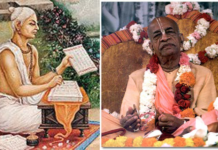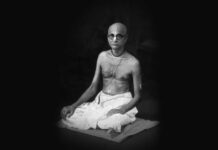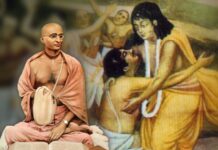



In the sub-division of Ukhḍa , within 20 miles of Śrīdhāma Māyāpura, the appearance place of Śrī Nadīyā-canda, near to where the founder of the Kartābhajā movement, Aula-canda, was found as a child by Mahadeva Barui, one very dynamic personality on the path of bhakti appeared at that place to dispel all sorts of delusional misconceptions, in order to drive the human intellect engrossed in worldly knowledge towards the path of the highest spiritual truth, and again propagate the flow of pure bhakti initiated by Śrī Māyāpura-candra all over the world.
A few years after his appearance, Ulanagar became depopulated due to an epidemic. Based on the severe effect of that epidemic, that nitya-siddha litterateur, who appeared in Ulagram, composed an epic poem named Vijana-grāma (‘The Empty Village’) in the amitrākṣara metre* for the very first time in the Bengali language. The period in which he composed it was 1863 of the Christian era.
*This is known as blank verse in English.
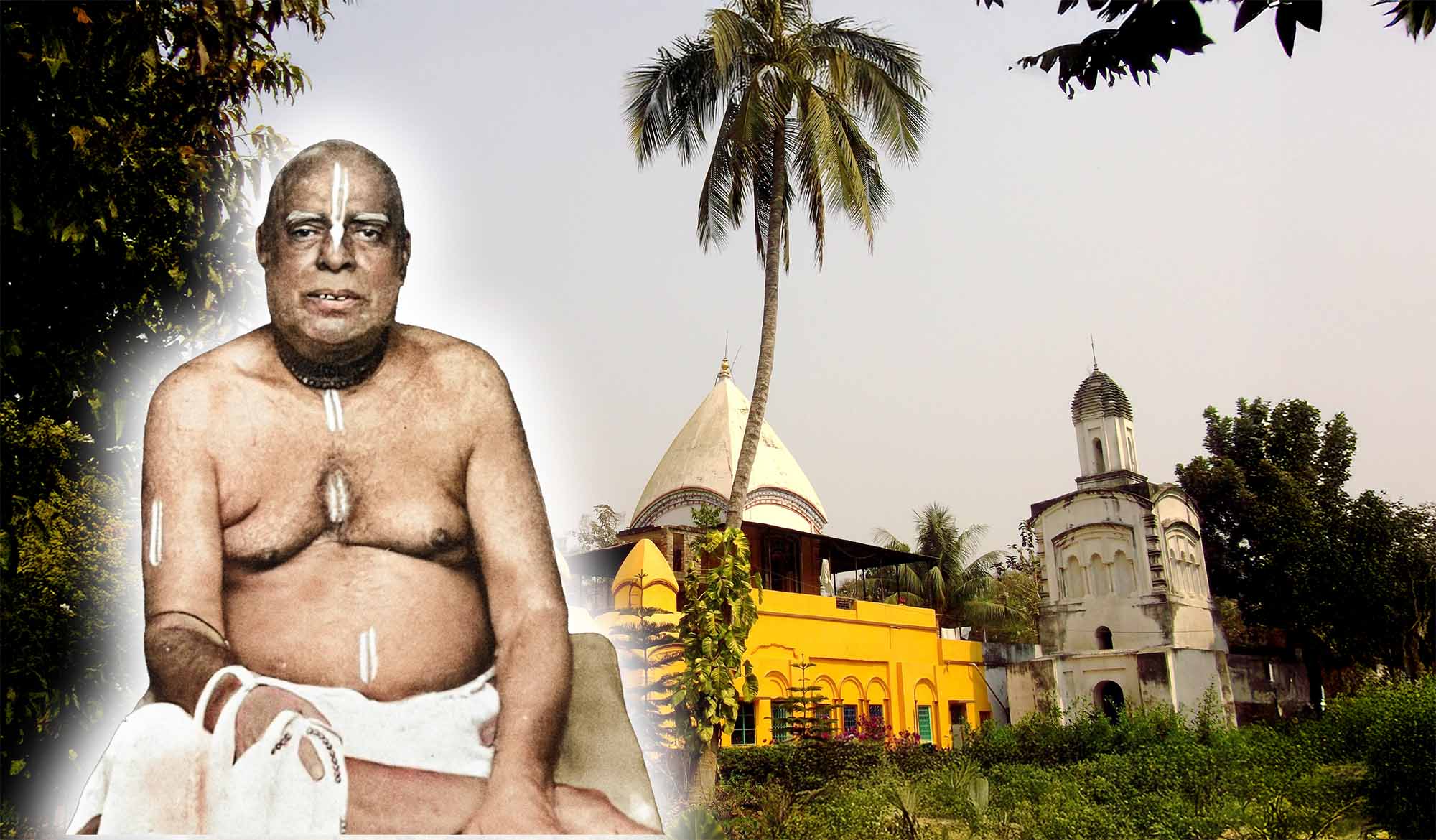
This Ulagram is in the sub-division of Ukhḍa, within the district of Nadīyā. From Calcutta, it’s distance is 51 miles. Immediately after the Ranaghat station on the Murshidabad line of East Bengal Railway is Birnagar Station, which is merely the new name of the well-known and ancient Ulagram. The specific site within this city where Bhaktivinoda Thakura appeared, the house in which he was born, still stands and sings songs of its past glories.
A little more than three hundred and fifty years has passed from the time when the revealers of Śrī Nadīyā – Śrī Māyāpura-candra and His associates – manifested Their own audārya-līlā (pastimes of magnanimity) in order to demonstrate progressive service which is contrary to the enjoying mentality of the jīvas contaminated by the filth of Kali. In 352 Gaurābda, 1760 Śakābda, 1895 Samvat, 1245 Baṅgābda, * on 2nd September, 1838 of the Christian era, and on the thirteenth lunar day on the 18th of the month of Bhādra of the Bengali calendar, one great personality who was three and a half hands length in height (approx. 5 foot, 3 inches), who was a supremely dear personal associate of Śrī Śrī Māyāpura-candra, appeared.
* There are various calendars used in India. Gaurābda is counted from the time of Mahāprabhu’s appearance. Śakābda is a luni-solar calendar introduced by Mahārāja Śalivāhana who defeated the Śaka tribe. Samvat is the ancient calendar introduced by Mahārāja Vikramāditya. Baṅgābda is the traditional Bengali calendar, aligned with Emperor Akbar’s revenue reforms in the 16th century.
In order to expand His own mahā-vadānya-līlā (pastimes of supreme magnanimity), Puruṣottama – the bestower of auspiciousness to the world and possessor of infinite potencies – revealed the example of attaining bliss through eternal, transcendental knowledge while traversing the path of pure bhakti. Yet, as His mutually contending potencies gradually unfolded, the jīvas of this world became fearful that the cooling rays of the spotless religion of prema might grow faint and become eclipsed by the ocean of impurity. To once again uncover those pure, soothing, and beautiful sun-rays of prema, His intimate associate – that exalted soul devoted to the service of Puruṣottama – appeared in this world as the āśraya-vigraha of the viṣaya, Śrī Caitanya-candra.*
*Here, viṣaya refers to the Supreme Lord, and the āśraya refers to His devotee.
When he came, people perceived by their external vision that he had appeared in a family of pañcopāsakas. In actuality, a worshipper had appeared in the house of pañcopāsakas who was far beyond the material world. A weak-hearted man, overwhelmed by material enjoyment, depending on his own strength, roams the land of karma and assumes the responsibility of various kinds of virtuous and non-virtuous deeds. Yet if some potency of Bhagavān or bhagavat-prakāśa-tattva (that principle which reveals Bhagavān) appears in the world as the ideal of the pure jīvātmā’s nature and function, then alone can the welfare of the world be accomplished.
* Pañcopāsakas refers to the Smārtas who worship the impersonal Brahman in the form of five deities – Viṣṇu, Śiva, Durgā, Sūrya and Gaṇeśa.
The unsteady mind repeatedly engages the bound jīva in topics other than Kṛṣṇa, giving indulgence to reckless behaviour. It could never be that in the land of pious activities, beyond the sphere of Brahma-vārta, upon the eastern hills of Āryāvarta, within the sky of Gauḍa, some ideal star, free from selfish karma and jñāna, should arise – such was the delusion to be dispelled. For the purpose of making an unblessed land blessed, of sanctifying an unsanctified soil, of transforming the age of Kali into a pure Satya-yuga, for removing all inauspiciousness from the world and inviting auspiciousness – for this cause, the appearance of the Moon of Gauḍa and His constellation of attendant-stars was, in fact, the rightful claim of those very inhabitants of that unfortunate land, who were unworthy, impious people.
In Gauḍa-deśa, flooded by Tantras in the mode of ignorance, where the darkness resounded with the shrill ballads of Yogī Pāla and Bhogī-Pālas, and with the folk-songs of Maṅgala-Caṇḍī and Viṣahari’s cricket-like commotion* – there, the effulgent light of the divine proclamation from Śrī Hari’s own holy lips, ‘kīrtanīyaḥ sadā Hariḥ’ (‘the Name of Hari is to be constantly chanted’), completely dispelled that mass of gloom.
* Yogī Pāla (also known as Chowranginath) was a prince of the Pāla Dynasty of Bengal, who gave up his royal lifestyle and became a tantrika yogī. Less is known about Bhogī Pāla. Maṅgala-Caṇḍī is a goddess worshipped in rural Bengal; Viṣahari is another name for Manasā Devī, the snake goddess, who removes the effects of snake bites.
In that land at that time, among those very assemblies of the heroes of karma where practices such as bhūta-siddhi (control over spirits), vaśīkaraṇa (enchantments), pañca-pakṣi-sādhana (omens based upon five specific birds), and pañca-deva-vāhana (invoking the five deities) etc, were powerful – to those very people there, the appearance of one supremely transcendental embodiment of all-auspiciousness was nothing other than a sign of Bhagavān’s amandodaya-dayā (strong and progressive mercy).
After the concealment of Śrī Gaurasundara’s prema-līlā, Ācārya Śrīnivasa, Ṭhākura Narottama, and Prabhu Śyāmānanda became the divine triad for showering that prema upon the world. They infused the waters of śravaṇa and kīrtana drawn from the ambrosial ocean of bhakti-rasa into the heart-fields of those driven by selfish desires, karma, and dry jñāna. Due to many years of draught and scanty rainfall, the desert-like heart of the jīva had become incapable for the sprout of prema to emerge.
Hence, no one can deny the necessity of proper arrangements for delivering the cultivators of ulterior desires from the overwhelming power of time. The expectation of the rise of prema can be considered as timely, as the accompanying medicine for all sorts of diseases such as indulgence in intoxicants, the restless efforts of morally bewildered hearts, intense thirst for argument, and the craving for unlawful material advancement. At that time, the Supreme Person, who is the Reality of truth, knowledge, and unlimited bliss, sanctioned the service regulations in this world established by Saccidānanda, the servant of Puruṣottama. Instead of flowing in hundreds of streams, the threefold flow of Srinivāsa etc., being felicitated by the favourable service-flow to the Six Gosvāmīs while travelling to the confluence of the sea which is the abode of all nectarean rasas, instead faced obstacles such as dryness scarcity etc along the way.
At this time, from the devotional ocean of nectarean rasa, the kṛpā-śakti (mercy-potency) of Śrī Navadvīpa-candra, who is a rising ocean of strong and progressive mercy, once again caused the current of the Bhāgīrathī of pure bhakti to flow, thereby rejuvenating the wish-fulfilling tree of auspiciousness. In the midst of dense darkness, even two bright stars are incapable of fully expanding their powerful influence. After the light of the sun disappears in the western sky, the constellation of stars help the viewers by dispelling the darkness of night. Even at twilight, for some time, light and shadow continue to give the traveller a little assistance to a certain extent. Once again, with the arrival of the lord of night (the moon), the mind of the jīva becomes joyful with hope.
Far be it from seeking eternal life, the jīvas, intoxicated by the commotion arising out of karma, in their thirst for peace, desire to enter into the dense darkness of Kevalādvaitavāda (absolute monism) – that is itself a deviation. When there is a scarcity of persons to give caution against such deviation, then the majority of society becomes afflicted by various conflicting opinions.
When all the jīvas, who are scorched by distress, hear the loud declaration of those philosophers who claim that there is no distinction in the self, one’s race, or that of others, they then pursue the search for kaivalya (oneness) in order to find the akāśa-puṣpa of imaginary peace.* At that time, the humble, quiet voice of the guileless devotee engaged in bhajana announces the futility of the shrill tones of the followers of Kevalādvaitavāda – that voice becomes favourable to the attainment of the most auspicious fruits of the wish-fulfilling tree of auspiciousness.
* The phrase akāśa-puṣpa (sky-flower) is a common analogy used in Indian philosophy to denote something which is illusory. The sky does not produce flowers, therefore, anything that is referred to as an akāśa-puṣpa suggests that it is a misconception not based in reality.
The jīva has the aptitude to receive suffering in the thorny field of bhoga (enjoyment) and tyāga (renunciation) at every moment. Reasoning possessed of carelessness and short-sighted vision is incapable of bestowing ultimate auspiciousness. For this reason, we must take constant support by considering bhakti which is under the guidance of the aśraya (Śrī Guru). As the medicine suited to the disease, the bhakti-latā (creeper of devotion) that originated in Vṛndāvana was revealed in the Eastern region. However, the worshippable forms of the Lord that signify the principles of sambandha, abhidheya and prayojana, attract the sincere souls. They alone can progress in accepting that truth which is nirasta-kuhaka (without deceit). This itself is called sukṛti. Those travellers who regard karma, yoga, jñāna, tapasya, etc. as the true path, become anxious upon losing their way and go astray – for them alone there is the necessity of an honest guide. Śrī Caitanya-candra, encouraging those who had taken shelter of Him, and constructed the road of bhakti, leading from the entanglement of worldly existence toward the transcendental path. Yet, since that path was also inaccessible and filled with thorns, fear arose, and the travellers on the path of life encountered dangers and obstacles in many places. Through the simple and direct path of bhakti, the supreme joy attainable establishes the prayojana-tattva. Yet, there was an absence of an exemplary life to make this known. To what extent Ṭhākura Bhaktivinoda has fulfilled all those deficiencies is to be observed with the awakening of pure knowledge.
Ṭhākura Bhaktivinoda has shown the purpose of the conscious and unconscious worlds in relation to Kṛṣṇa. Service to Bhagavān is the only abhidheya, and that the desire for material enjoyment is an obstacle to it – he preserved these teachings through the propagation of proper conduct. Peace, enjoyment, and bliss – all culminate in supreme peace and true kṛṣṇa-bhakti. By revealing this, he has pointed out prayojana-tattva. When one considers the greatness of those who glorify or discuss other subject matters, it becomes clear that relying upon the greatness of those who cannot direct us to that strong and progressive mercy of the Lord, is not at all necessary for those who seek auspiciousness.
Ṭhākura Bhaktivinoda’s compassion, through his conduct and propagation, serves to demonstrate the unparalleled nature of the manner in which Śrī Gaurasundara and His own pure devotees distributed mercy; it is the subject of hearing, chanting, and remembering during the time of His annual appearance.
The śāstra says that by rejecting bad association and establishing oneself in good association, one can become free from the influence of inauspiciousness through hearing, chanting, and remembering. If we advance by taking shelter of Bhagavān and His own associates by cultivating the threefold process of hearing, chanting, and remembering, then only we will surely become an object worthy of the eternal mercy of Jagannātha, the Supreme Protector. May He, who bestows boundless mercy to protect us from sinking in this ocean of material existence, and who is the knower of the principles of sambandha, abhidheya, and prayojana – in other words, that wise one possessing knowledge of subjugation and liberation – may he guide us like the Pole Star on the path of life.
Deepen your Bhakti-yoga practice, harmonize relationships, and receive guided coaching — all at Vedavarsity.com