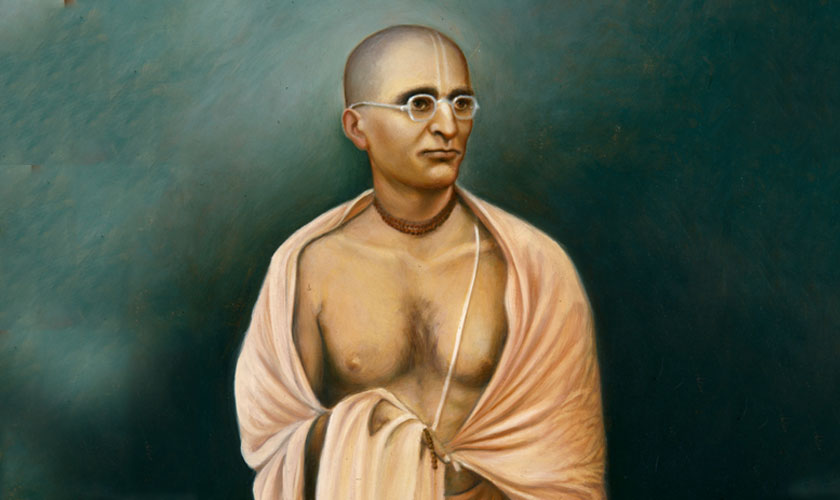
Srila Bhaktisiddhanta Sarasvati Gosvami Maharaja was one of ten children born to Bhaktivinoda Thakura, a great Vaisnava teacher in the disciplic succession from Lord Caitanya Himself. While residing at Narayana Chata near the temple of Lord Jagannatha in Puri, Bhaktivinoda Thakura served as a Deputy Magistrate and superintendent of the Jagannatha temple. Despite his official responsibilities, he energetically advanced the cause of Krsna consciousness. Praying to Lord Caitanya for assistance in preaching, he requested a son to continue his mission.
On February 6, 1874, Bhaktisiddhanta Sarasvati was born to Bhaktivinoda Thakura and Bhagavati Devi in Jagannatha Puri. Born with the umbilical cord wrapped around his neck and draped across his chest like a sacred thread, he was considered the answer to his father’s prayers. At six months, he underwent the annaprasana ceremony and was named Bimala Prasada. Soon after, during the Jagannatha festival, the infant spontaneously touched the feet of Lord Jagannatha and was blessed with a garland falling from the Deity, signifying his future as a great devotee.
Bimala Prasada spent his early infancy in Puri and then in Nadia District, Ranaghat, where he absorbed devotional knowledge from his mother. Raised in a strict Vaisnava family, he refrained from eating unoffered food. At the age of four, after a minor incident involving a mango not offered to Krsna, he vowed never to eat mangoes unoffered, a vow he maintained throughout his life. By age seven, he had memorized the Bhagavad-gita and could explain its verses. His father trained him in proofreading and printing for the publication of Sajjana-tosani.
In 1881, during the construction of Bhakti Bhavana at Rambagan, Calcutta, a deity of Kurmadeva was unearthed, and young Bimala Prasada was entrusted with its service. In 1884, his father was appointed senior Deputy Magistrate of Serampore, where Bimala entered Serampore High School. He excelled in writing, inventing the Bicanto script, and studied mathematics and astrology under Pandita Mahesacandra Cudamoni, though his primary interest remained devotional literature.
By 1892, Bimala entered the Sanskrit College of Calcutta, studying philosophy, Vedas under Prithvidhara Sarma, and contributing articles to religious journals. Later, he established an autonomous Catuspathi, publishing journals such as Jyotirvid and Vrihaspati, and by age twenty-five, he was recognized as Siddhanta Sarasvati for his expertise in Sanskrit, mathematics, and astronomy.
In 1895, he served as editor for Rajaratnakara, the history of the Tripura royal family, and educated the Yuvaraja and princes. Observing corruption in state affairs, he renounced worldly employment after three years, maintaining only spiritual pursuits. From 1898, he accompanied his father on pilgrimages to Kasi, Prayag, and Gaya, discussing philosophical topics with learned scholars and increasing his inclination toward renunciation.
At age twenty-six, following his father’s guidance, he sought initiation from Gaurakisora dasa Babaji, a renounced Vaisnava known for strict detachment and austerity. After persistent requests and demonstrating devotion, Bimala received diksa from Gaurakisora Babaji, who instructed him to preach the Absolute Truth and set aside all other work.
In 1900, he accompanied his father on pilgrimages to Balasore, Remuna, Bhuvanesvar, and Puri, lecturing on the Caitanya-caritamrta. Through his father’s efforts, the current of pure bhakti began to flow again, reversing the darkness after Lord Caitanya’s disappearance. Siddhanta Sarasvati contributed to the revival of suddha-bhakti siddhanta, writing numerous books and periodicals, and establishing Namahatta and Prapannasrama centers.
In 1905, he took a vow to chant the Hare Krsna mantra one billion times, residing in Mayapur in a grass hut, performing austerities and chanting day and night. In 1912, he attended a Vaisnava Sammilani in Cossimbazar, preaching suddha-bhakti to learned persons while fasting due to the presence of non-Vaisnava sectarians.
During this period, he opposed prakrita Sahajiya sects misrepresenting Vaisnavism, firmly disassociating from deviated practices and performing bhajana in solitude. Once, Lord Caitanya and the six Gosvamis appeared in vision, instructing him to re-establish Varnasrama and propagate devotional love.
In 1911, he defended the principle that anyone, regardless of birth, can become a Vaisnava, conclusively proving through scripture that qualities, not birth, determine brahminical status. After his father’s disappearance in 1916, and following the instructions of his parents, he continued preaching and editing Sajjana-tosani, establishing the Bhagwat Press in Krishnanagar.
In 1918, he assumed sannyasa at Mayapur, taking the name Bhaktisiddhanta Sarasvati Gosvami Maharaja. He utilized the printing press as a “brhat mrdanga,” disseminating Krsna consciousness worldwide. He established sixty-four Suddha Bhakti Mathas across India and abroad, and initiated twenty-five learned disciples into Tridandi sannyasa.
He published numerous periodicals, including:
- Sajjanatosani (Bengali fortnightly)
- The Harmonist (English fortnightly)
- Gaudiya (Bengali weekly)
- Bhagavata (Hindi fortnightly)
- Nadiya Prakasa (Bengali daily)
- Kirtana (Assamese monthly)
- Paramarthi (Odiya monthly)
A few days before his departure, he instructed his disciples: “Preach the message of Rupa Raghunatha, remain humble and tolerant, glorify Hari constantly, and never abandon bhajana even amidst dangers, insults, or persecutions.”
In the early hours of January 1, 1937, Srila Bhaktisiddhanta Sarasvati Gosvami Maharaja passed away, leaving a worldwide movement dedicated to the service of Lord Caitanya and pure devotional principles.
Deepen your Bhakti-yoga practice, harmonize relationships, and receive guided coaching — all at Vedavarsity.com