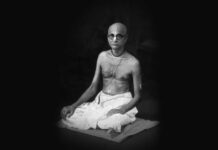
Śrī Haribolananda Ṭhākura, a most exalted Vaiṣṇava saint, appeared on the sacred day of Janmāṣṭamī in the village of Ganganandapur, near Jhikargacha railway station in the district of Jessore (now in Bangladesh). This village is situated close to Śrīpata Vodhakhana. Before his initiation, his name was Navīncandra Bhaṭṭācārya. His younger brother was Benimādhava Bhaṭṭācārya.
Navīncandra remained in household life until the age of forty, earning his livelihood as a teacher in a small rural school. From early childhood, he displayed exemplary qualities of impartiality, truthfulness, self-control, simplicity, and gentle demeanor. At the age of forty, on the pretext of a minor dispute over family property, Navīncandra renounced home and went to Kāligāṭa in Calcutta. There, offering repeated prostrated obeisances before Goddess Kālī, he earnestly prayed for divine guidance. In due course, he received a divine command to travel throughout India on foot, visiting all the holy places.
Thus, without money or possessions, Navīncandra left home and began his pilgrimage solely by walking. For several years, he traveled all over India, day and night, visiting innumerable tīrthas. Yet, despite his rigorous journey, he felt no true spiritual fulfillment. Returning at last to Kāligāṭa, he once again submitted himself before the goddess. It is said that the Divine Mother personally appeared before him and instructed: “My child, in this age of Kali, the holy name of Hari is the supreme essence and final truth. Therefore, go forth, incessantly chanting ‘Haribol,’ and distribute this name freely among all, without discrimination. Beg everyone you meet to chant the holy name of Hari.”
Receiving this divine instruction, Navīncandra began uninterruptedly chanting the Haribol-nāma. Residing in Bāgbāzār (North Calcutta), he daily walked on foot to Kāligāṭa (South Calcutta), chanting “Haribol, Haribol” to everyone he met. He would grasp each person’s feet and not release them until that person, in response, uttered “Haribol.”
On one occasion, while walking along Chowringhee Road, he fell at the feet of an English gentleman and began chanting “Haribol.” Mistaking him for a beggar, the Englishman offered some coins, but Navīncandra continued to hold his feet. Taking him to be insane, the Englishman struck him with a whip, causing his back to bleed. Yet, even under suffering, Navīncandra did not release his hold but kept chanting “Haribol.” A crowd gathered, perplexed by the scene. At last, a Bengali gentleman explained to the Englishman that Navīncandra sought not money but only that he should utter the name of God. The Englishman, realizing his mistake, knelt down, apologized, and chanted the Lord’s name in English. Only then did Navīncandra release his feet.
From that day until the end of his life, he went about chanting “Haribol,” falling at the feet of whomever he met—young or old, of any caste, creed, or faith. He even added “Haribol” to the names of ordinary objects—bhāṭa-Haribol, dāl-Haribol—and would speak nothing unless the word “Haribol” had first been uttered. In this way, he incessantly wandered through the streets and lanes of Calcutta, distributing the holy name. His dress was exceedingly simple: a cloth wrapped around the waist, another across the shoulders, a hat made from discarded leaf cups once used for Lord Jagannātha’s mahāprasāda, a small sling bag upon his shoulder, and a conch shell in his hand. As he moved about chanting “Haribol,” he would blow the conch in such a way that its sound mingled harmoniously with his chanting, evoking great spiritual ecstasy in all who heard. Sometimes the sound of his conch seemed like a human voice calling “Haribol.” For this reason, he became widely known as Śrī Haribolananda Ṭhākura.
Many people in Calcutta were drawn by his extraordinary spiritual influence. One such person, Śrī Kṣetranātha Mallik of Rādhānātha Mallik Lane near College Square, became his devoted disciple. Śrī Haribolananda Ṭhākura would name his disciples after the intimate associates (parṣadas) of Lord Caitanya Mahāprabhu—such as Nityānanda, Rāmānanda, Śrīvāsa, and Gadādhara—infusing in each the divine disposition associated with that personality. Yet he never gave the names of Lord Gaurāṅga or Advaita Prabhu to any disciple. Each disciple incessantly chanted “Haribol,” and, following the example of their guru, would greet every person by falling at their feet and offering humble obeisances. Most of his disciples came from humble communities—blacksmiths, potters, washermen, and scavengers—showing his disregard for caste distinction; only a few were from higher castes.
During a great plague epidemic in Calcutta, Śrī Haribolananda Ṭhākura, along with Śrī Kṣetra Mallik, organized extensive saṅkīrtana throughout the city. Groups of devotees performed harināma-saṅkīrtana day and night, even traveling in tramcars while singing the Lord’s holy names. The respected Vaiṣṇava saint Śrī Rāmdāsa Bābājī witnessed this divine event and later testified that the entire city became surcharged with nāma-saṅkīrtana. Christians, in reverence, removed their hats and knelt on the ground as the kīrtana parties passed by; Muslims respectfully covered their necks and invited the devotees into their mosques, even joining them in glorifying the Lord in their own way. It appeared as though the divine Mahāsaṅkīrtana-līlā of Lord Caitanya had once again descended upon the earth. Śrī Haribolananda Ṭhākura was among the foremost pioneers of this glorious movement.
Once, Śrī Haribolananda learned that Kṣetra Mallik had fallen sick with the plague and was near death. The Ṭhākura hurried to his bedside and, seeing his condition, went to Kāligāṭa to fetch water sanctified by the sword of Goddess Kālī. He instructed the attendants to have Kṣetra Mallik drink the sanctified water and then said: “The patient will fall asleep. After he awakens, feed him with whatever food he desires.” Kṣetra Mallik soon fell into deep sleep, not having rested for many days. After several hours, he awoke and, regaining strength, asked for rice and mūṅg-dāl. After partaking, he completely recovered. This miracle brought much public attention to Śrī Haribolananda, who, desiring to avoid fame, departed for Kāśī and established his bhajana-kuṭīra at Gaṇeśa-mahalla on the banks of Brahmakunda.
While residing in Calcutta, he once helped enlarge the garden property of a house owner by directing his disciples to bring earth from the Gaṅgā, constantly chanting nāma as they labored. One evening, a disciple, hungry after a full day’s work, begged the Ṭhākura for some food. In mock anger, Haribolananda mixed Ganges clay with cow dung and offered it to him as food. The disciple joyfully partook of it, exclaiming that he had never tasted nectar so sweet. The Ṭhākura would sometimes declare, “Behold! I am a king, for I can live merely by taking Gaṅgā-mṛt.”
Among his prominent disciples was Śrī Haricaraṇa Dhada of Uttarapāḍā, whom he initiated with the Kṛṣṇa-mantra and named Gadādhara Haribol. At times, Śrī Haribolananda Ṭhākura would swim across the Gaṅgā to visit Haricaraṇa’s home, staying several days there. He would wander through nearby villages—Bali, Uttarapāḍā, Konnagar—chanting “Haribol” loudly, drawing crowds of all ages, especially children, who became enchanted by his presence. He would affectionately embrace and chant with them, distributing prasāda with great love. As he walked through the streets chanting loudly, children from both sides would rush out to join him, creating scenes of divine joy.
The Ṭhākura had many notable disciples—among them Kṣetranātha Mallik; Vipinchandra Cattopādhyāya of Makaddaha; Haricaraṇa Dhada; Bhūpāl of Kāmachāti; Rājanīkānta Datta of Midnapore; Cārucandra Pāl of Badāmānikpur; Vinay Maitra; Gadādhara Dāsa; Nivāraṇa; Śarat; and Rākhal.
When Vipin Babu was serving as a Munsif at Raujān, the Ṭhākura, out of affection, went to visit him. One evening, after kīrtana, Vipin requested, “Please, my lord, reveal your svarūpa.” The Ṭhākura replied simply, “My son, I am Haribol.” For hours Vipin pressed him further, until, overwhelmed by spiritual eagerness, he raised his revolver and said tearfully, “If you do not reveal your divine identity, you will bear the burden of killing a brāhmaṇa.” Seeing his sincerity, the Ṭhākura declared, “I am the direct incarnation (sākṣāt avatāra) of Śrī Advaita-candra, the Lord of Śāntipura.” Vipin at once fell at his feet, begging: “Please pledge that your lotus feet have been bestowed upon Vipinvihārī Cattopādhyāya, the second son of the late Śyāmacaraṇa Cattopādhyāya.” Initially, the Ṭhākura remained silent, but later, in the presence of Rāmānanda (Vinay Maitra), Bada Mā (Vipin’s elder brother’s wife), and others, he granted the disciple’s request.
When Vipin resided at Makaddaha, Kalna, and elsewhere, the Ṭhākura would often visit him. He could not bear to see anything wasted. Dried branches of betel and coconut trees found in the garden he would personally carry indoors for cooking bhoga. Even the ashes from a fire he would carefully sift and use for cleaning cloth.
Śrī Haribolananda was very firm in training his disciples. Those who constantly chanted the holy name were most dear to him, whereas those who merely performed external duties without sincere chanting were disregarded. He would say: “A devotee who chants harināma continuously, though imperfect in conduct, is worth sixty-three paise, but the one who performs regulations punctually while neglecting nāma is not worth even one.” If a sincere chanter committed some apparent fault, he would overlook it, but he would never tolerate an offense (aparādha) to a devotee.
His disciple Gadādhara Haribol chanted so loudly that the entire village could hear him, yet he was negligent in his personal discipline. The Ṭhākura, knowing this, said nothing. But when Gadādhara once offended a devotee, the Ṭhākura withdrew his grace, saying, “From today, I withdraw the prema I had given you.” Soon after, Gadādhara lost his divine voice and lived in deep lamentation for the rest of his life—a testimony to his guru’s immense spiritual potency.
Similarly, he once withdrew his favor from Vinay Maitra for disobedience, though when Vinay later rendered sincere service to Vipin, the Ṭhākura forgave him.
Śrī Haribolananda Ṭhākura’s manner of speech was often enigmatic, full of hidden meaning understandable only to the pure-hearted. To correct a disciple, he would sometimes assume the blame himself, impressing upon all the true spirit of humility. He would often say: “The Haribol-nāma contains the guru, Gaura, the gopīs, Rādhā-Śyāma—everything. If you take me into a forest and cut off my head, and that severed head does not still chant ‘Haribol,’ then you may cease chanting forever.”
He was deeply attached to his mother and served her lovingly in her final days. Personally performing every aspect of devotional service to his Gopāla Deity, he prepared food, cooked, and served with his own hands. Desiring to serve the Vaiṣṇavas, he would sometimes cook a large pot of khicri and wait outside, calling all passers-by to honor prasāda. After feeding everyone, he would return home content. He instructed his disciples to bathe three times daily, eat in moderation, and chant the holy name incessantly, never excusing carelessness in these vows.
Śrī Haribolananda Ṭhākura departed from this world on the auspicious day of Varāha-dvādaśī. He shared intimate affection with the saintly Rāmdāsa Bābājī. It is said that even after his passing, he was once sighted blowing his conch near the house of the Śīla family. When asked to wait so that Rāmdāsa Bābājī might come out to meet him, the Ṭhākura vanished. When Rāmdāsa came and found no one, he burst into tears, realizing that Haribolananda Ṭhākura had already left this world.
Deepen your Bhakti-yoga practice, harmonize relationships, and receive guided coaching — all at Vedavarsity.com