Śukadeva Gosvāmī said: After hearing from the great sage Maitreya about the Lord’s incarnation as Varāha, Vidura, who had taken a vow, begged him with folded hands to please narrate further transcendental activities of the Lord, since he [Vidura] did not yet feel satisfied (1). Śrī Vidura said: O chief amongst the great sages, I have heard by disciplic succession that Hiraṇyākṣa, the original demon, was slain by the same form of sacrifices, the Personality of Godhead [Lord Boar] (2).
What was the reason, O brāhmaṇa, for the fight between the demon king and Lord Boar while the Lord was lifting the earth as His pastime? My mind has become very inquisitive, and therefore I am not satisfied with hearing the narration of the Lord’s appear ance. Please, therefore, speak more and more to a devotee who is faithful (3). The great sage Maitreya said: O warrior, the inquiry made by you is just befitting a dev otee because it concerns the incarnation of the Personality of Godhead. He is the source of lib eration from the chain of birth and death for all those who are otherwise destined to die (4).
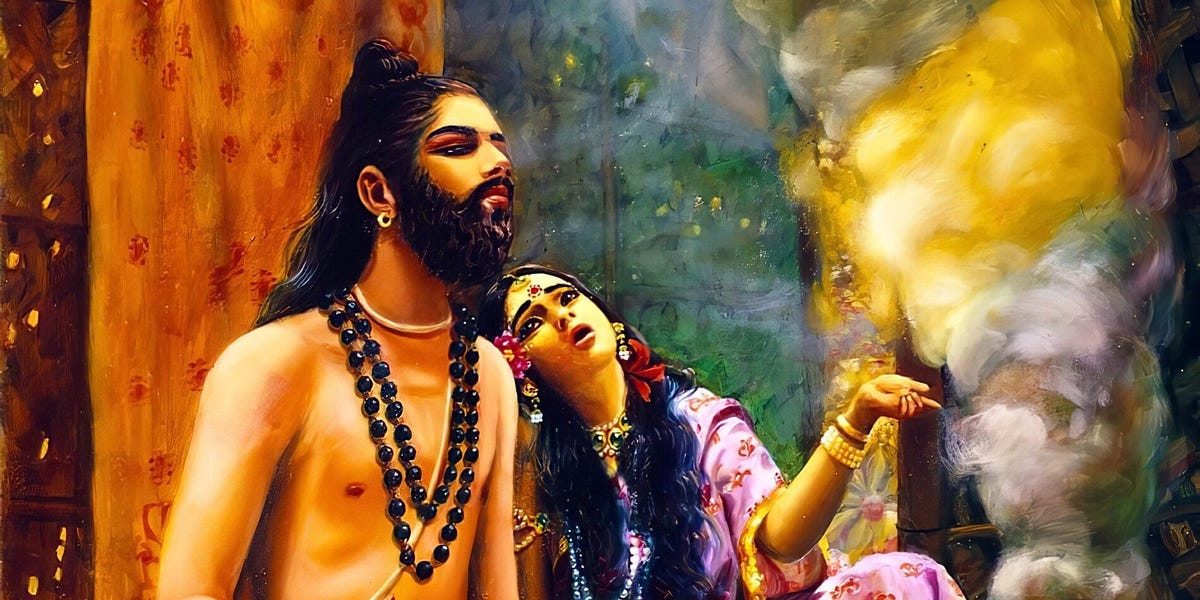
By hearing these topics from the sage [Nārada], the son of King Uttānapāda [Dhruva] was enlight ened regarding the Personality of Godhead, and he ascended to the abode of the Lord, placing his feet over the head of death (5).This history of the fight between the Lord as a boar and the demon Hiraṇyākṣa was heard by me in a year long ago as it was described by the foremost of the demigods, Brahmā, when he was ques tioned by the other demigods (6).Diti, daughter of Dakṣa, being afflicted with sex desire, begged her husband, Kaśyapa, the son of Marīci, to have intercourse with her in the evening in order to beget a child (7).
The sun was setting, and the sage was sitting in trance after offering oblations to the Supreme Person ality of Godhead, Viṣṇu, whose tongue is the sacrificial fire (8). In that place the beautiful Diti expressed her desire: O learned one, Cupid is taking his arrows and distressing me forcibly, as a mad el ephant troubles a banana tree (9). Therefore you should be kind towards me by showing me complete mercy. I desire to have sons, and I am much distressed by seeing the opulence of my co-wives. By performing this act, you will be come happy (10).
A woman is honored in the world by the benediction of her husband, and a husband like you will become famous by hav ing children because you are meant for the ex pansion of living entities (11).In days long ago, our father, the most opulent Dakṣa, who was af fectionate to his daughters, asked each of us separately whom we would prefer to select as our husband (12).Our well-wishing father, Dakṣa, after knowing our intentions, handed over thirteen of his daughters unto you, and since then we have all been faithful (13).
O lo tus-eyed one, kindly bless me by fulfilling my desire. When someone in distress approaches a great person, his pleas should never go in vain (14). O hero [Vidura], Diti, being thus afflicted by the contamination of lust, and therefore poor and talkative, was pacified by the son of Marīci in suitable words (15).O afflicted one, I shall forthwith gratify whatever desire is dear to you, for who else but you is the source of the three perfections of liberation? (16)
As one can cross over the ocean with seagoing vessels, one can cross the dangerous situation of the material ocean by living with a wife (17). O respectful one, a wife is so helpful that she is called the better half of a man’s body because of her shar ing in all auspicious activities. A man can move without anxiety entrusting all responsibilities to his wife (18).
As a fort commander very easily conquers invading plunderers, by taking shelter of a wife one can conquer the senses, which are unconquerable in the other social orders (19). O queen of the home, we are not able to act like you, nor could we repay you for what you have done, even if we worked for our entire life or even after death. To repay you is not possible, even for those who are admirers of personal qualities (20). Even though it is not possible to repay you, I shall satisfy your sex desire imme diately for the sake of begetting children. But you must wait for only a few seconds so that others may not reproach me (21).This particu lar time is most inauspicious because at this time the horrible-looking ghosts and constant companions of the lord of the ghosts are visible (22).
Lord Śiva, the king of the ghosts, sitting on the back of his bull carrier, travels at this time, accompanied by ghosts who follow him for their welfare (23).Lord Śiva’s body is red dish, and he is unstained, but he is covered with ashes. His hair is dusty from the whirlwind dust of the burning crematorium. He is the younger brother of your husband, and he sees with his three eyes (24).Lord Śiva regards no one as his relative, yet there is no one who is not con nected with him. He does not regard anyone as very favorable or abominable. We respectfully worship the remnants of his foodstuff, and we vow to accept what is rejected by him (25).
Alt hough no one in the material world is equal to or greater than Lord Śiva, and although his un impeachable character is followed by great souls to dismantle the mass of nescience, he nevertheless remains as if a devil to give salva tion to all devotees of the Lord (26). Unfortu nate, foolish persons, not knowing that he is en gaged in his own self, laugh at him. Such fool ish persons engage in maintaining the body which is eatable by dogs with dresses, orna ments, garlands and ointments (27). Demigods like Brahmā also follow the religious rites ob served by him. He is the controller of the mate rial energy, which causes the creation of the material world. He is great, and therefore his devilish characteristics are simply imitation (28).
Maitreya said: Diti was thus informed by her husband, but she was pressed by Cupid for sexual satisfaction. She caught hold of the clothing of the great brāhmaṇa sage, just like a shameless public prostitute (29). Understand ing his wife’s purpose, he was obliged to per form the forbidden act, and thus after offering his obeisances unto worshipable fate, he lay with her in a secluded place (30).Thereafter the brāhmaṇa took his bath in the water and con trolled his speech by practicing trance, meditat ing on the eternal effulgence and chanting the holy Gāyatrī hymns within his mouth (31).O son of the Bharata family, Diti, after this, went nearer to her husband, her face lowered because of her faulty action. She spoke as follows (32).
The beautiful Diti said: My dear brāhmaṇa, kindly see that my embryo is not killed by Lord Śiva, the lord of all living enti ties, because of the great offense I have com mitted against him (33).Let me offer my obei sances unto the angry Lord Śiva, who is simul taneously the very ferocious great demigod and the fulfiller of all material desires. He is all-aus picious and forgiving, but his anger can imme diately move him to chastise (34).
Let him be pleased with us, since he is my brother-in-law, the husband of my sister Satī. He is also the worshipable lord of all women. He is the per sonality of all opulences and can show mercy towards women, who are excused even by the uncivilized hunters(35). Maitreya said: The great sage Kaśyapa thus addressed his wife, who was trembling because of fear that her husband was offended. She un derstood that he had been dissuaded from his daily duties of offering evening prayers, yet she desired the welfare of her children in the world (36).
The learned Kaśyapa said: Because of your mind’s being polluted, because of defile ment of the particular time, because of your negligence of my directions, and because of your being apathetic to the demigods, every thing was inauspicious (37).O haughty one, you will have two contemptuous sons born of your condemned womb. Unlucky woman, they will cause constant lamentation to all the three worlds! (38) They will kill poor, faultless living entities, torture women and enrage the great souls (39).At that time the Lord of the universe, the Supreme Personality of Godhead, who is the well-wisher of all living entities, will de scend and kill them, just as Indra smashes the mountains with his thunderbolts (40).
Diti said: It is very good that my sons will be magnanimously killed by the arms of the Personality of Godhead with His Sudarśana weapon. O my husband, may they never be killed by the wrath of the brāhmaṇa devotees (41).A person who is condemned by a brāhmaṇa or is always fearful to other living entities is not favored either by those who are already in hell or by those in the species in which he is born (42). The learned Kaśyapa said: Because of your lamentation, penitence and proper delib eration, and also because of your unflinching faith in the Supreme Personality of Godhead and your adoration for Lord Śiva and me, one of the sons [Prahlāda] of your son [Hiraṇyakaśipu] will be an approved devotee of the Lord, and his fame will be broadcast equally with that of the Personality of Godhead (43-44).
In order to follow in his footsteps, saintly persons will try to emulate his character by practicing freedom from animosity, just as the purifying processes rectify gold of inferior quality (45).Everyone will be pleased with him because the Personality of Godhead, the su preme controller of the universe, is always sat isfied with a devotee who does not wish for an ything beyond Him (46).That topmost devotee of the Lord will have expanded intelligence and expanded influence and will be the greatest of the great souls. Due to matured devotional ser vice, he will certainly be situated in transcen dental ecstasy and will enter the spiritual sky after quitting this material world (47).
He will be a virtuously qualified reservoir of all good qualities; he will be jolly and happy in others’ happiness, distressed in others’ distress, and will have no enemies. He will be a destroyer of the lamentation of all the universes, like the pleasant moon after the summer sun (48).Your grandson will be able to see, inside and outside, the Supreme Personality of Godhead, whose wife is the beautiful goddess of fortune. The Lord can assume the form desired by the devo tee, and His face is always beautifully deco rated with earrings (49). The sage Maitreya said: Hearing that her grandson would be a great devotee and that her sons would be killed by Kṛṣṇa, Diti was highly pleased in mind (50).
Deepen your Bhakti-yoga practice, harmonize relationships, and receive guided coaching — all at Vedavarsity.com