Sūta Gosvāmī said: Upon reaching the bor der of His most prosperous metropolis, known as the country of the Ānartas [Dvārakā], the Lord sounded His auspicious conchshell, her alding His arrival and apparently pacifying the dejection of the inhabitants (1).The white and fatbowled conchshell, being gripped by the hand of Lord Kṛṣṇa and sounded by Him, ap peared to be reddened by the touch of His tran scendental lips. It seemed that a white swan was playing in the stems of red lotus flowers (2).
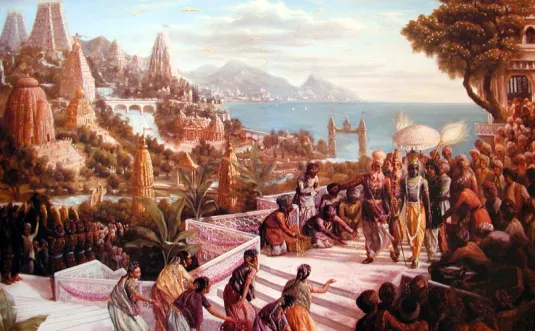
The citizens of Dvārakā, having heard that sound which threatens fear personified in the material world, began to run towards Him fast, just to have a long desired audience with the Lord, who is the protector of all devotees (3).The citizens arrived before the Lord with their respective presentations, offering them to the fully satisfied and selfsufficient one, who, by His own potency, incessantly supplies oth ers (4). These presentations were like the offer ing of a lamp to the sun. Yet the citizens began to speak in ecstatic language to receive the Lord, just as wards welcome their guardian and father (5).
The citizens said: O Lord, You are worshiped by all demigods like Brahmā, the four Sanas and even the King of heaven. You are the ultimate rest for those who are really as piring to achieve the highest benefit of life. You are the supreme transcendental Lord, and inev itable time cannot exert its influence upon You (6).O creator of the universe, You are our mother, wellwisher, Lord, father, spiritual mas ter and worshipable Deity. By following in Your footsteps we have become successful in every respect. We pray, therefore, that You continue to bless us with Your mercy (7).Oh, it is our good luck that we have come again today under Your protection by Your presence, for Your Lordship rarely visits even the denizens of heaven. Now it is possible for us to look into Your smiling face, which is full of affectionate glances. We can now see Your transcendental form, full of all auspiciousness (8).
O lotuseyed Lord, whenever You go away to Mathu rāVṛndāvana or Hastināpura to meet Your friends and relatives, every moment of Your absence seems like millions of years. O infalli ble one, at that time our eyes become useless, as if bereft of sun (9).O master, if You live abroad all the time, then we cannot look at Your attractive face, whose smiles vanquish all our sufferings. How can we exist without Your presence?(10) As Bhogavatī, the capital of Nāgaloka, is protected by the Nāgas, so was Dvārakā pro tected by the descendants of Vṛṣṇi Bhoja, Madhu, Daśārha, Arha, Kukura, Andhaka, etc. who were as strong as Lord Kṛṣṇa (11).The city of Dvārakāpurī was filled with the opulences of all seasons. There were hermitages, orchards, flower gardens, parks and reservoirs of water breeding lotus flowers all over (12).The city gateway, the household doors and festooned arches along the roads were all nicely decorated with festive signs like plantain trees and mango leaves, all to welcome the Lord. Flags, garlands and painted signs and slogans all combined to shade the sunshine (13).
The highways, sub ways, lanes, markets and public meeting places were all thoroughly cleansed and then mois tened with scented water. And to welcome the Lord, fruits, flowers and unbroken seeds were strewn everywhere (14).In each and every door of the residential houses, auspicious things like curd, unbroken fruits, sugarcane and full water pots with articles for worship, incense and can dles were all displayed (15).
On hearing that the most dear Kṛṣṇa was ap proaching Dvārakādhāma, magnanimous Vasudeva, Akrūra, Ugrasena, Balarāma (the superhumanly powerful), Pradyumna, Cārudeṣṇa and Sāmba the son of Jāmbavatī, all extremely happy, abandoned resting, sitting and dining.They hastened toward the Lord on chariots with brāhmaṇas bearing flowers. Be fore them were elephants, emblems of good fortune. Conchshells and bugles were sounded, and Vedic hymns were chanted. Thus they of fered their respects, which were saturated with affection (16-18).
At the same time, many hun dreds of wellknown prostitutes began to pro ceed on various vehicles. They were all very eager to meet the Lord, and their beautiful faces were decorated with dazzling earrings, which enhanced the beauty of their foreheads (19).Ex pert dramatists, artists, dancers, singers, histo rians, genealogists and learned speakers all gave their respective contributions, being in spired by the superhuman pastimes of the Lord. Thus they proceeded on and on (20). Lord Kṛṣṇa, the Personality of Godhead, ap proached them and offered due honor and re spect to each and every one of the friends, rel atives, citizens and all others who came to re ceive and welcome Him (21).
The almighty Lord greeted everyone present by bowing His head, exchanging greetings, embracing, shak ing hands, looking and smiling, giving assur ances and awarding benedictions, even to the lowest in rank.Then the Lord personally en tered the city accompanied by elderly relatives and invalid brāhmaṇas with their wives, all of fering benedictions and singing the glories of the Lord. Others also praised the glories of the Lord (22-23). When Lord Kṛṣṇa passed over the public roads, all the ladies from the respectable fami lies of Dvārakā went up to the roofs of their pal aces just to have a look at the Lord. They con sidered this to be the greatest festival (24).
The inhabitants of Dvārakā were regularly accus tomed to look upon the reservoir of all beauty, the infallible Lord, yet they were never sati ated.The Lord’s chest is the abode of the god dess of fortune. His moonlike face is the drink ing vessel for eyes which hanker after all that is beautiful. His arms are the resting places for the administrative demigods. And His lotus feet are the refuge of pure devotees who never talk or sing of any subject except His Lordship (25 26).As the Lord passed along the public road of Dvārakā, His head was protected from the sun shine by a white umbrella. White feathered fans moved in semicircles, and showers of flowers fell upon the road. His yellow garments and garlands of flowers made it appear as if a dark cloud were surrounded simultaneously by sun, moon, lightning and rainbows (27).
After entering the house of His father, He was embraced by the mothers present, and the Lord offered His obeisances unto them by plac ing His head at their feet. The mothers were headed by Devakī [His real mother].The moth ers, after embracing their son, sat Him on their laps. Due to pure affection, milk sprang from their breasts. They were overwhelmed with de light, and the tears from their eyes wetted the Lord (28-29).Thereafter, the Lord entered His palaces, which were perfect to the fullest ex tent. His wives lived in them, and they num bered over sixteen thousand (30).The queens of Lord Śrī Kṛṣṇa rejoiced within their minds to see their husband home after a long period abroad. The queens got up at once from their seats and meditations. As was socially custom ary, they covered their faces shyly and looked about coyly (31).
The insuperable ecstasy was so strong that the queens, who were shy, first embraced the Lord in the innermost recesses of their hearts. Then they embraced Him visually, and then they sent their sons to embrace Him [which is equal to personal embracing]. But, O chief amongst the Bhṛgus, though they tried to restrain their feelings, they inadvertently shed tears (32).Although Lord Śrī Kṛṣṇa was con stantly by their sides, as well as exclusively alone, His feet appeared to them to be newer and newer. The goddess of fortune, although by nature always restless and moving, could not quit the Lord’s feet. So what woman can be de tached from those feet, having once taken shel ter of them?(33)
The Lord was pacified after killing those kings who were burdensome to the earth. They were puffed up with their military strength, their horses, elephants, chariots, infantry, etc. He Himself was not a party in the fight. He simply created hostility between the powerful administrators, and they fought amongst them selves. He was like the wind which causes fric tion between bamboos and so sparks a fire (34).That Supreme Personality of Godhead, Śrī Kṛṣṇa, out of His causeless mercy, appeared on this planet by His internal potency and enjoyed Himself amongst competent women as if He were engaging in mundane affairs (35).
Alt hough the queens’ beautiful smiles and furtive glances were all spotless and exciting, and alt hough they could conquer Cupid himself by making him give up his bow in frustration, and although even the tolerant Śiva could fall vic tim to them, still, despite all their magical feats and attractions, they could not agitate the senses of the Lord.The common materialistic conditioned souls speculate that the Lord is one of them. Out of their ignorance they think that the Lord is affected by matter, although He is unattached(36-37).This is the divinity of the Personality of Godhead: He is not affected by the qualities of material nature, even though He is in contact with them. Similarly, the devotees who have taken shelter of the Lord do not be come influenced by the material qualities (38).The simple and delicate women truly thought that Lord Śrī Kṛṣṇa, their beloved hus band, followed them and was dominated by them. They were unaware of the extent of the glories of their husband, as the atheists are un aware of Him as the supreme controller (39).
Deepen your Bhakti-yoga practice, harmonize relationships, and receive guided coaching — all at Vedavarsity.com