


Sūta Gosvāmī said: Arjuna, the celebrated friend of Lord Kṛṣṇa, was griefstricken because of his strong feeling of separation from Kṛṣṇa, over and above all Mahārāja Yudhiṣṭhira’s speculative inquiries (1).Due to grief, Arjuna’s mouth and lotuslike heart had dried up. There fore his body lost all luster. Now, remembering the Supreme Lord, he could hardly utter a word in reply (2).
With great difficulty he checked the tears of grief that smeared his eyes. He was very distressed because Lord Kṛṣṇa was out of his sight, and he increasingly felt affection for Him.Remembering Lord Kṛṣṇa and His well wishes, benefactions, intimate familial rela tions and His chariot driving, Arjuna, over whelmed and breathing very heavily, began to speak (3-4). Arjuna said: O King! The Supreme Person ality of Godhead, Hari, who treated me exactly like an intimate friend, has left me alone. Thus my astounding power, which astonished even the demigods, is no longer with me (5).
I have just lost Him whose separation for a moment would render all the universes unfavorable and void, like bodies without life (6).Only by His merciful strength was I able to vanquish all the lusty princes assembled at the palace of King Drupada for the selection of the bridegroom. With my bow and arrow I could pierce the fish target and thereby gain the hand of Draupadī (7).Because He was near me, it was possible for me to conquer with great dexterity the powerful King of heaven, Indradeva, along with his dem igod associates and thus enable the firegod to devastate the Khāṇḍava Forest. And only by His grace was the demon named Maya saved from the blazing Khāṇḍava Forest, and thus we could build our assembly house of wonderful architectural workmanship, where all the princes assembled during the performance of Rājasūyayajña and paid you tributes (8).
Your respectable younger brother, who possesses the strength of ten thousand elephants, killed, by His grace, Jarāsandha, whose feet were wor shiped by many kings. These kings had been brought for sacrifice in Jarāsandha’s Mahābhairavayajña, but they were thus re leased. Later they paid tribute to Your Majesty (9).It was He only who loosened the hair of all the wives of the miscreants who dared open the cluster of your Queen’s hair, which had been nicely dressed and sanctified for the great Rājasūya sacrificial ceremony. At that time she fell down at the feet of Lord Kṛṣṇa with tears in her eyes (10).
During our exile, Durvāsā Muni, who eats with his ten thousand disciples, in trigued with our enemies to put us in dangerous trouble. At that time He [Lord Kṛṣṇa], simply by accepting the remnants of food, saved us. By His accepting food thus, the assembly of munis, while bathing in the river, felt sumptuously fed. And all the three worlds were also satisfied (11).It was by His influence only that in a fight I was able to astonish the personality of god Lord Śiva and his wife, the daughter of Mount Himālaya. Thus he [Lord Śiva] became pleased with me and awarded me his own weapon. Other demigods also delivered their respective weapons to me, and in addition I was able to reach the heavenly planets in this present body and was allowed a halfelevated seat (12).
When I stayed for some days as a guest in the heav enly planets, all the heavenly demigods, includ ing King Indradeva, took shelter of my arms, which were marked with the Gāṇḍīva bow, to kill the demon named Nivātakavaca. O King, descendant of Ajamīḍha, at the present moment I am bereft of the Supreme Personality of God head, by whose influence I was so powerful (13). The military strength of the Kauravas was like an ocean in which there dwelled many in vincible existences, and thus it was insur mountable. But because of His friendship, I, seated on the chariot, was able to cross over it. And only by His grace was I able to regain the cows and also collect by force many helmets of the kings, which were bedecked with jewels that were sources of all brilliance (14).
It was He only who withdrew the duration of life from everyone and who, in the battlefield, withdrew the speculative power and strength of enthusi asm from the great military phalanx made by the Kauravas, headed by Bhīṣma, Karṇa, Droṇa, Śalya, etc. Their arrangement was ex pert and more than adequate, but He [Lord Śrī Kṛṣṇa], while going forward, did all this (15).Great generals like Bhīṣma, Droṇa, Karṇa, Bhūriśravā, Suśarmā, Śalya, Jayadratha and Bāhlika all directed their invincible weapons against me. But by His [Lord Kṛṣṇa’s] grace they could not even touch a hair on my head. Similarly, Prahlāda Mahārāja, the supreme devotee of Lord Nṛsiṁhadeva, was unaffected by the weapons the demons used against him (16).
It was by His mercy only that my enemies neglected to kill me when I descended from my chariot to get water for my thirsty horses. And it was due to my lack of esteem for my Lord that I dared engage Him as my chariot driver, for He is worshiped and offered services by the best men to attain salvation (17).O King! His jokings and frank talks were pleasing and beau tifully decorated with smiles. His addresses unto me as “O son of Pṛthā, O friend, O son of the Kuru dynasty,” and all such heartiness are now remembered by me, and thus I am over whelmed (18).
Generally both of us used to live together and sleep, sit and loiter together. And at the time of advertising oneself for acts of chivalry, sometimes, if there were any irregu larity, I used to reproach Him by saying, “My friend, You are very truthful.” Even in those hours when His value was minimized, He, be ing the Supreme Soul, used to tolerate all those utterings of mine, excusing me exactly as a true friend excuses his true friend, or a father ex cuses his son (19).O Emperor, now I am sepa rated from my friend and dearmost wellwisher, the Supreme Personality of Godhead, and therefore my heart appears to be void of every thing. In His absence I have been defeated by a number of infidel cowherd men while I was guarding the bodies of all the wives of Kṛṣṇa (20).
I have the very same Gāṇḍīva bow, the same arrows, the same chariot drawn by the same horses, and I use them as the same Arjuna to whom all the kings offered their due re spects. But in the absence of Lord Kṛṣṇa, all of them, at a moment’s notice, have become null and void. It is exactly like offering clarified butter on ashes, accumulating money with a magic wand or sowing seeds on barren land (21).O King, since you have asked me about our friends and relatives in the city of Dvārakā, I will inform you that all of them were cursed by the brāhmaṇas, and as a result they all be came intoxicated with wine made of putrefied rice and fought among themselves with sticks, not even recognizing one another. Now all but four or five of them are dead and gone (22 23).
Factually this is all due to the supreme will of the Lord, the Personality of Godhead. Some times people kill one another, and at other times they protect one another (24).O King, as in the ocean the bigger and stronger aquatics swallow up the smaller and weaker ones, so also the Su preme Personality of Godhead, to lighten the burden of the earth, has engaged the stronger Yadu to kill the weaker, and the bigger Yadu to kill the smaller (25-26).Now I am attracted to those instructions imparted to me by the Per sonality of Godhead [Govinda] because they are impregnated with instructions for relieving the burning heart in all circumstances of time and space (27).
Sūta Gosvāmī said: Thus being deeply ab sorbed in thinking of the instructions of the Lord, which were imparted in the great inti macy of friendship, and in thinking of His lotus feet, Arjuna’s mind became pacified and free from all material contamination (28).Arjuna’s constant remembrance of the lotus feet of Lord Śrī Kṛṣṇa rapidly increased his devotion, and as a result all the trash in his thoughts subsided (29).Because of the Lord’s pastimes and activ ities and because of His absence, it appeared that Arjuna forgot the instructions left by the Personality of Godhead. But factually this was not the case, and again he became lord of his senses (30).
Because of his possessing spiritual assets, the doubts of duality were completely cut off. Thus he was freed from the three modes of material nature and placed in transcendence. There was no longer any chance of his becom ing entangled in birth and death, for he was freed from material form (31). Upon hearing of Lord Kṛṣṇa’s returning to His abode, and upon understanding the end of the Yadu dynasty’s earthly manifestation, Mahārāja Yudhiṣṭhira decided to go back home, back to Godhead (32).Kuntī, after over hearing Arjuna’s telling of the end of the Yadu dynasty and disappearance of Lord Kṛṣṇa, en gaged in the devotional service of the transcen dental Personality of Godhead with full atten tion and thus gained release from the course of material existence (33).
The supreme unborn, Lord Śrī Kṛṣṇa, caused the members of the Yadu dynasty to relinquish their bodies, and thus He relieved the burden of the world. This action was like picking out a thorn with a thorn, though both are the same to the controller (34).The Supreme Lord relinquished the body which He manifested to diminish the burden of the earth. Just like a magician, He relinquishes one body to accept different ones, like the fish incarnation and others (35).When the Personal ity of Godhead, Lord Kṛṣṇa, left this earthly planet in His selfsame form, from that very day Kali, who had already partially appeared, be came fully manifest to create inauspicious con ditions for those who are endowed with a poor fund of knowledge (36).Mahārāja Yudhiṣṭhira was intelligent enough to understand the influ ence of the Age of Kali, characterized by in creasing avarice, falsehood, cheating and vio lence throughout the capital, state, home and among individuals. So he wisely prepared him self to leave home, and he dressed accordingly (37).
Thereafter, in the capital of Hastināpura, he enthroned his grandson, who was trained and equally qualified, as the emperor and mas ter of all land bordered by the seas (38).Then he posted Vajra, the son of Aniruddha [grandson of Lord Kṛṣṇa], at Mathurā as the King of Śūrasena. Afterwards Mahārāja Yudhiṣṭhira performed a Prājāpatya sacrifice and placed in himself the fire for quitting household life (39).Mahārāja Yudhiṣṭhira at once relinquished all his garments, belt and ornaments of the royal order and became completely disinter ested and unattached to everything (40).Then he amalgamated all the sense organs into the mind, then the mind into life, life into breath ing, his total existence into the embodiment of the five elements, and his body into death. Then, as pure self, he became free from the ma terial conception of life (41).
Thus annihilating the gross body of five elements into the three qualitative modes of material nature, he merged them in one nescience and then absorbed that nescience in the self, Brahman, which is inex haustible in all circumstances (42).After that, Mahārāja Yudhiṣṭhira dressed himself in torn clothing, gave up eating all solid foods, volun tarily became dumb and let his hair hang loose. All this combined to make him look like an ur chin or madman with no occupation. He did not depend on his brothers for anything. And, just like a deaf man, he heard nothing (43).He then started towards the north, treading the path ac cepted by his forefathers and great men, to de vote himself completely to the thought of the Supreme Personality of Godhead. And he lived in that way wherever he went (44).
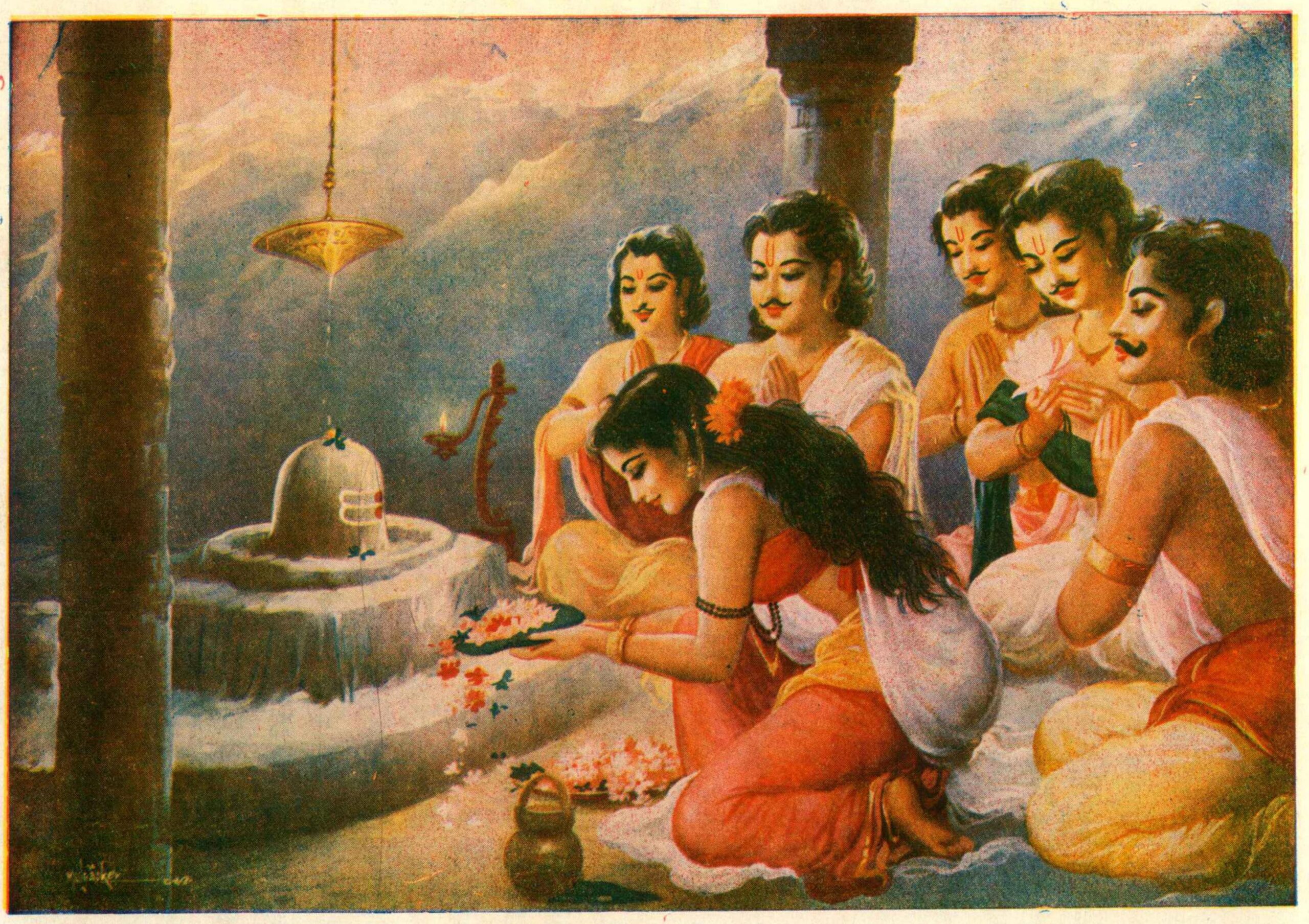
The younger brothers of Mahārāja Yudhiṣṭhira observed that the Age of Kali had already arrived throughout the world and that the citizens of the kingdom were already af fected by irreligious practice. Therefore they decided to follow in the footsteps of their elder brother (45).They all had performed all the principles of religion and as a result rightly de cided that the lotus feet of the Lord Śrī Kṛṣṇa are the supreme goal of all. Therefore they meditated upon His feet without interruption (46).Thus by pure consciousness due to con stant devotional remembrance, they attained the spiritual sky, which is ruled over by the Su preme Nārāyaṇa, Lord Kṛṣṇa. This is attained only by those who meditate upon the one Su preme Lord without deviation. This abode of the Lord Śrī Kṛṣṇa, known as Goloka Vṛndāvana, cannot be attained by persons who are absorbed in the material conception of life. But the Pāṇḍavas, being completely washed of all material contamination, attained that abode in their very same bodies (47-48).
Vidura, while on pilgrimage, left his body at Prabhāsa. Be cause he was absorbed in thought of Kṛṣṇa, he was received by the denizens of the Pitṛloka planet, where he returned to his original post (49).Draupadī also saw that her husbands, without caring for her, were leaving home. She knew well about Lord Vāsudeva, Kṛṣṇa, the Personality of Godhead. Both she and Sub hadrā became absorbed in thoughts of Kṛṣṇa and attained the same results as their husbands (50). The subject of the departure of the sons of Pāṇḍu for the ultimate goal of life, back to God head, is fully auspicious and is perfectly pure. Therefore anyone who hears this narration with devotional faith certainly gains the devotional service of the Lord, the highest perfection of life (51).
Deepen your Bhakti-yoga practice, harmonize relationships, and receive guided coaching — all at Vedavarsity.com