By Dr. T. D. Singh (Bhaktisvarüpa Dämodara Swami) and Sadäpüta däsa
Now the question arises: “What determines the particular biological form and type of consciousness that a living being acquires?” To answer this question, let us first investigate the transformations of form and consciousness that occur within one lifetime.
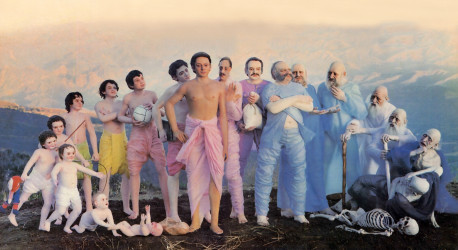
As mentioned earlier, consciousness and biological form are interrelated, due to the influence of the modes of nature. Thus a child’s body and its conscious development are different from those of its youthful stage, and so on. In principle, then, as the body changes from boyhood to old age, the living being, or ātmā, actually passes through many bodies of various ages and varieties of conscious development. Thus the body changes, but the eternal living being within the body-the self-remains the same. Biological science confirms this. In his book The Human Brain, John Pfeiffer points out, “Your body does not contain a single one of the molecules that it contained seven years ago.” The movement of the living entity through numerous bodies within one lifetime-something we can all verify by a little introspection-can be termed internal (or continuous) reincarnation or transmigration.
But what about the living being’s passage to a new body at the time of death? To the author’s knowledge, reports in the literature on the study of reincarnation are based primarily on some scattered data regarding some children’s memories of previous lives. This information comes mainly from northern India, Sri Lanka, Burma, Thailand, Vietnam, and some areas of western Asia.4 Although this information certainly supports the theory of reincarnation, it does not provide us with a scientific foundation from which to study it, because the vast majority of people cannot remember their past lives. Therefore we must consult a source of information more reliable than haphazard memory. That information is available in the Vedas.
In the Bhagavad-gītā Lord Kṛṣṇa very clearly explains reincarnation to His friend and devotee Arjuna. The Lord says, “Just as a person puts on new garments, giving up old ones, similarly the individual living entity accepts new material bodies, giving up the old and useless ones.” (Bg. 2.22) ”Just as the embodied living entity passes, in one body, from boyhood to youth to old age, so the living entity similarly passes into another body at death.” (Bg. 2.13) Lord Kṛṣṇa further explains that the mind is the mechanism underlying all these transmigrations: “Whatever state of being one remembers when he quits his body, that state he will attain without fail in his next life.” (Bg. 8.6) So, the living entity in a man’s body could go into the body of an animal, a bird, an insect, a plant, another human, and so on. This journey of the self, or living entity, into different bodies can be referred to as external (or discontinuous) reincarnation or transmigration.
To illustrate how external reincarnation works, we will briefly relate the story of King Bharata, one of the great personalities in Vedic history, from the Śrīmad-Bhāgavatam, the foremost of the eighteen Purāṇas.
One day, after King Bharata had taken his bath as usual in the River Gaṇḍakī, he was chanting his mantra when he saw a pregnant deer come to the riverbank to drink water. Suddenly the thundering roar of a lion resounded throughout the forest. The deer was so frightened that it immediately gave birth to its calf. It crossed the river, but then died immediately thereafter. Bharata took compassion on the motherless calf, rescued it from the water, took it to his āśrama, and cared for it affectionately. He gradually became attached to the young deer, and he always thought of it lovingly.
As it grew up, the deer became Bharata’s constant companion, and he always took care of it. Gradually he became so absorbed in thinking of this deer that his mind became agitated, he reduced his meditative disciplines, and he fell away from his mystic yoga practice. Once, when the deer was absent, Bharata was so disturbed that he began to search for it. While searching and lamenting the deer’s absence, Bharata fell down and died. Because his mind was fully absorbed in thinking of the deer, he naturally took his next birth in the womb of a deer. (Bhāg. 5.8)
As has been mentioned earlier, there is a subtle body, made up of mind, intelligence, and apparent self. In either kind of reincarnation, internal or external, the living being is carried by the subtle body under the laws of karma.
The word karma is a Sanskrit term that can be defined as “the function and activity of the living entity within the framework of his free will and under the influence of the three modes of material nature over a span of time.” For every action that an individual living being performs, he must undergo an appropriate reaction. For example, if someone is very charitable toward educational institutions, in his next life he may be very wealthy and receive an excellent education. On the other hand, if one performs or has an abortion, he or she will suffer the same fate in the next life. Thus we arrive at a definition of reincarnation, or transmigration, according to the Vedic information: “the continuous journey of the living entity, from one body to another, either internally or externally, under the stringent laws of his individual karma.”
Deepen your Bhakti-yoga practice, harmonize relationships, and receive guided coaching — all at Vedavarsity.com