


President Murmu ISKCON Vrindavan Visit: A Divine Confluence of Leadership and Bhakti
The sacred visit of Droupadi Murmu to the renowned Krishna Balaram Mandir in Vrindavan marks a spiritually significant moment for devotees worldwide. The President Murmu ISKCON Vrindavan visit was not merely ceremonial but deeply symbolic, reflecting the eternal connection between governance and dharma (righteous duty).
This auspicious visit, conducted on March 19, 2026, during her spiritual tour of Uttar Pradesh, highlights the timeless relevance of Vedic culture in modern leadership.
A Reverential Arrival at Krishna Balaram Mandir
Upon her arrival, President Murmu was warmly welcomed by senior devotees and temple authorities. The presence of dignitaries such as Anandiben Patel further emphasized the importance of the occasion.
The temple, established by A. C. Bhaktivedanta Swami Prabhupada, stands as a beacon of Krishna consciousness (Kṛṣṇa-bhakti) across the globe. As the President entered the premises, the atmosphere resonated with kīrtana (devotional chanting), reflecting the transcendental vibration described in the scriptures.
Homage at Srila Prabhupada’s Samadhi
A key moment of the visit was the President’s offering of respects at the samādhi (memorial shrine) of A. C. Bhaktivedanta Swami Prabhupada. Here, she performed parikramā (circumambulation), a traditional act of reverence in Vedic culture.
Spiritual Significance of Samadhi Darshan
In Vedic understanding, the samādhi of a pure devotee is non-different from his presence. By offering obeisances, one connects with the paramparā (disciplic succession), receiving spiritual benefit.
Śrīla Prabhupāda dedicated his life to fulfilling the instruction of Chaitanya Mahaprabhu—to spread the holy name of Krishna to every town and village. Thus, the President’s visit acknowledged not just a historical figure but a living spiritual legacy.
Darshan of Sri Sri Krishna-Balaram
Following the samādhi visit, President Murmu proceeded for darśana (sacred viewing) of Sri Sri Krishna-Balaram, the presiding deities of the temple.
The Philosophy of Deity Worship (Arcana)
In the Bhakti tradition, deity worship is not idol worship but a direct engagement with the Supreme Personality of Godhead. As explained in the Bhagavad-gītā:
- The Lord accepts offerings made with devotion (bhakti).
- The deity form enables conditioned souls to develop personal relationship with Bhagavān.
President Murmu’s participation in ārati (ceremonial worship) demonstrated an understanding of this profound spiritual practice.
Participation in Evening Ārati and Devotional Offerings
The President attended the evening ārati, offering prayers at both the Krishna-Balaram and Rādhā-Śyāmasundara altars. The ārati ceremony, accompanied by conch shells, bells, and kīrtana, represents the offering of all elements—earth, water, fire, air, and ether—to the Supreme Lord.
Ārati: A Universal Expression of Bhakti
This sacred ritual symbolizes:
- Surrender (śaraṇāgati)
- Gratitude (kṛtajñatā)
- Divine connection (yoga)
Such participation by a national leader reinforces the principle that spiritual culture transcends social and political distinctions.
Cultural Reception by Gurukul Students
A particularly heartwarming highlight of the President Murmu ISKCON Vrindavan visit was the reception by students of the Bhaktivedanta Gurukul and International School.
The students welcomed the dignitaries with Vedic hymns, including:
“Om pūrṇam adaḥ pūrṇam idaṁ”
(This invocation from the Īśopaniṣad describes the completeness of the Absolute Truth.)
Preservation of Vedic Education
The Gurukul system emphasizes:
- Character formation (saṁskāra)
- Spiritual knowledge (jñāna)
- Discipline (niyama)
The President’s appreciation for the students highlights the relevance of traditional education systems in nurturing future generations.
Odissi Dance and Global Devotional Expression
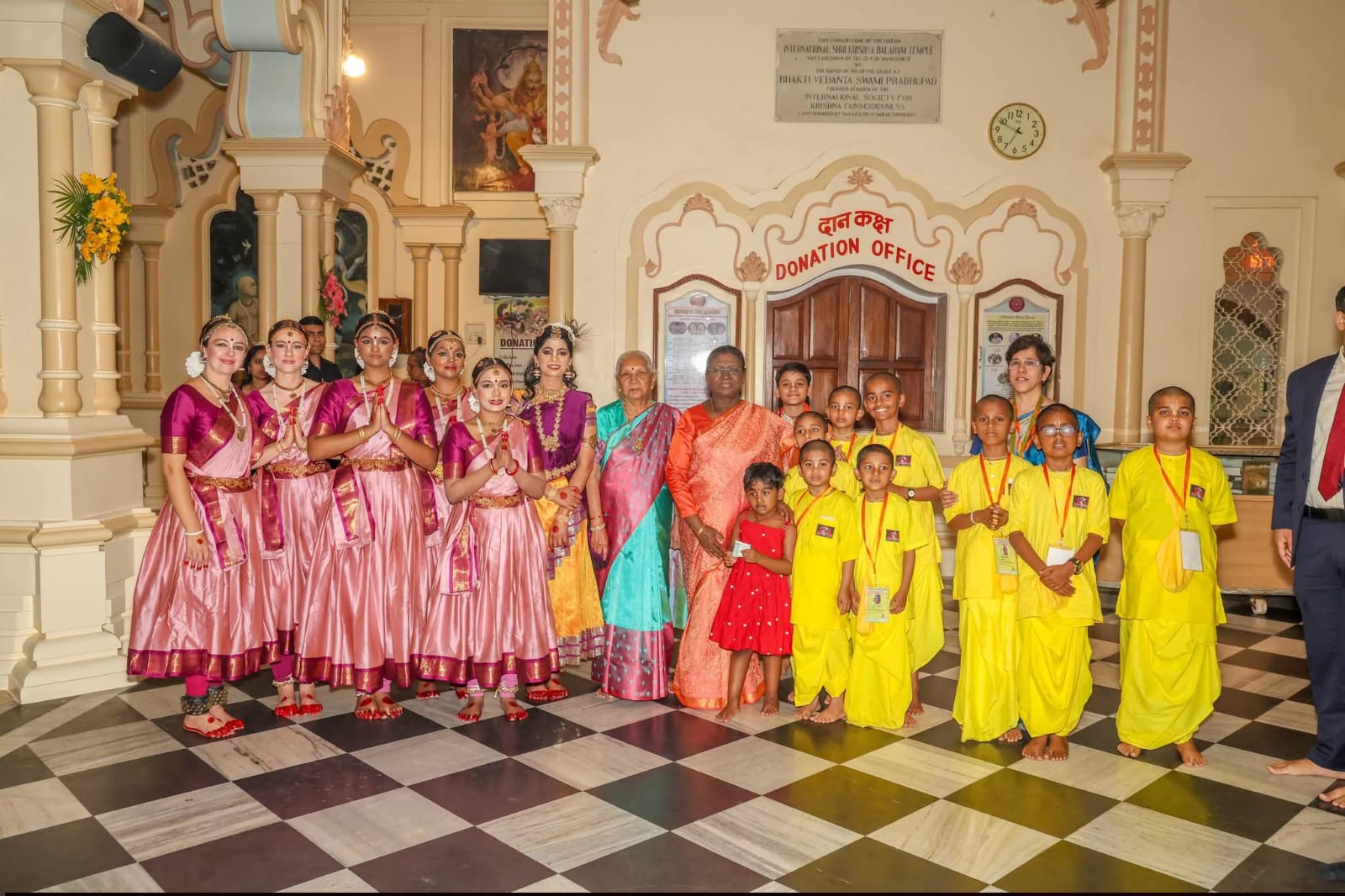
Devotee artists from various countries presented an Odissi dance performance, showcasing how bhakti transcends geographical boundaries.
Bhakti as a Universal Culture
ISKCON’s global presence demonstrates:
- Unity in diversity
- Spiritual inclusivity
- Cultural harmony
The dance performance served as an offering (seva) to the Lord, aligning with the principle that all talents should be engaged in divine service.
Interaction with Students and Distribution of Prasāda
In a gesture of affection, President Murmu distributed chocolates to the Gurukul students and interacted warmly with them.
The Spirit of Prasāda Distribution
In Vedic culture, prasāda (sanctified food) symbolizes divine mercy. Although chocolates are modern, the gesture reflects the same principle—sharing joy and blessings.
Her interaction reflected the qualities of a rājarṣi (saintly king), described in scriptures as one who governs with compassion and spiritual awareness.
President Murmu’s Reflections on Vrindavan Dham
During her visit, President Murmu expressed profound appreciation for the spiritual atmosphere of Vrindavan. She remarked that this sacred land is not merely geographical but a living embodiment of divine presence.
Understanding Vrindavan’s Transcendental Nature
According to Vedic scriptures:
- Vrindavan is non-different from the spiritual world (Goloka).
- Every particle is spiritually conscious.
- The Lord’s pastimes eternally manifest here.
Her statement aligns with the teachings of great ācāryas, affirming that Vrindavan is experienced through devotion, not material perception.
The Role of Leadership in Promoting Dharma
The President Murmu ISKCON Vrindavan visit illustrates the essential role of leadership in upholding dharma.
Rājadharma in Modern Context
Vedic texts emphasize that rulers should:
- Protect spiritual culture
- Encourage moral values
- Support religious institutions
By visiting ISKCON, the President reinforced the importance of spiritual institutions in societal development.
ISKCON’s Global Mission and Its Recognition
Founded by A. C. Bhaktivedanta Swami Prabhupada in 1966, ISKCON has grown into a worldwide movement dedicated to spreading Krishna consciousness.
Core Teachings of ISKCON
- Chanting the holy name (Hare Krishna Mahāmantra)
- Studying Bhagavad-gītā and Śrīmad-Bhāgavatam
- Living a life of purity and devotion
The President’s visit signifies national recognition of ISKCON’s contributions to spiritual and cultural upliftment.
Conclusion: President Murmu ISKCON Vrindavan Visit as a Spiritual Milestone
The President Murmu ISKCON Vrindavan visit stands as a remarkable convergence of governance and spirituality. By honoring A. C. Bhaktivedanta Swami Prabhupada and participating in devotional practices at the Krishna Balaram Mandir, President Murmu demonstrated that true leadership is rooted in humility, devotion, and adherence to dharma.
Such events inspire society to reconnect with its spiritual heritage and reaffirm the eternal teachings of Sanātana-dharma. As Vrindavan continues to radiate divine love and devotion, visits like these strengthen the bridge between tradition and modernity, guiding humanity toward a higher purpose.

The President at Srila Prabhupada’s Samadhi Mandir.

President Murmu before Srila Prabhupada’s murti in the Temple.

Children happily gather around President Murmu during the visit.
Deepen your Bhakti-yoga practice, harmonize relationships, and receive guided coaching — all at Vedavarsity.com