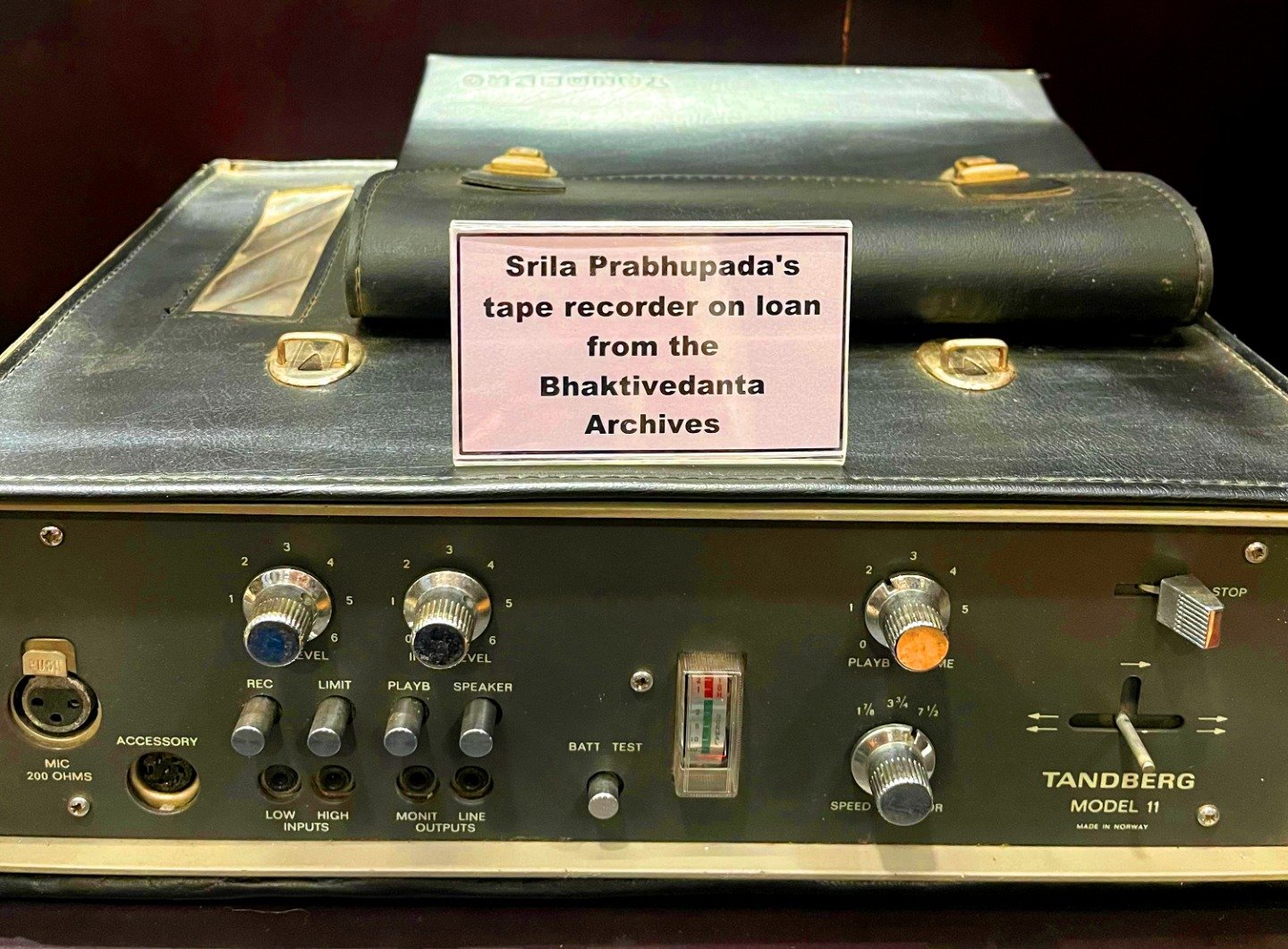
One of the two original tape recorders used by Srila Prabhupada, on loan from the Bhaktivedanta Archives for the museum display.
On February 18, 2025, the Temple of the Vedic Planetarium (TOVP) in Mayapur opened the A.C. Bhaktivedanta Swami Legacy Museum, a project years in the making and grounded in devotion. Hundreds of visitors flowed through its doors that morning. Soft light fell across the first wall of photographs tracing Srila Prabhupada’s life from Calcutta to New York and beyond. The sound of kirtan carried faintly from the temple courtyard. Among those who helped make the moment possible was Parama-rupa Das, founder, president, and director of preservation at the Bhaktivedanta Archives.
For Parama-rupa Das, who began safeguarding Srila Prabhupada’s recordings and correspondence in the late 1970s, the museum’s opening was a visible expression of nearly five decades of work. In the Bhaktivedanta Archives’ ninth volume of Archival Spirit, released this September, he and his team shared how the collaboration with the TOVP unfolded, and how their service turned preservation into pilgrimage.
From the Archives to Mayapur
“The invitation came from Daivi Shakti Mata,” Parama-rupa recalled. “She was coordinating the museum setup in Mayapur and asked me to come for conservation and preservation support. She knew we had the images and experience.”
He arrived in Mayapur to find the project already underway. “We sat together and planned what would go in each room, what I would supply, and what the team on site would do,” he said. The museum occupies what was once cited as the residence of two senior pujaris, including two bedrooms and a small living area. “Those spaces became the three museum rooms,” he explained. “The outer wall became part of the display, too. It was a practical beginning for something with enormous potential.”
Designing the Experience
The team agreed that the museum should feel like a journey through Srila Prabhupada’s life. The outer wall tells that story in two parts: the first depicts his early years and spiritual preparation; the second captures the Jaladuta voyage and the first years of preaching in the West. “We wanted people to pause there before stepping inside,” Parama-rupa said. “That wall introduces what they’re about to experience, a visual and emotional history.”
Inside the first room, visitors move through a timeline of Back to Godhead covers, legal documents, personal correspondence, and global book displays. Every page and photograph came through the Bhaktivedanta Archives. “Nothing original is on display,” Parama-rupa emphasized. “Everything you see is a facsimile. Light destroys paper over time, so we protect the originals in our vaults. Even the cabinets were built to lock behind glass. We learned long ago that if it’s sacred, you guard it.”
A Room from the Past
The second room, modeled after Srila Prabhupada’s Bhajan Kutir, holds a special place in Parama-rupa’s heart. “We used the same type of straw and bamboo they still use locally today,” he said. “When you walk in, it feels like stepping back in time. The photograph on the wall represents the window from which Srila Prabhupada watched prasadam being served. It isn’t just decoration, it’s perspective.”
The murti of Srila Prabhupada in that room receives daily worship, giving the exhibit a living rhythm. “You come from the outside world and step into his space,” he said. “It’s quiet, intimate. The bed, the window, the scent of straw, it draws you in. That’s my favorite part.”
Objects That Speak
Among the museum’s most striking pieces are Srila Prabhupada’s personal items, his cooking utensils, clothing, and walking sticks, many unseen for decades. Two historically important artifacts came directly from the Bhaktivedanta Archives: the Sony TC-150 recorder used during morning walks and lectures, and the dictaphone on which he dictated manuscripts. “Both are on loan,” Parama-rupa said. “We wanted people to see the very tools that captured his voice and words.”
Each object bears a small label identifying its origin. Near the entrance, a plaque expresses gratitude to the Archives for the materials, photographs, and guidance. “Originally, there wasn’t going to be a plaque,” he said. “During the opening rush, the Archives weren’t mentioned, and it was an oversight. Later, they added it right at the door. It means a lot to our team. Without those images and documents, the museum couldn’t exist.”The Legacy Museum placard at the TOVP honors the Bhaktivedanta Archives for its vital role in preserving Srila Prabhupada’s legacy.The ISKCON Worldwide Kiosk highlights Srila Prabhupada’s global mission.A chronological display showcases Srila Prabhupada’s early writings, photographs, and the many objects he used to produce his books.
Behind the Scenes
The project drew on the skills of many devotees. Daivi Shakti Devi Dasi coordinated the overall concept and spiritual tone. Radha Ballabha Das designed the interiors and cabinetry, sourcing local materials to mirror the textures of Mayapur’s early years. Balaram Das handled graphic design, and Thakur Saranga Das handled large-format printing. Sunanda Das served as liaison, while Acyutasevini Indulekha Devi Dasi managed the careful handling of collections. Artist Nitya-trpta Devi Dasi contributed the signature “Ever Well Wisher” design displayed near the Archives’ exhibit.
“Each person brought a piece of their heart,” Parama-rupa said. “That’s what visitors see on the walls, devotees’ hearts translated into history.”
A Legacy of Preservation
The Bhaktivedanta Archives itself began in the late 1970s, soon after Srila Prabhupada’s disappearance. Parama-rupa, then a young devotee in Los Angeles, started collecting tapes and letters that might otherwise have been lost. “We didn’t know the term ‘archival science’ then,” he said. “We just knew these were sacred recordings and they had to be protected.”
From that small beginning grew an organized preservation facility in Sandy Ridge, North Carolina, housing thousands of audio reels, photographs, and manuscripts. The Archives pioneered digital restoration of Srila Prabhupada’s lectures and produced reference editions used in ISKCON centers worldwide. “Every project we’ve done has led to this point,” he said. “The museum is a physical reflection of everything the Archives has been doing quietly for decades.”Some of Srila Prabhupada’s personal effects preserved in remarkable condition.Inside the recreated Bhajan Kutir, Srila Prabhupada sits peacefully before the Deities.A recreated view from Srila Prabhupada’s Bhajan Kutir window, depicting the daily prasadam distribution outside.
The Museum’s Future
The current installation occupies about 1,000 square feet, representing only the first phase of what will expand to 21,000 square feet, making it one of the largest museums ever devoted to a single person. Future phases will include interactive displays, research rooms, and seminar spaces on Srila Prabhupada’s teachings. The TOVP website describes it as “a living record of the Gaudiya Vaishnava succession from Sri Caitanya Mahaprabhu to Srila Prabhupada.”
Parama-rupa hopes the Archives will continue supporting the expansion. “There will be updates and more images needed,” he said. “It’s an ongoing service. Preservation never ends.”
A Living Archive
Even as the museum grows, Parama-rupa continues his traveling outreach. “In three weeks, I’ll be in Alachua giving a presentation on preservation,” he said. “We collect original devotee documents and teach them how to protect what they have. People think an archive is just boxes on a shelf. It’s not. It’s a living thing.”
Behind him, two safes symbolize that work: one marked “Fort Knox” for documents, another climate-controlled for photographs and negatives. “That’s how we protect Srila Prabhupada’s words,” he said, smiling. “It’s not glamorous, but it’s sacred.”
Why It Matters
For ISKCON’s global community, the Legacy Museum represents continuity. It links Srila Prabhupada’s personal journey with the movement’s modern expression in art, scholarship, and service. “It’s a pilgrimage within a pilgrimage,” Parama-rupa said. “When devotees visit Mayapur, they can walk through this museum and feel his presence. That’s what we wanted, to give form to remembrance.”
Younger devotees, in particular, find inspiration there. Standing before the Jaladuta exhibit or the recreation of the Bhajan Kutir, they encounter a living history that might otherwise feel distant. The museum invites them to participate, not just observe.
Continuing the Spirit
Looking ahead, the Archives plan to expand public access through digital exhibitions and traveling displays. “We’d like to bring aspects of the Legacy Museum to temples worldwide,” Parama-rupa said. “The more people connect with Srila Prabhupada’s life, the stronger their own service becomes.” Before our conversation ended, he returned to what drives his work. “We’re caretakers,” he said. “Our duty is to ensure that future generations can see, hear, and feel Srila
Prabhupada’s presence as vividly as we did. If someone walks into that museum and feels a spark of connection, then the Archives have done their job.”
From tapes and letters in the 1970s to a world-class museum in 2025, the Bhaktivedanta Archives initiative reflects the same principle Srila Prabhupada taught his followers: sincere service, offered steadily, bears eternal fruit. The Legacy Museum now stands as a testament to that truth, a place where devotion, art, and preservation meet in service of remembrance.
Deepen your Bhakti-yoga practice, harmonize relationships, and receive guided coaching — all at Vedavarsity.com