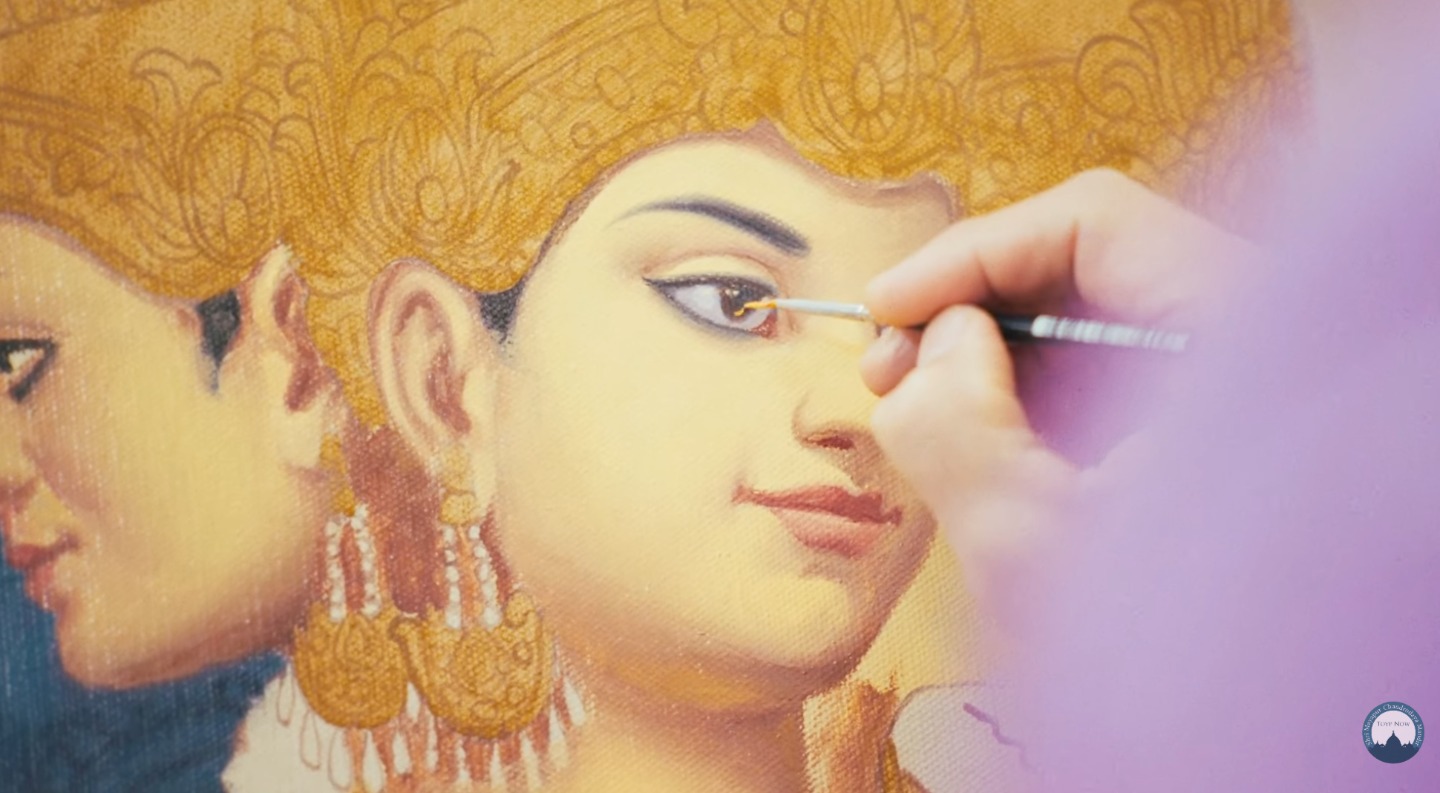
The Nrsimhadeva Paintings for TOVP represent a remarkable devotional art project that seeks to visually narrate one of the most powerful pastimes described in the Śrīmad-Bhāgavatam. These paintings are being created for the interior of the Temple of the Vedic Planetarium (TOVP) in Śrīdhāma Māyāpur, the spiritual headquarters of the Kṛṣṇa consciousness movement.
Through sacred imagery, artistic devotion, and philosophical depth, the Nrsimhadeva Paintings for TOVP aim to present the timeless story of the Lord’s appearance to protect His devotee Prahlāda Mahārāja. This artistic offering follows the tradition established by His Divine Grace A. C. Bhaktivedanta Swami Prabhupāda, who emphasized the importance of devotional art in communicating transcendental knowledge.
In the Vedic tradition, art is not merely decoration; it is seva—loving service to the Supreme Lord. Thus these paintings are intended not only to beautify the temple but also to educate and spiritually uplift visitors.
The Vision Behind the Nrsimhadeva Paintings for TOVP
The Nrsimhadeva Paintings for TOVP are part of a grand initiative to enrich the spiritual atmosphere of the Temple of the Vedic Planetarium. The TOVP itself is envisioned as a cultural and spiritual landmark that presents Vedic cosmology and devotional philosophy to the entire world.
Śrīla Prabhupāda desired that the temple in Māyāpur would become a place where people from every nation could understand the philosophy of bhakti-yoga—the path of loving devotional service to the Supreme Personality of Godhead, Śrī Kṛṣṇa.
To fulfill this vision, devotional artists are creating a series of sixteen monumental paintings illustrating the dramatic events of Lord Nṛsiṁhadeva’s appearance. These artworks will guide visitors through the entire narrative, making the teachings of the Bhāgavatam accessible through visual storytelling.
Such sacred paintings serve as a bridge between philosophy and experience, allowing viewers to contemplate transcendental truths through form, color, and emotion.
The Story Depicted in the Paintings
The Curse of Jaya and Vijaya
The narrative presented in the Nrsimhadeva Paintings for TOVP begins with the well-known incident of the four Kumāras—Sanaka, Sanātana, Sanandana, and Sanat-kumāra.
These eternally liberated sages once attempted to enter the spiritual world of Vaikuṇṭha but were stopped by the gatekeepers Jaya and Vijaya. Feeling obstructed, the sages cursed them to take birth in the material world.
This curse eventually resulted in their appearance as the powerful demons Hiraṇyākṣa and Hiraṇyakaśipu. Such events illustrate the mysterious workings of the Lord’s divine plan, where even apparent misfortune becomes an instrument for revealing the Lord’s glory.
The Rise of Hiraṇyakaśipu
Another dramatic theme illustrated in the Nrsimhadeva Paintings for TOVP is the tyranny of the demon king Hiraṇyakaśipu.
Through severe austerities (tapasya), he obtained extraordinary boons from Lord Brahmā and became nearly invincible. Empowered by his arrogance, he attempted to establish himself as the supreme controller of the universe.
The Śrīmad-Bhāgavatam explains that such pride arises from ahaṅkāra, false ego, which makes the conditioned soul forget the Supreme Lord.
The paintings capture the grandeur of Hiraṇyakaśipu’s palace and his oppressive rule, visually conveying the atmosphere of fear that prevailed during his reign.
The Devotion of Prahlāda Mahārāja
At the heart of the Nrsimhadeva Paintings for TOVP lies the sublime character of Prahlāda Mahārāja, the saintly son of Hiraṇyakaśipu.
Despite being born in a demonic family, Prahlāda possessed pure devotion (śuddha-bhakti) to Lord Viṣṇu. From his earliest childhood he constantly remembered the Lord and instructed others in devotional service.
The Bhāgavatam glorifies Prahlāda as an example of unwavering faith. Even when subjected to severe persecution by his father—poison, fire, and attempts to kill him—Prahlāda remained fearless, always chanting the holy names of the Lord.
The artists carefully depict these scenes of persecution and divine protection, emphasizing the triumph of devotion over tyranny.
The Appearance of Lord Nrsimhadeva
The most dramatic moment portrayed in the Nrsimhadeva Paintings for TOVP is the extraordinary appearance of Lord Nṛsiṁhadeva.
When Hiraṇyakaśipu angrily demanded to know where Prahlāda’s God was, the child replied that the Lord is present everywhere—even within a pillar.
Enraged, the demon struck the pillar, and from it emerged the half-man, half-lion incarnation of the Supreme Lord. This form is described as ugra—terrifying to the demons yet protective to the devotees.
The paintings capture the intensity of this moment: the pillar bursting open, the divine form of Nṛsiṁhadeva emerging, and the cosmic justice that follows.
This event illustrates the Vedic principle that the Lord always protects His devotees (rakṣaṇa).
The Deliverance of Hiraṇyakaśipu
Another powerful scene within the Nrsimhadeva Paintings for TOVP shows the Lord defeating Hiraṇyakaśipu.
Because of the demon’s clever boon, he could not be killed by man or beast, indoors or outdoors, during day or night, or by any weapon. Yet the Lord effortlessly transcended these conditions.
At twilight (sandhyā), on the threshold of the palace, Lord Nṛsiṁhadeva placed the demon on His lap and destroyed him with His nails.
This moment demonstrates the ultimate supremacy of the Lord, who cannot be limited by material conditions.
The Coronation of Prahlāda Mahārāja
The final sequence in the Nrsimhadeva Paintings for TOVP concludes with the coronation of Prahlāda Mahārāja.
After pacifying Lord Nṛsiṁhadeva with heartfelt prayers, Prahlāda was installed as the righteous king. His reign symbolizes the restoration of dharma, the eternal principles of righteousness and devotion.
These concluding paintings depict divine peace and spiritual harmony, contrasting with the earlier scenes of conflict and oppression.
Thus the entire series presents a complete spiritual narrative—from arrogance and tyranny to devotion and divine protection.
The Devotional Effort of the Artists
Creating the Nrsimhadeva Paintings for TOVP requires immense dedication and spiritual focus.
One of the artists involved, Rasikananda Dāsa, has explained that each painting may take three to six months to complete. The level of detail is extraordinary: intricate architecture, elaborate ornaments, expressive figures, and accurate scriptural references.
Such artwork is sometimes called “Kṛṣṇa art,” a term encouraged by Śrīla Prabhupāda to describe devotional paintings that communicate transcendental knowledge.
For the artists, the work is not merely technical craftsmanship—it is devotional meditation. By contemplating the pastimes of the Lord while painting them, the artists engage in a form of bhakti-yoga.
Sacred Art as Spiritual Education
The Nrsimhadeva Paintings for TOVP also serve an educational purpose.
In the Vedic tradition, sacred art has always been used to convey philosophical teachings. Temples were historically decorated with sculptures and paintings that illustrated the scriptures.
Such visual storytelling helps visitors understand complex spiritual narratives even without reading lengthy texts.
When pilgrims walk through the TOVP and observe these paintings, they will experience the Bhāgavatam not only through philosophy but through living imagery.
In this way, the temple becomes a place where art, devotion, and knowledge harmoniously unite.
Conclusion: The Spiritual Impact of Nrsimhadeva Paintings for TOVP
The Nrsimhadeva Paintings for TOVP represent a profound offering of devotion, creativity, and philosophical expression. Through these monumental artworks, the dramatic story of Lord Nṛsiṁhadeva and His devotee Prahlāda Mahārāja will inspire generations of visitors.
Such sacred paintings fulfill the vision of presenting Vedic wisdom in a powerful and accessible form. They remind us that the Supreme Lord always protects His sincere devotees and ultimately establishes righteousness.
As these artworks gradually appear within the Temple of the Vedic Planetarium, they will stand as timeless reminders of the eternal teachings of the Śrīmad-Bhāgavatam.
Indeed, the Nrsimhadeva Paintings for TOVP are not simply works of art—they are expressions of devotion meant to awaken spiritual consciousness in the hearts of all who behold them.
Deepen your Bhakti-yoga practice, harmonize relationships, and receive guided coaching — all at Vedavarsity.com