Naimisaranya Temple: Sacred Vishnu Forest of India
The holy land of Naimisaranya Temple stands as one of the most revered spiritual centers in Vedic tradition. Located in Naimisaranya, this sacred forest is glorified as one of the 108 Divya Desams—celestial abodes of Lord Vishnu praised in the Tamil hymns of the Alwars. The Naimisaranya Temple is unique, for here the Lord is worshipped not merely in deity form but as the very forest itself (āranya-svarūpa), revealing a profound dimension of divine presence.
Naimisaranya Temple: Location and Sacred Identity
The Naimisaranya Temple is situated in the state of Uttar Pradesh, near the banks of the sacred Gomati River, and is accessible via Lucknow. Traditionally known as Nimsar or Nimkhar, this region is part of the sacred Vada Naadu (northern division) of Divya Desams.
Presiding here is Lord Vishnu as Devarajan (Śrī Hari), along with His consort Pundarikavalli (Harilakṣmī). The temple’s sacred tank is the renowned Chakra Theertham, and the divine structure is crowned by the Śrī Hari Vimanam.
Unlike conventional temples, the entire forest of Naimisaranya is revered as the embodiment of the Lord, signifying that the Supreme pervades all existence (sarvaṁ khalv idaṁ brahma).
Spiritual Importance in Vedic Tradition
The Naimisaranya Temple holds a central place in Vedic history. It is described as the residence of 60,000 sages (ṛṣis), who gathered here to hear discourses on the great epics and Purāṇas.
Great sages such as Vyasa and Suka delivered sacred teachings in this forest. It is here that the essence of the Mahabharata and the Ramayana was expounded for the benefit of humanity.
Thus, the Naimisaranya Temple is not merely a pilgrimage site but a living center of spiritual knowledge (jñāna).
Legend of the Chakra and Origin of Naimisaranya
Brahma’s Divine Wheel
According to the Vayu Purana and the Brahmanda Purana, Lord Brahma released a divine wheel (manomaya chakra) after worshipping Lord Shiva.
The sages were instructed to follow this radiant wheel, and wherever it came to rest would be the most sacred place for penance. The wheel eventually stopped at Naimisaranya, where its rim shattered.
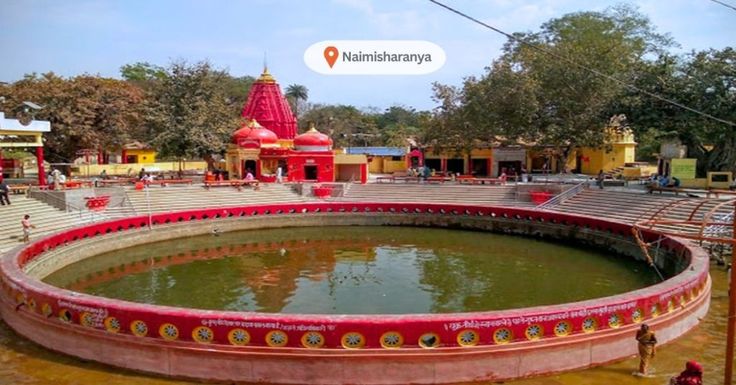
This sacred spot became the Chakra Theertham, the heart of the Naimisaranya Temple, and a powerful center of spiritual energy.
Meaning of “Naimisha”
Another legend from the Varaha Purana explains that the name Naimisha comes from nimisha (a moment), as Lord Vishnu destroyed the entire army of demons in a single instant at this place.
Thus, the Naimisaranya Temple represents the swift destruction of ignorance by divine grace.
Chakra Theertham and Sacred Waters
The Chakra Theertham is the most sacred water body at the Naimisaranya Temple. This hexagonal tank marks the spot where Brahma’s wheel fell and where Lord Vishnu used His Sudarshana Chakra to annihilate evil forces.
Bathing here, especially on auspicious days like Somavati Amavasya, is believed to purify sins and elevate one’s consciousness.
Other sacred waters include:
- Pancha Prayag
- Godavari Tirtha
- Kasi Tirtha
- Gangotri Tirtha
These holy waters symbolize the convergence of spiritual energies within the sacred geography of Naimisaranya.
Temples and Sacred Sites in Naimisaranya
The Naimisaranya Temple region includes numerous shrines that enhance its spiritual significance:
- Temple of Chakranarayana (Vishnu)
- Shrines of Lord Rama and Lakshmana
- Temple of Lord Ganesha
- Veda Vyasa shrine en route to the river
- Puran Mandir, associated with scriptural recitations
The forest is also home to the revered temple of Lalita Devi, attracting large gatherings of devotees, especially on new moon days.
Association with Great Personalities
The sanctity of the Naimisaranya Temple is further enhanced by its association with great saints and historical figures:
- Adi Shankaracharya visited and sanctified this place
- Surdas is believed to have resided here
In the Śrī Vaiṣṇava tradition, institutions such as Ahobila Mutt and Ramanuja Kootam continue the lineage of devotion and philosophical teaching.
Parikrama and Sacred Traditions
A significant spiritual practice associated with the Naimisaranya Temple is the parikrama (circumambulation pilgrimage).
This sacred journey begins at Nimkhar and extends to Misrikh, covering various holy sites such as:
- Korauna
- Haraiya
- Gomati banks
- Deogaon
Misrikh and Dadichi Kund
At Misrikh lies the sacred Dadichi Kund, associated with sage Dadhichi, who sacrificed his body so that his bones could be used to create a divine weapon to destroy demons.
Another important site is the Hatyaharana Tirtha, where Lord Rama is believed to have purified Himself after the battle with Ravana.
Glorification by Tirumangai Alwar
The Naimisaranya Temple is glorified in the hymns (paasurams) of Tirumangai Alvar, one of the prominent Alwars of the Bhakti tradition.
In his Tamil verses, he lovingly refers to Lord Vishnu of Naimisaranya as:
“Naimisaaranyattull en Taai” — “My Lord who resides in Naimisaranya.”
Such expressions reveal the intimate devotional mood (bhāva) cultivated by the saints.
Philosophical Understanding: Vishnu as Aranya Swaroopi
One of the most unique aspects of the Naimisaranya Temple is the conception of Vishnu as Āranya Svarūpa—the Lord manifest as a forest.
This teaches a profound Vedic truth:
- The Supreme is all-pervading (vyāpaka)
- Nature itself is a manifestation of the divine energy (prakṛti)
- Spiritual realization is not confined to temples but extends to all creation
By meditating in such a sacred environment, the mind becomes purified and attuned to higher consciousness.
Conclusion: Naimisaranya Temple and Eternal Wisdom
The Naimisaranya Temple stands as a timeless beacon of Vedic wisdom, devotion, and spiritual practice. From the presence of ancient sages to the divine pastimes of Lord Vishnu, every aspect of this sacred forest invites deep reflection.
By visiting or meditating upon the Naimisaranya Temple, one connects with a lineage of spiritual seekers who pursued truth beyond material existence.
Ultimately, the Naimisaranya Temple reminds us that the Supreme Lord resides not only in sacred structures but in every aspect of creation—and that sincere inquiry, devotion, and association with saintly teachings lead one toward liberation (mokṣa).
Deepen your Bhakti-yoga practice, harmonize relationships, and receive guided coaching — all at Vedavarsity.com