


The city of Mathura is famous as the birthplace of Lord Shri Krishna, the Supreme Personality of Godhead, who appeared in the city within the prison cell of Kamsa five thousand years ago. A verse in the Saura Purana says, “Here is the place named Mathura, famous in the three worlds. Its pathways are purified by the dust from the lotus feet of Lord Krishna. Simply by its touch people can attain salvation from the miseries and bondage of the material world.”
The Skanda Purana says, “O King, those who constantly remember Mathura and the King of Mathura [Krishna] attain devotional service at the feet of Lord Hari.” Even before the important event of Lord Krishna’s birth, Mathura was already well known and considered to be the holiest city in India. It is stated in the Adi-Varaha Purana, “Although it may be possible to count all the particles of dust on the face of the earth, it is not possible to count all the holy places in Mathura.” The same Purana also says, “O Devi, the result one receives by residing in Varanasi for one thousand years is achieved by residing in Mathura simply for a moment.”
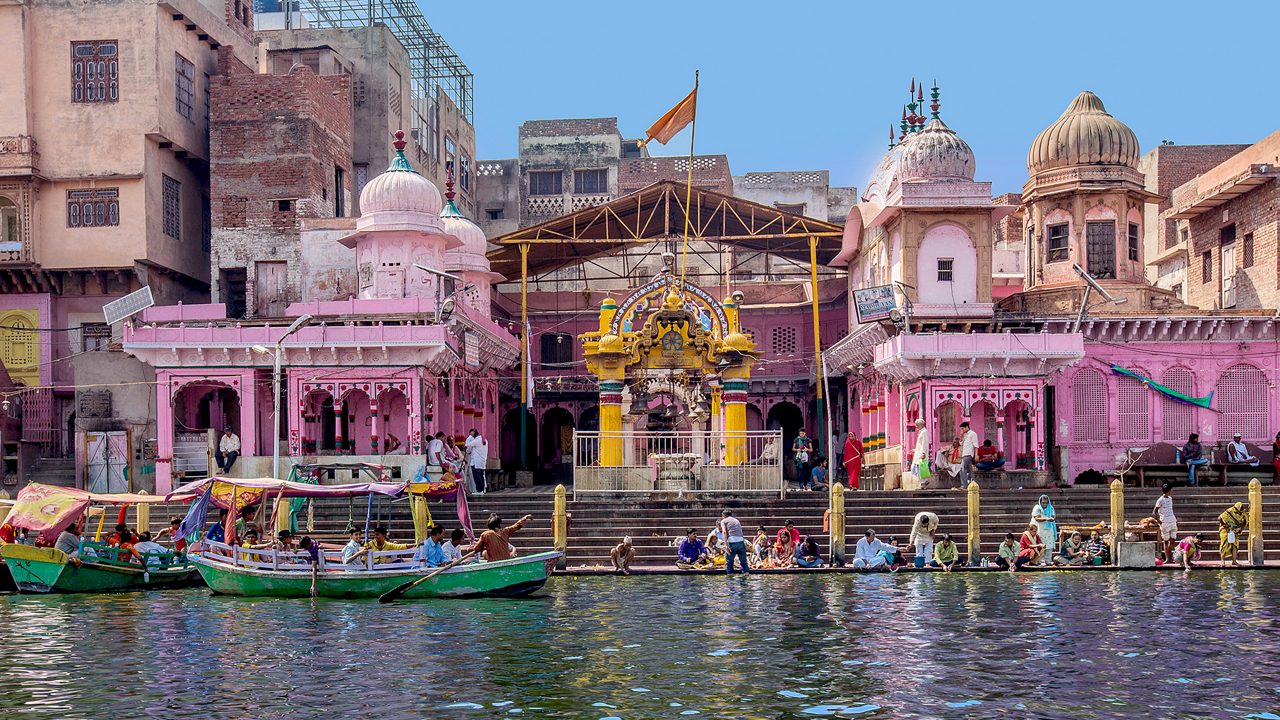
According to the Puranas, the holy city of Mathura, also known as Mathura Puri, is situated on the western bank of the Yamuna River within the boundary of the sacred forest of Madhuvana. In the Padma Purana it says, “O best of the brahmanas, when a person becomes purified through meditation, pious activities, and austerities, only then can he attain the darshana of My auspicious Mathura Puri. Others cannot see Mathura in thousands of kalpas.” Mathura is the place where during the Satya-yuga, the incarnation of Vishnu, Lord Varahadeva, spoke the Adi-Varaha Purana to Bhumi Devi, while He rested at Vishrama Ghata after having saved the earth from the ocean of devastation. In the Skanda Purana it is said, “Is there any type of result which cannot be attained in Mathura, where Kshetrapala Mahadeva exists eternally and where there are holy places like Vishrama-ghata.”
The holy city of Mathura is celebrated in the Vedic scriptures as having the shape of a half-moon which is caused by the River Yamuna running in a crescent shape along the city’s eastern boundary. The Adi-Varaha Purana says, “Those who live in this half-moon shaped place undoubtedly attain liberation. One who controls his eating and baths here achieves the imperishable abode. Of this there is no doubt. Hey Devi! Those who leave their body at this crescent moon-shaped region reach My abode, Vaikuntha.” The same Purana also says, “The Siddhas, Bhutas, and Devas see the inhabitants of Mathura as possessing four arms.”
Mathura is mentioned in the Garuda Purana to be one of the famous ‘sapta-puris’ or the ‘seven holy cities of India, where one can easily achieve moksha or liberation. The others are Haridwara, Kashi, Ujjain, Dwaraka, Kanchi, and Ayodhya. The Gopala-tapani Upanishad (236) says, “As on the summit of Mount Sumeru there are seven cities that fulfill all desires, so even on earth are seven cities that fulfill desires and grant liberation. Among them the city of Gopala Puri is directly the spiritual world. Protected by My chakra, this city of Mathura, or Gopala Puri, stands in this world as a lotus stands on a lake.” In the Adi-Varaha Purana it says, “They who die in the twenty yojana (160 miles) area of Mathura (Vraja Mandala) become perfect and attain the supreme destination.”
The city of Mathura has been built upon a series of hills (tilas) and nine are most famous including: Ambarisha-tila, Bali-tila, Rishi-tila, Dhruva-tila, Gatashrama-tila, Kamsa-tila, Hanumana-tila, Kali-yuga-tila, and Rajaka-vada-tila. The famous kundas of Mathura include; Balabhadra-kunda, Potra-kunda, Saraswati-kunda, Mahavidya-kunda, and Siva-tala. The old walled city is also famous for its four gates: Vrindavana Gate, Dig Gate, Bharatpur Gate and Holi Gate. The only city gate existing at the present time is Holi Gate which was rebuilt during the rule of the British Raj.
Deepen your Bhakti-yoga practice, harmonize relationships, and receive guided coaching — all at Vedavarsity.com