


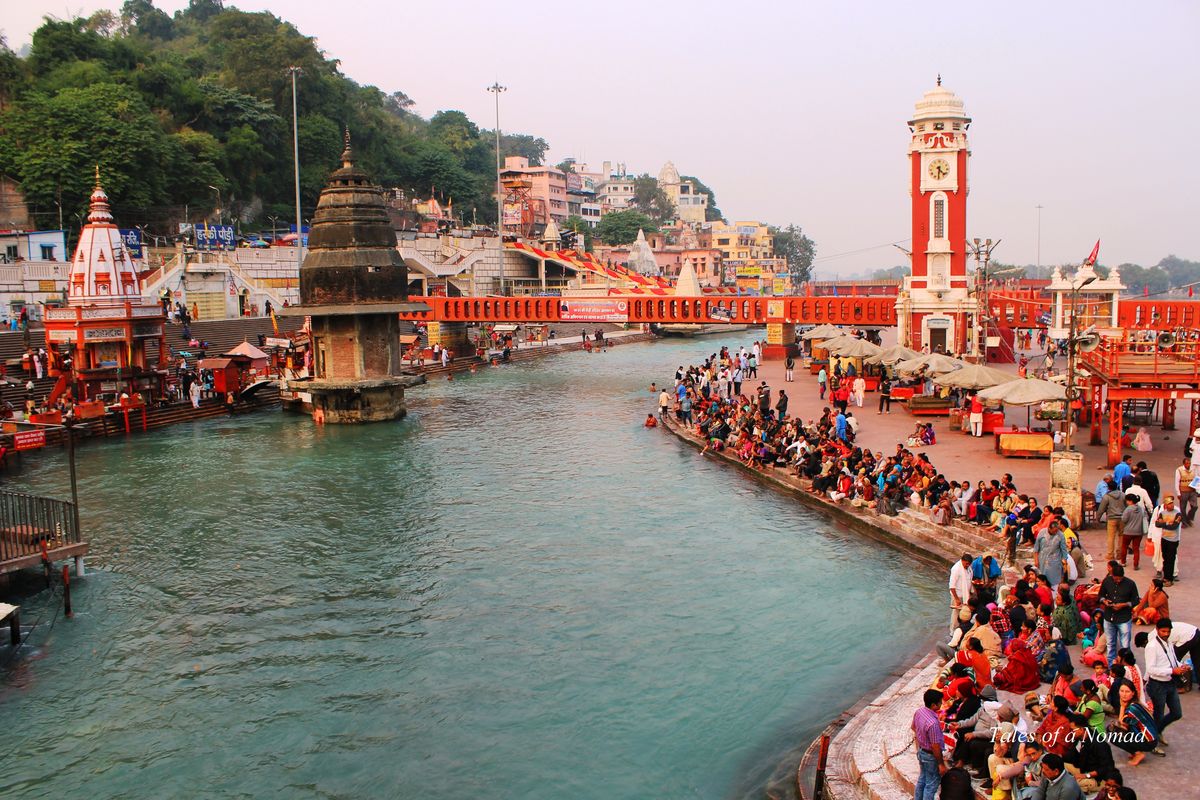
Haridwar, situated at the very foothills of the majestic Himalayas, marks the sacred point where the holy river Gaṅgā descends from the mountains and enters the vast plains of Bhārata–varṣa. From time immemorial, this hallowed city has been revered as a foremost place of pilgrimage, sanctified by the presence of innumerable saints and devotees. The renowned Chinese pilgrim Xuanzang (Hiuen Tsang), who journeyed through India during the first millennium of the Common Era, describes Haridwar under the name Mayura, situated upon the eastern banks of the Gaṅgā. Even today, the landscape of Haridwar is adorned with numerous temples and āśramas, evoking in the visitor a deep sense of stepping into another, timeless world.
According to ancient legend, it was here that King Bhagīratha performed his arduous austerities to bring the celestial Gaṅgā down to earth for the deliverance of his forefathers, who had been reduced to ashes by the curse of the sage Kapila. The sacred site known as Kapilastāna, situated within Haridwar, is pointed out as the hermitage of that great sage. In those ancient days, Haridwar was thus known as Gaṅgādvāra—“the gateway of the Gaṅgā.”
Haridwar, together with its neighboring holy town Ṛṣikeśa, is considered the gateway to the supreme Himalayan pilgrimage shrines of Badrinātha and Kedāranātha. The commencement of this great pilgrimage traditionally coincides with the time when the sun enters the zodiac sign of Aries (Mesha-rāśi). Haridwar is also celebrated as one of the principal sites for the auspicious Kumbha–melā, a grand festival recurring once every twelve years, when the planet Jupiter (Bṛhaspati) transits through the sign of Aquarius (Kumbha–rāśi).
Five sacred bathing spots (paṣca–tīrthas) are especially venerated at Haridwar—Gaṅgādvāra, Kankhala, Nīla–parvata, Bilva–tīrtha, and Kusāvarta. Among these, the chief and most revered is Hari–ki–pāurī, renowned for bearing the divine footprint of Lord Viṣṇu imprinted upon a stone within its ancient wall. Beside it stands the temple of Gaṅgādvāra, the most prominent of the many temples gracing this holy town.
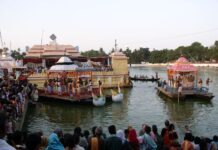
Each evening, as twilight descends, the renowned Gaṅgā–ārati is performed at seven o’clock—a sight of extraordinary beauty and devotion. At that sacred hour, the worship of Mother Gaṅgā is simultaneously conducted in the temples of Haridwar, while hundreds of devotees gather along the banks at Hari–ki–pāurī to participate in this moving ceremony. With hearts filled with reverence, they offer lamps and flowers into the flowing current of the sacred river, watching as innumerable flickering lights float downstream—a mesmerizing vision of divine worship upon the waters.
In the vicinity of Haridwar lie the towns of Māyāpuri and Kankhala. It is at Kankhala that the ancient Dakṣeśvara temple stands, traditionally identified as the site of the ill-fated sacrifice performed by Dakṣa, which was later destroyed by Lord Śiva in righteous anger.
Deepen your Bhakti-yoga practice, harmonize relationships, and receive guided coaching — all at Vedavarsity.com