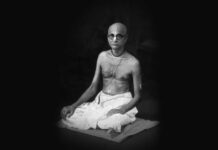




Gauracaraṇa Cakravartī was born near Dulālbājār in the district of Noākhālī (present-day Bangladesh). He was the only child of his parents. Having lost his mother in early childhood, he was raised by his father, who took the boy with him wherever he traveled. Soon thereafter, his father also passed away, leaving Gauracaraṇa completely orphaned and without material shelter. Although he wandered without fixed residence, he naturally developed qualities such as truthfulness, simplicity, and compassion.
At that time, Dulālbājār was inhabited by many Vaiṣṇavas. Observing the gentle nature and good character of the boy, the local adhikārī gave him shelter and, out of affection, trained him in the principles, customs, and practices of Vaiṣṇavism.
Once, Gauracaraṇa went on pilgrimage to Śrīkunda to visit Śrī Viśvanātha. There he observed innumerable streams of water descending from a higher elevation. He noticed that when the chanting of the holy name filled the air, the flow of water appeared to increase. Desiring to see the source of this thousand-streamed spring, he traveled through mountainous regions accompanied by several wandering mendicants. Eventually, they reached a remote and dangerous area where shelter was unavailable. Stricken with hunger and cold, Gauracaraṇa fearlessly chanted the holy name and, after undergoing severe hardship, returned safely from the forest. From that time onward, he became increasingly detached from worldly life.
Soon afterward, Gauracaraṇa set out on foot, penniless, for Jagannātha Purī. After taking darśana of Lord Jagannātha, he continued to visit other holy places. He lived beneath trees, accepted food only when it was offered unasked, and otherwise fasted. After several months of wandering in this manner, he experienced a change of heart and felt drawn to a deeper spiritual purpose. He returned to Purī, where he maintained himself by accepting food from the chātrās, taking darśana of Lord Jagannātha, and resting beneath trees or along the roadside.
At that time, Śrī Rādhāramaṇa dāsa regularly performed saṅkīrtana through the streets of Purī. One day, while chanting at the main gate of the Jagannātha temple, he attracted the attention of Gauracaraṇa and initiated him. Gauracaraṇa felt that after a long search he had attained the cherished goal of his life. A deep bond of affection developed between guru and disciple, and Gauracaraṇa dedicated himself completely to the service of Rādhāramaṇa dāsa. Upon the instruction of his guru, he later approached Kartā Bābājī of Nārāyaṇa Chātrā and accepted veśāśraya, receiving the name Śrī Govinda dāsa.
By the desire of Kartā Bābājī, Govinda dāsa devoted himself fully to the loving service of Rādhāramaṇa dāsa. He was entrusted with serving the Vaiṣṇavas by collecting alms, while he himself accepted only the remnants left by the devotees. He maintained his body by begging prasāda from various chātrās and engaged constantly in service, passing his days in spiritual happiness.
Sometimes large quantities of mahāprasāda, along with various preparations from the maṭha, would arrive, and many invited and uninvited guests would partake. Afterward, the devotees would playfully pour the remnants upon Govinda dāsa, loudly chanting “Haribol.” Seeing his humble reactions and gentle protests, the devotees would forget their own hunger and feel fully satisfied. Such incidents occurred repeatedly.
Govinda dāsa was a close associate of Navadvīpa dāsa and Govinda dāsa (Govindadāda), and together they were always alert in the service of Rādhāramaṇa. Govinda dāsa underwent many tests of obedience. On one occasion, he was ordered to offer daṇḍavat praṇāma at places used as latrines by the residents of Nīlācala along the road to the Jagannātha temple. Despite ridicule from passersby, he followed the instruction without hesitation. On another occasion, while suffering from severe fever, he was instructed to bathe 108 times at Narendra-sarovara, which he did joyfully and without question.
Govinda dāsa could intuitively understand the desires of Rādhāramaṇa and would often prepare offerings even before they were requested. All were astonished by his extraordinary cooking ability, meticulous attention to service, deep attachment to guru and Vaiṣṇava-sevā, and compassion for the poor, afflicted, and neglected. Those who witnessed his participation in saṅkīrtana with devotees such as Navadvīpa, Gokula, Rāmadāsa, and Jayagopāla experienced an atmosphere of profound spiritual joy.
One morning, Rādhāramaṇa dāsa wrote a letter instructing Govinda dāsa to proceed immediately to Vṛndāvana and reside at Rādhā-kuṇḍa, maintaining himself by mādhukarī and performing jhāḍu-sevā. Govinda dāsa accepted the order without hesitation. Accompanied by Nityasvarūpa brahmacārī, Śyāmānanda dāsa, and Nitāidāsa, he traveled to Vṛndāvana.
There he circumambulated Girirāja Govardhana and resided at Rādhā-kuṇḍa, performing jhāḍu-sevā continuously for six years without interruption. During this period, he rarely left Rādhā-kuṇḍa and lived with intense concentration and austerity. Through such service, he attained deep spiritual realization.
Later, when Rādhāramaṇa dāsa arrived in Vṛndāvana, Govinda dāsa met him and, by his instruction, returned to Jagannātha Purī. Afterward, while staying at Navadvīpa, Rādhāramaṇa dāsa suddenly passed away. Govinda dāsa was overwhelmed by separation. After some time, he received a divine instruction in a dream to go to Jagannātha Purī and dedicate himself to the service of Śrī Haridāsa Ṭhākura.
At that time, the samādhi temple of Haridāsa Ṭhākura in Purī had fallen into neglect and was threatened with auction due to debt. Govinda dāsa single-handedly revived the service, personally carrying out all aspects of worship, offering bhoga with devotion, and distributing prasāda to the poor, as well as to birds and animals, before taking anything himself. For twenty-two years he continued this service without criticizing others, giving shelter to the shelterless and sustenance to the destitute.
Before the end of his life, he trained a disciple thoroughly in all details of the service, revealing both siddhānta and līlā so that the worship would continue without deviation. Govinda dāsa showed special mercy to those rejected by society, drawing them close with affection and instructing them in devotion to Śrī Rādhāramaṇa.
In his final years, he resided near Śrī Rādhāramaṇa Bāga at Navadvīpa, where Vaiṣṇava-sevā and sat-saṅga continued regularly. He was especially fond of Śrī Caitanya-caritāmṛta and Bṛhad-bhāgavatāmṛta. In the year 1930, Śrī Govinda dāsa departed this world at Navadvīpa.
Deepen your Bhakti-yoga practice, harmonize relationships, and receive guided coaching — all at Vedavarsity.com