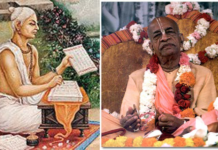
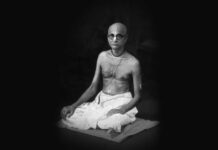
Gopāla Guru Gosvāmī was a disciple of Śrī Vakreśvara Paṇḍita, one of the prominent associates of Śrī Caitanya Mahāprabhu. His former name was Makaradhvaja Paṇḍita, and his father was Murāri Paṇḍita (see Vakreśvara-carita, Madhya, p. 116).
From early childhood, Gopāla served Śrī Caitanya Mahāprabhu personally. On one occasion, shortly before the Lord’s disappearance from Purī, Gopāla noticed that while resting the Lord held His tongue between His teeth. In a respectful and light-hearted manner, Gopāla remarked that although the Lord’s actions were manifestations of His own līlā, if an ordinary living entity were to imitate such behavior, it would hinder the chanting of the holy name. Hearing this, the Lord approved his statement and declared that from that time onward he would be known as “Guru.” Thus he became celebrated as Gopāla Guru.
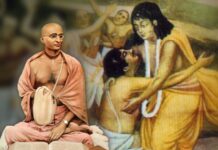
After the disappearance of Śrī Caitanya Mahāprabhu, Vakreśvara Paṇḍita was entrusted with the service of the Gambhīrā in the house of Kāśī Miśra, where the Lord had resided during His stay in Purī. Following Vakreśvara Paṇḍita’s disappearance, Gopāla Guru succeeded him as the sevāita of the Śrī Rādhākānta Deity at the Gambhīrā. When Śrī Narottama dāsa Ṭhākura later met Gopāla Guru at Nīlācala, the two devotees embraced one another in deep spiritual emotion (see Bhakti-ratnākara 8.389).
When reports circulated regarding Gopāla Guru’s being addressed as “guru” by Lord Caitanya, Śrī Abhirāma Gosvāmī came to Purī to ascertain the truth. At that time, Gopāla Guru took full shelter of the Lord, who placed His lotus feet upon Gopāla’s head, marking him with the impression of His footprint and granting him protection. Thereafter, Gopāla Guru remained undisturbed and continued his service.
Between approximately 1538 and 1548 CE, Gopāla Guru was responsible for the worship of Śrī Rādhākānta. During this period, the temple was thoroughly renovated. On his advice, four additional Deities—Śrī Rādhā, Lalitā-sakhī, Śrī Nityānanda Prabhu, and Śrī Gaurāṅga—were installed. Śrī Rādhā and Lalitā were placed on either side of Rādhākānta, while Nityānanda Prabhu and Lord Gaurāṅga were installed in dancing postures. An existing painting of Advaita Ācārya was respectfully preserved.
Gopāla Guru formally undertook the service of Śrī Rādhākānta on the dvādaśī day of the bright fortnight of Māgha. This occasion is commemorated annually with a festival. It is traditionally believed that on this day Gopāla Guru manifests briefly near the Lord’s seat. Several personal items used by Śrī Caitanya Mahāprabhu—such as His wrapper, waterpot, and wooden sandals—are preserved at the Gambhīrā.
In his later years, Gopāla Guru entrusted the service of Rādhākānta to his disciple Dhyānacandra. Due to a procedural irregularity, royal officials temporarily seized the temple during Gopāla Guru’s funeral rites. Hearing of this, Dhyānacandra lamented greatly. According to traditional accounts, Gopāla Guru then revived long enough to return to the temple, after which the officials withdrew their action. He continued to oversee the service through the reigns of successive kings and finally disappeared on the navamī day of the bright fortnight of Kārtika.
It is said that Gopāla Guru later manifested in Vraja, where he was seen performing bhajana near Vaṁśīvaṭa. Upon being requested by Dhyānacandra to return to Nīlācala, Gopāla Guru instructed that an image of himself be carved from the wood of a nimba (margosa) tree standing before the Rādhākānta temple and installed in the jagamohana. This image remains there to this day.
Gopāla Guru Gosvāmī authored a work entitled Gaurā-govindārcana-paddhati, describing the worship of Śrī Gaurāṅga and Śrī Govinda.
Deepen your Bhakti-yoga practice, harmonize relationships, and receive guided coaching — all at Vedavarsity.com