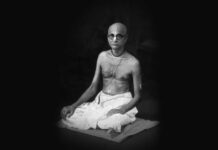
Gaurakisora Dasa Babaji, the paramahamsa-guru of Bhaktisiddhanta Sarasvati Thakura, was the most exalted servant of the Lord and a perfect example of humility, renunciation, and strict devotional life (Bhakti-rasamrita-sindhu 1.1.25). He never accepted any material possession and lived a life of extreme simplicity. For clothing he used discarded loincloths from corpses, and for food he begged, soaking rice in river water and garnishing it with salt and chili (Bhagavata 7.5.23, purport).
Born as Vansidasa in a Vaisya family in Bagjana near Tepakhola on the bank of the Padma, he was a householder engaged in agriculture and trade. After the death of his wife, he renounced all family life and came to Vrndavana, where he was initiated into vairagi-vesa by Bhagavata Dasa Babaji, a disciple of Jagannatha Dasa Babaji (Caitanya-caritamrita Adi 5.45).
Gaurakisora Dasa Babaji survived on madhukari (alms of honey or rice) and slept beneath trees. He constantly offered obeisances to all living entities, trees, flowers, and land, considering them manifestations of Krsna. He spent thirty years in Vraja serving the Lord’s pastimes, and later came to Navadvipa, where he displayed various ecstatic moods of devotion (Caitanya-caritamrita Madhya 23.90).
He often chanted the holy names of the Lord, sometimes dancing ecstatically on the banks of the Ganges, and sometimes lying unconscious in spiritual absorption. He wore only a strip of cloth and sometimes went completely naked. When japa beads were unavailable, he knotted a cloth to serve as a substitute for chanting (Caitanya-caritamrita Antya 6.125). He occasionally visited Godruma to hear Srimad Bhagavatam from Bhaktivinoda Thakura.
Gaurakisora Dasa Babaji strictly observed rules of prasada. He refused food if it was offered with improper motives or by persons of impure character. Once he stopped speaking to a devotee for three days because prasada had been financed by a woman of questionable profession (Caitanya-caritamrita Antya 7.15). He advised that devotees avoid worldly charity that could distract from Hari-bhajan and emphasized that the chanting of the holy name alone can reveal the Supreme Lord (Bhagavad-gita 9.14; Caitanya-caritamrita Antya 6.22).
Even when invited by kings or wealthy men, he never accepted luxury, fearing attachment to wealth. To the Maharaja of Kasimbazar, he suggested that the Maharaja first give away all his wealth before engaging in devotional service (Caitanya-caritamrita Madhya 24.120).
He was extremely particular about living conditions for Haribhajan. Once he agreed to stay at a devotee’s house only if he could reside in the toilet room, which he sanctified through his devotion. This demonstrates that a realized devotee can practice Haribhajan anywhere, making that place spiritually sublime (Caitanya-caritamrita Antya 7.45).
Gaurakisora Dasa Babaji never delivered public discourses, yet his pure character attracted all. He taught that Srimad Bhagavatam should not be recited for material gain and that those chanting for remuneration are not properly engaged in devotional service (Caitanya-caritamrita Antya 6.55).
On Ekadasi, November 1915, Gaurakisora Dasa Babaji left this world. Bhaktisiddhanta Sarasvati Thakura personally arranged the burial of his divine guru, who had shown the path of pure renunciation and devotion to all (Caitanya-caritamrita Antya 7.125).
Deepen your Bhakti-yoga practice, harmonize relationships, and receive guided coaching — all at Vedavarsity.com