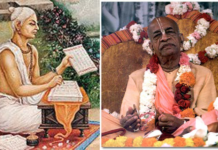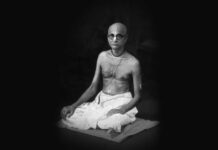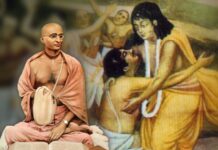
Gauragovindananda Svami, also known as Bhagavatasvami, was born in a high-caste Brahmana family in a prosperous village in Jessore district, Bangladesh. He lost his father and mother at a very young age and was brought up by his maternal grandfather, Sanyal Mahasaya, a middle-class professor noted for his hospitality (Caitanya-caritamrita Antya 4.23).
From early childhood, Gauragovinda displayed extraordinary devotional inclinations. Once, while his grandfather was away, he personally attended to a visiting brahmacari, offering obeisances, water, and service, and was deeply impressed by the saint’s appearance and demeanor. After the visitor departed, Gauragovinda realized he had not paid proper obeisances and ran to the brahmacari, calling out, “Thakura! Thakura!” (Caitanya-caritamrita Antya 4.24).
At the age of thirteen or fourteen, after the death of Sanyal Mahasaya, Gauragovinda left home to travel with a brahmacari, wearing the dress of a young Vaisnava. He came to the asrama of a Vaisnava guru, who was greatly pleased with the boy’s intelligence, devotional inclination, and vairagya. The guru predicted that the boy would become a shaven-headed hermit, fully engaged in transcendental service (Srimad Bhagavatam 1.2.11, purport).
Gauragovinda studied in Navadvipa under the guidance of a Vaisnava householder, learning scriptures in an ashram-like environment. Due to an incident with a widow, he left and continued wandering as an udasina, engaging in devotional practices. Eventually, he met the same brahmacari who had inspired him earlier to renounce home life, and together they visited the asrama of a highly advanced Vaisnava guru. There, Gauragovinda served the aged saint with humility, nursing him, massaging his body with ointments, and observing all regulations of devotional service. By the mercy of the guru, he received direct instruction in Srimad Bhagavatam and other sastras (Srimad Bhagavatam 1.5.25, purport).
During his training, Gauragovinda demonstrated miraculous spiritual qualities. He acquired perfect knowledge of the sastras through the mercy of saints and dreams, memorizing and understanding Srimad Bhagavatam, Upanisads, Nyaya, Mimamsa, Patanjala, and Vedanta philosophy without formal study (Caitanya-caritamrita Antya 4.45).
Around 1903 AD, he studied Vedanta philosophy under Paramananda Tirtha Maharaja of Kasi, following brahmacari vows, wearing tulasi-leaf garlands, applying the sectarian mark, and performing regular Krsnarcana rituals. In 1905–1906 AD, he observed Mathuravasa, living in an asrama atop Krsnaganga, serving sannyasis and Vaisnavas, and receiving mercy from a paramahamsa saint known as Devagiri Muni. He later visited Vrndavana, Govardhana, and observed mounavrata for one year, deepening his realization of Srimad Bhagavatam (Bhagavatam 1.5.25, purport).
Gauragovindananda Svami authored several books: Kripakusumanjali (1935 AD), Sadhanakusumanjali (1936 AD), Sriguruvaisnavabhaktikusumanjali (1940 AD), and Srililatattva-kusumanjali (1941 AD), documenting his interactions with prominent saints such as Paramananda Tirtha Svami, Bholanandagiri Maharaja, Krsnaprasada Dasa Babaji (Gudhibaba), Siddha Jagadisa Baba, and Ramadasa Kathia Baba.
He practiced intense bhajan in a dark cave at Kamyavana, Vraja, for seven years and later traveled to Srihatta, Tripura, Silchar, Dhaka, and Mymensingh, preaching and rescuing fallen souls. Gauragovindananda Svami departed this world on 8 Jaistha, 1349 BS (May–June 1942 AD), leaving behind a life of exemplary renunciation, scholarship, and devotional service (Caitanya-caritamrita Antya 4.125).
Deepen your Bhakti-yoga practice, harmonize relationships, and receive guided coaching — all at Vedavarsity.com