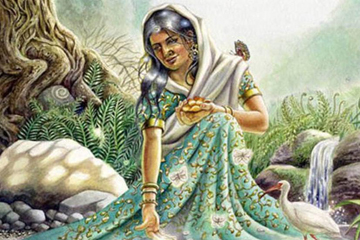
Saci Devi, the only daughter of King Naresanarayana of Puntiya in Rajsahi district (now in Bangladesh), was endowed with a religious temperament from childhood. She became proficient in vyakarana, kavya, and other scriptures at an early age (Caitanya-caritamrita Antya 6.12, purport). Though extremely beautiful, her heart was absorbed in Madanagopala, and she refused all worldly marriage proposals, declaring that she would never marry a mortal (Caitanya-caritamrita Antya 6.13, purport).
After the passing of her parents, Saci Devi temporarily managed the royal administration, but soon renounced all responsibilities and set out on pilgrimage. In Puri, she sought the shelter of a sat-guru, meeting Haridasa Pandita, a disciple of Ananta Acarya. Falling at his feet with tears, she prayed for guidance (Caitanya-caritamrita Antya 6.15, purport).
Haridasa initially advised her to return home to practice bhajana, but Saci Devi, firm in renunciation, continued her devotional service. Gradually, she gave up costly garments and ornaments, and under Haridasa’s instruction went out on madhukari in Vraja, covering herself with a simple tattered garment. Despite her austerity, her grace distinguished her from ordinary women. She bathed in the Yamuna, cleaned temple yards, performed parikrama, attended arati, and listened attentively to devotional discourses (Caitanya-caritamrita Antya 6.17, purport).
Seeing her unwavering devotion, Haridasa Pandita initiated Saci Devi in Radha-Krsna mantra on the thirteenth day of the bright fortnight in the month of Chaitra. She then studied Gosvami sastra under his guidance, becoming thoroughly conversant with Gosvami-siddhanta in a short period (Caitanya-caritamrita Antya 6.20, purport).
Together with Laksmipriya, another ardent devotee of Haridasa, Saci Devi performed Radhakunda bhajana and Govardhana parikrama daily. When Haridasa saw her purity and steadfastness, he instructed her to move to Puridhama (Puri) to continue her devotional service and preach Lord Caitanya’s teachings among the residents (Caitanya-caritamrita Antya 6.23, purport).
In Puri, Saci Devi resided in the dilapidated house of Sarvabhauma Pandita and recited from Srimad Bhagavatam to the devotees. Her recitation and commentaries became widely respected. Maharaja Mukunda-deva, impressed by her discourse, offered her a site near Sveta-ganga. Initially hesitant, she accepted the land following the command of Lord Jagannatha (Caitanya-caritamrita Antya 6.25, purport).
On the auspicious day of Varuni, desiring to bathe in the Ganges, she followed her guru’s instruction to remain in Sriksetra. That night, Lord Jagannatha appeared in her dream and assured her that the Ganges would flow to her. When Saci Devi went to bathe, she was miraculously carried by the waters into the restricted bathing place within the temple premises, fulfilling the Lord’s desire (Caitanya-caritamrita Antya 6.27, purport).
Due to misunderstanding, she was briefly imprisoned, but Lord Jagannatha appeared again to Maharaja Mukunda-deva in a dream, commanding her immediate release. The Maharaja prostrated at her feet, and Saci Devi granted mantra-diksa to him and the priests. From that time she was known as Gangamata Gosvamini, a revered acharya and spiritual guide (Caitanya-caritamrita Antya 6.28, purport).
As a token of devotion, Maharaja Mukunda-deva offered land and daily items of mahaprasada for the Matha of Gangamata. She permitted only two vessels of prasada, one vessel of vegetables, one cloth, and 160 paise to be sent daily after the noon offering. This custom continues to this day (Caitanya-caritamrita Antya 6.30, purport).
Gangamata Gosvamini’s life exemplifies vairagya, pure devotion, and unflinching surrender to guru and Lord Caitanya, serving as a model for devotional service in both Vrndavana and Puri.
Deepen your Bhakti-yoga practice, harmonize relationships, and receive guided coaching — all at Vedavarsity.com