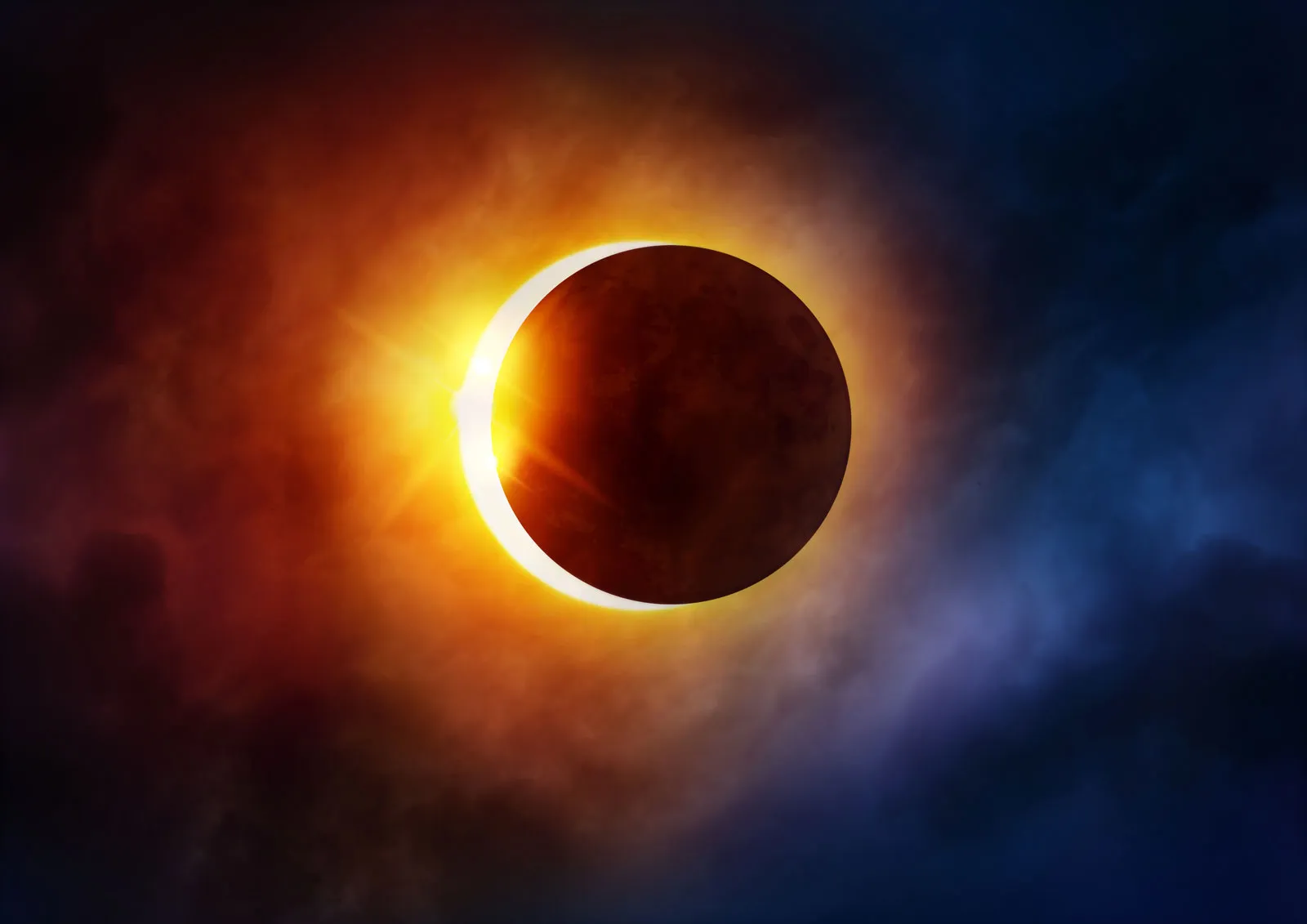
If we go 80,000 miles above the region of the Siddhas, Cāraṇas, and Vidyādharas, we come to the level of the planet called Rāhu. Some 80,000 miles above Rāhu we reach the level of the sun, which is said to lie between Bhūrloka and Bhuvarloka in the middle of antarikṣa (SB 5.20.43, 5.24.1). We note that these measurements account for only part of the distance from Bhū-maṇḍala to the sun, since this is given as 100,000 yojanas (or 800,000 miles) in SB 5.23.9p.
In the Vedic literature it is often mentioned that Rāhu causes solar and lunar eclipses by passing in front of the sun or moon. To many people, this seems to blatantly contradict the modern explanation of eclipses, which holds that a solar eclipse is caused by the passage of the moon in front of the sun and a lunar eclipse is caused by the moon’s passage through the earth’s shadow. However, the actual situation is somewhat more complicated than this simple analysis assumes.
The reason for this is that the Sūrya-siddhānta presents an explanation of eclipses that agrees with the modern explanation but also brings Rāhu into the picture. This work explicitly assumes that eclipses are caused by the passage of the moon in front of the sun or into the earth’s shadow. It describes calculations based on this model that make it possible to predict the occurrence of both lunar and solar eclipses and compute the degree to which the disc of the sun or moon will be obscured. At the same time, rules are also given for calculating the position of Rāhu and another, similar planet named Ketu. It turns out that either Rāhu or Ketu will always be lined up in the direction of any solar or lunar eclipse.
In Chapter 1 we have already described how the astronomical siddhāntas define the orbit of Rāhu, and a similar definition is given for Ketu. The positions assigned to Rāhu and Ketu correspond to the ascending and descending nodes of the moon-the points where the orbit of the moon (projected onto the celestial sphere) intersects the ecliptic, or the orbit of the sun. These nodal points rotate around the ecliptic from east to west, with a period of about 18.6 years. One of them must always point in the direction of an eclipse, since the moon can pass in front of the sun or into the earth’s shadow only if the sun, moon, and earth lie on a straight line. Thus, by placing Rāhu and Ketu at the nodal points of the moon, the Sūrya-siddhānta conforms both with the modern theory of eclipses and the Vedic explanation involving Rāhu and Ketu.
One objection that may be raised to the explanation given in the Sūrya-siddhānta is that it contradicts the Vedic statement that the moon is higher than the sun. However, we have seen that this statement refers to the height of the moon above the plane of Bhū-maṇḍala, and not the distance along the line of sight from the earth globe to the moon.
Another objection one might raise is that the explanation in the Sūrya-siddhānta seems to be a cheap compromise between the Vedic account of eclipses (which many will regard as mythological) and the modern account (which many will regard as an import into India from the Greeks). It is true that Rāhu and Ketu seem to play a rather superfluous role in the eclipse calculations given in the Sūrya-siddhānta. However, there are reasons for supposing that these planets do not appear in these calculations as a mere decoration.
The principal reason for this is that the positions of Rāhu and Ketu play an important role in astrology. This means that astrologers need some system of calculation that will tell them where Rāhu and Ketu are at any given time. We have argued in Chapter 1 that astrology has traditionally played an important role in Vedic culture. From this it follows that some methods for calculating the positions of Rāhu and Ketu have traditionally been required in Vedic society. Since we have no evidence that any other method of calculating these positions has ever been used, this can be taken as an indirect indication that the method used in the Sūrya-siddhānta has co-existed with the Vedic śāstras for a very long time.
Of course, by this argument we cannot conclude definitely that this particular method of calculation has always been used. But we can at least be sure that the Vedic society, with its emphasis on astrology and the astronomical timing of religious ceremonies, has always needed more than a mere qualitative story to account for eclipses and other astronomical phenomena.
In the West there is also a long tradition ascribing solar and lunar eclipses to the action of some celestial beings of a demonic nature. There these beings have also been associated with the nodes of the moon, and they are known as the head and tail of the dragon. The story of this eclipse-dragon may help give us some indication of how little we really know about history. Figure 16 is a medieval Islamic picture showing an angel severing the head of the eclipse-dragon. (This is reminiscent of the story of the decapitation of Rāhu by Lord Viṣṇu.) Figure 17 is a strikingly similar picture showing St. George, the patron saint of England, slaying a dragon. Unless this is a complete coincidence, it would seem that the story of the eclipse-dragon was somehow woven into the iconography of early Christianity without any indication of its significance being preserved. (St. George is said to have been born in Asia Minor in about A.D. 300, but there is apparently no information indicating how he came to be connected with a dragon (BD, p. 539).) Unfortunately, our knowledge of the ancient history of this story is practically nonexistent.
Deepen your Bhakti-yoga practice, harmonize relationships, and receive guided coaching — all at Vedavarsity.com