


At Durvaśana Śrī Caitanya Mahāprabhu visited the temple of Lord Rāmacandra, and on the hill known as Mahendra- śaila He saw Lord Paraśurāma. (198) Śrī Caitanya Mahāprabhu then went to Setubandha [Rāmeśvara], where He took His bath at the place called Dhanus- tīrtha. From there He visited the Rāmeśvara temple and then took rest. (199) There, among the brāhmaṇas, Śrī Caitanya Mahāprabhu listened to the Kūrma Purāṇa, wherein is mentioned the chaste woman’s narration. (200) Śrīmatī Sītādevī is the mother of the three worlds and the wife of Lord Rāmacandra. Among chaste women she is supreme, and she is the daughter of King Janaka. (201) When Rāvaṇa came to kidnap mother Sītā and she saw him, she took shelter of the fire- god, Agni. The fire- god covered the body of mother Sītā, and in this way she was protected from the hands of Rāvaṇa. (202)
Upon hearing from the Kūrma Purāṇa how Rāvaṇa had kidnapped a false form of mother Sītā, Śrī Caitanya Mahāprabhu became very satisfied. (203) The fire- god, Agni, took away the real Sītā and brought her to the place of Pārvatī, goddess Durgā. An illusory form of mother Sītā was then delivered to Rāvaṇa, and in this way Rāvaṇa was cheated. (204) After Rāvaṇa was killed by Lord Rāmacandra, Sītādevī was brought before the fire and tested. (205) When the illusory Sītā was brought before the fire by Lord Rāmacandra, the fire- god made the illusory form disappear and delivered the real Sītā to Lord Rāmacandra. (206) When Śrī Caitanya Mahāprabhu heard this story, He was very pleased, and He remembered the words of Rāmadāsa Vipra. (207)
Indeed, when Śrī Caitanya Mahāprabhu heard these conclusive statements from the Kūrma Purāṇa, He felt great happiness. After asking the brāhmaṇas’ permission, He took possession of the manuscript leaves of the Kūrma Purāṇa. (208) Since the Kūrma Purāṇa was very old, the manuscript was also very old. Śrī Caitanya Mahāprabhu took possession of the original leaves in order to have direct evidence. The text was copied onto new leaves in order that the Purāṇa be replaced. (209) Śrī Caitanya Mahāprabhu returned to southern Mathurā [Madurai] and delivered the original manuscript of the Kūrma Purāṇa to Rāmadāsa Vipra. (210) “When he was petitioned by mother Sītā, the fire- god, Agni, brought forth an illusory form of Sītā, and Rāvaṇa, who had ten heads, kidnapped the false Sītā. The original Sītā then went to the abode of the fire- god. When Lord Rāmacandra tested the body of Sītā, it was the false, illusory Sītā that entered the fire. At that time the fire- god brought the original Sītā from his abode and delivered her to Lord Rāmacandra.” (211-212)
Rāmadāsa Vipra was very pleased to receive the original leaf manuscript of the Kūrma Purāṇa, and he immediately fell down before the lotus feet of Śrī Caitanya Mahāprabhu and began to cry. (213) After receiving the manuscript, the brāhmaṇa, being very pleased, said, “Sir, You are Lord Rāmacandra Himself and have come in the dress of a sannyāsī to give me audience. (214) “My dear Sir, You have delivered me from a very unhappy condition. I request that You take Your lunch at my place. Please accept this invitation. (215) “Due to my mental distress I could not give You a very nice lunch the other day. Now, by good fortune, You have come again to my home.” (216) Saying this, the brāhmaṇa very happily cooked food, and a first- class dinner was offered to Śrī Caitanya Mahāprabhu. (217) Śrī Caitanya Mahāprabhu passed that night in the house of the brāhmaṇa. Then, after showing him mercy, the Lord started toward the Tāmraparṇī River in Pāṇḍya- deśa. (218) There were nine temples of Lord Viṣṇu at Naya- tripati, on the bank of the river Tāmraparṇī, and after bathing in the river, Lord Caitanya Mahāprabhu saw the Deities with great curiosity and wandered on. (219)
After this, Śrī Caitanya Mahāprabhu went to a holy place known as Ciyaḍatalā, where He saw the Deities of the two brothers Lord Rāmacandra and Lakṣmaṇa. He then proceeded to Tila- kāñcī, where He saw the temple of Lord Śiva. (220) Lord Śrī Caitanya Mahāprabhu then visited the holy place named Gajendra- mokṣaṇa, where He went to a temple of Lord Viṣṇu. He then came to Pānāgaḍi, a holy place where He saw the Deities of Lord Rāmacandra and Sītā. (221) Later the Lord went to Cāmtāpura, where He saw the Deities of Lord Rāmacandra and Lakṣmaṇa. He then went to Śrī Vaikuṇṭha and saw the temple of Lord Viṣṇu there. (222) Śrī Caitanya Mahāprabhu then went to Malaya- parvata and offered prayers to Agastya Muni. He then visited Kanyā- kumārī [Cape Comorin]. (223)
After visiting Kanyā- kumārī, Śrī Caitanya Mahāprabhu came to Āmlitalā, where He saw the Deity of Śrī Rāmacandra. Thereafter He went to a place known as Mallāra- deśa, where a community of Bhaṭṭathāris lived. (224) After visiting Mallāra- deśa, Caitanya Mahāprabhu went to Tamāla- kārtika and then to Vetāpani. There He saw the temple of Raghunātha, Lord Rāmacandra, and passed the night. (225) Śrī Caitanya Mahāprabhu was accompanied by His servant, Kṛṣṇadāsa. He was a brāhmaṇa, but he met with the Bhaṭṭathāris there. (226) With women the Bhaṭṭathāris allured the brāhmaṇa Kṛṣṇadāsa, who was simple and gentle. By virtue of their bad association, they polluted his intelligence. (227) Allured by the Bhaṭṭathāris, Kṛṣṇadāsa went to their place early in the morning. The Lord also went there very quickly just to find him. (228)Upon reaching their community, Śrī Caitanya Mahāprabhu asked the Bhaṭṭathāris, “Why are you keeping My brāhmaṇa assistant? (229)
“I am in the renounced order of life, and so are you. Yet you are purposefully giving Me pain, and I do not see any good logic in this.” (230) Upon hearing Śrī Caitanya Mahāprabhu, all the Bhaṭṭathāris came running from all sides with weapons in their hands, desiring to hurt the Lord. (231) However, their weapons fell from their hands and struck their own bodies. When some of the Bhaṭṭathāris were thus cut to pieces, the others ran away in the four directions. (232) While there was much roaring and crying at the Bhaṭṭathāri community, Śrī Caitanya Mahāprabhu grabbed Kṛṣṇadāsa by the hair and took him away. (233) That very night, Śrī Caitanya Mahāprabhu and His assistant Kṛṣṇadāsa arrived at the bank of the Payasvinī River. They took their bath and then went to see the temple of Ādi- keśava. (234)
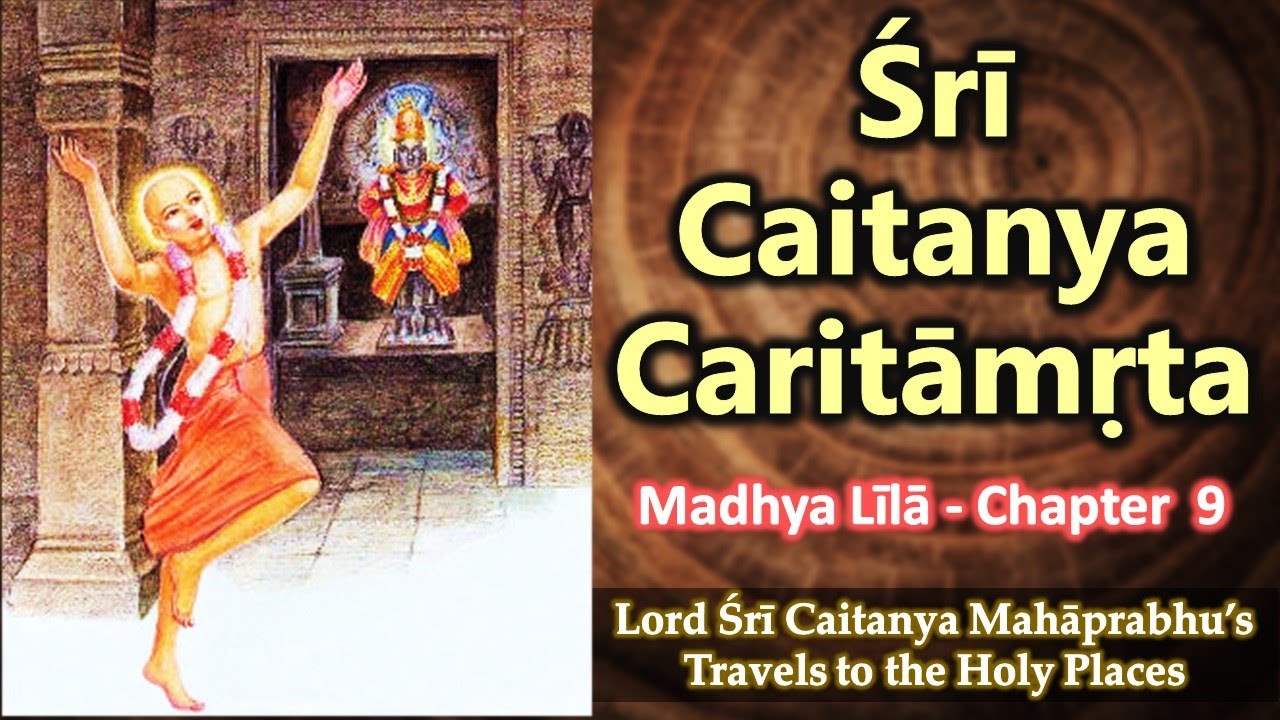
When the Lord saw the Ādi- keśava temple, He was immediately overwhelmed with ecstasy. Offering various obeisances and prayers, He chanted and danced. (235) All the people there were greatly astonished to see the ecstatic pastimes of Śrī Caitanya Mahāprabhu. They all received the Lord very well. (236) In the temple of Ādi- keśava, Śrī Caitanya Mahāprabhu discussed spiritual matters among highly advanced devotees. While there, He found a chapter of the Brahma- saṁhitā. (237) Śrī Caitanya Mahāprabhu was greatly happy to find a chapter of that scripture, and symptoms of ecstatic transformation—trembling, tears, perspiration, trance and jubilation—were manifest in His body. (238) There is no scripture equal to the Brahma- saṁhitā as far as the final spiritual conclusion is concerned. Indeed, that scripture is the supreme revelation of the glories of Lord Govinda, for it reveals the topmost knowledge about Him. Since all conclusions are briefly presented in the Brahma- saṁhitā, it is essential among all the Vaiṣṇava literatures. (239-240)
Śrī Caitanya Mahāprabhu copied the Brahma- saṁhitā, and then with great pleasure He went to a place known as Ananta Padmanābha. (241) Śrī Caitanya Mahāprabhu remained for two or three days at Ananta Padmanābha and visited the temple there. Then, in great ecstasy He went to see the temple of Śrī Janārdana. (242) Śrī Caitanya Mahāprabhu chanted and danced at Śrī Janārdana for two days. He then went to the bank of the Payasvinī River and visited the temple of Śaṅkara- nārāyaṇa. (243) Then He saw the monastery known as Śṛṅgeri- maṭha, the abode of Ācārya Śaṅkara. He then visited Matsya- tīrtha, a place of pilgrimage, and took a bath in the river Tuṅgabhadrā. (244)
Caitanya Mahāprabhu next arrived at Uḍupī, the place of Madhvācārya, where the philosophers known as Tattvavādīs resided. There He saw the Deity of Lord Kṛṣṇa and became mad with ecstasy. (245) While at the Uḍupī monastery, Śrī Caitanya Mahāprabhu saw “dancing Gopāla,” a most beautiful Deity. This Deity appeared to Madhvācārya in a dream. (246) Madhvācārya had somehow or other acquired the Deity of Kṛṣṇa from a heap of gopī- candana that had been transported in a boat. (247) Madhvācārya brought this dancing Gopāla Deity to Uḍupī and installed Him in the temple. To date, the followers of Madhvācārya, known as Tattvavādīs, worship this Deity. (248) Śrī Caitanya Mahāprabhu received great pleasure in seeing this beautiful form of Gopāla. For a long time He danced and chanted in ecstatic love. (249)
Deepen your Bhakti-yoga practice, harmonize relationships, and receive guided coaching — all at Vedavarsity.com