


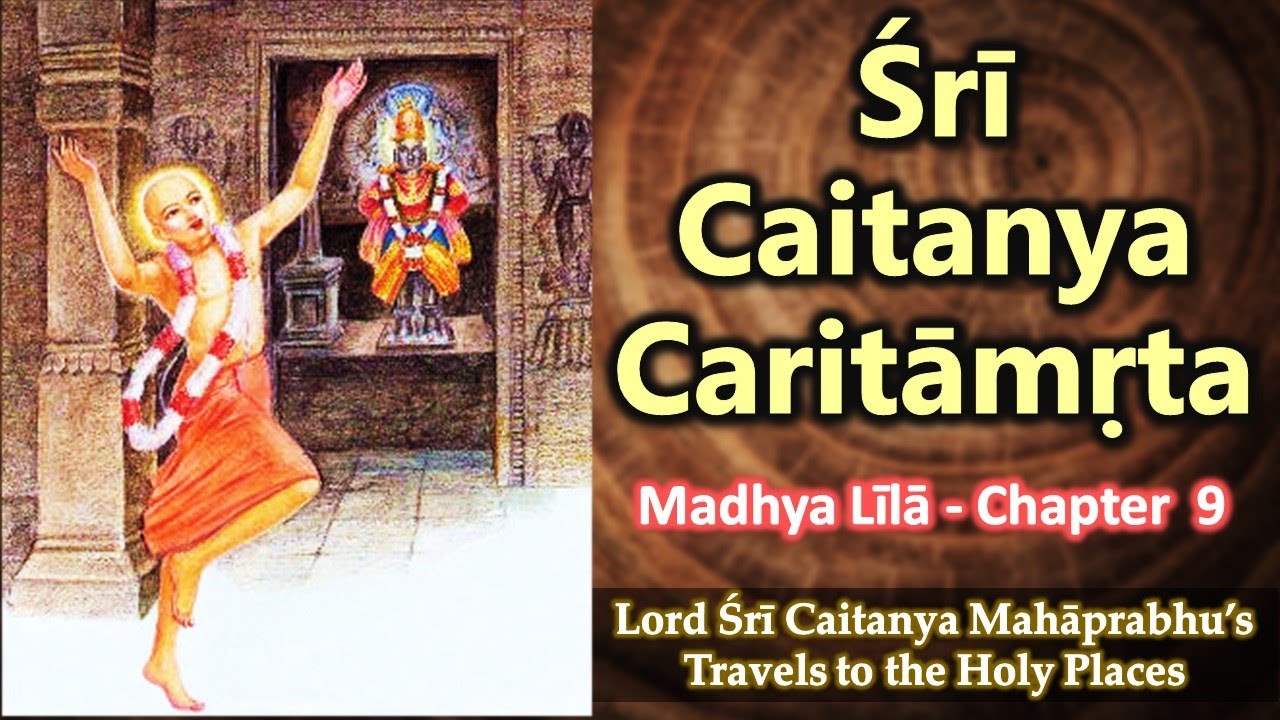
In the holy place of Śrī Raṅga- kṣetra, a brāhmaṇa Vaiṣṇava used to visit the temple daily and recite the entire text of the Bhagavad- gītā.(93) The brāhmaṇa regularly read the eighteen chapters of the Bhagavad- gītā in great transcendental ecstasy, but because he could not pronounce the words correctly, people used to joke about him. (94) Due to his incorrect pronunciation, people sometimes criticized him and laughed at him, but he did not care. He was full of ecstasy due to reading the Bhagavad- gītā and was personally very happy. (95) While reading the book, the brāhmaṇa experienced transcendental bodily transformations. The hairs on his body stood on end, tears welled up in his eyes, and his body trembled and perspired as he read. Seeing this, Śrī Caitanya Mahāprabhu became very happy. (96)
Śrī Caitanya Mahāprabhu asked the brāhmaṇa, “My dear sir, why are you in such ecstatic love? Which portion of the Bhagavad- gītā gives you such transcendental pleasure?” (97) The brāhmaṇa replied, “I am illiterate and therefore do not know the meaning of the words. Sometimes I read the Bhagavad- gītā correctly and sometimes incorrectly, but in any case I am doing this in compliance with the orders of my spiritual master.” (98) The brāhmaṇa continued, “Actually I only see Lord Kṛṣṇa sitting on a chariot as Arjuna’s charioteer. Taking the reins in His hands, He appears very beautiful and blackish. (99) “While seeing Lord Kṛṣṇa sitting in a chariot and instructing Arjuna, I am filled with ecstatic happiness. (100) “As long as I read the Bhagavad- gītā, I simply see the Lord’s beautiful features. It is for this reason that I am reading the Bhagavad- gītā, and my mind cannot be distracted from this.” (101) Śrī Caitanya Mahāprabhu told the brāhmaṇa, “Indeed, you are an authority in the reading of the Bhagavad- gītā. Whatever you know constitutes the real purport of the Bhagavad- gītā.” (102)
After saying this, Lord Caitanya Mahāprabhu embraced the brāhmaṇa, and the brāhmaṇa, catching the lotus feet of the Lord, began to cry. (103) The brāhmaṇa said, “Upon seeing You, my happiness is doubled. I take it that You are the same Lord Kṛṣṇa.” (104) The mind of the brāhmaṇa was purified by the revelation of Lord Kṛṣṇa, and therefore he could understand the truth of Śrī Caitanya Mahāprabhu in all details. (105) Śrī Caitanya Mahāprabhu then taught the brāhmaṇa very thoroughly and requested him not to disclose the fact that He was Lord Kṛṣṇa Himself. (106) That brāhmaṇa became a great devotee of Śrī Caitanya Mahāprabhu, and for four continuous months he did not give up the Lord’s company. (107) Śrī Caitanya Mahāprabhu remained at the house of Veṅkaṭa Bhaṭṭa and constantly talked with him about Lord Kṛṣṇa. In this way He was very happy. (108) Being a Vaiṣṇava in the Rāmānuja- sampradāya, Veṅkaṭa Bhaṭṭa worshiped the Deities of Lakṣmī and Nārāyaṇa. Seeing his pure devotion, Śrī Caitanya Mahāprabhu was very satisfied. (109)
Constantly associating with each other, Śrī Caitanya Mahāprabhu and Veṅkaṭa Bhaṭṭa gradually developed a friendly relationship. Indeed, sometimes they laughed and joked together. (110) Śrī Caitanya Mahāprabhu told the Bhaṭṭācārya, “Your worshipable goddess of fortune, Lakṣmī, always remains on the chest of Nārāyaṇa, and she is certainly the most chaste woman in the creation. (111) “However, my Lord is Lord Śrī Kṛṣṇa, a cowherd boy who is engaged in tending cows. Why is it that Lakṣmī, being such a chaste wife, wants to associate with My Lord? (112) “Just to associate with Kṛṣṇa, Lakṣmī abandoned all transcendental happiness in Vaikuṇṭha and for a long time accepted vows and regulative principles and performed unlimited austerities.” (113)
Caitanya Mahāprabhu then said, “‘O Lord, we do not know how the serpent Kāliya attained such an opportunity to be touched by the dust of Your lotus feet. Even the goddess of fortune, for this end, performed austerities for centuries, giving up all other desires and observing austere vows. Indeed, we do not know how the serpent Kāliya got such an opportunity.’” (114) Veṅkaṭa Bhaṭṭa then said, “Lord Kṛṣṇa and Lord Nārāyaṇa are one and the same, but the pastimes of Kṛṣṇa are more relishable due to their sportive nature. (115) “Since Kṛṣṇa and Nārāyaṇa are the same personality, Lakṣmī’s association with Kṛṣṇa does not break her vow of chastity. Rather, it was in great fun that the goddess of fortune wanted to associate with Lord Kṛṣṇa.” (116) Veṅkaṭa Bhaṭṭa continued, “‘According to transcendental realization, there is no difference between the forms of Nārāyaṇa and Kṛṣṇa. Yet in Kṛṣṇa there is a special transcendental attraction due to the conjugal mellow, and consequently He surpasses Nārāyaṇa. This is the conclusion of transcendental mellows.’ (117)
“The goddess of fortune considered that her vow of chastity would not be damaged by her relationship with Kṛṣṇa. Rather, by associating with Kṛṣṇa she could enjoy the benefit of the rāsa dance.” (118) Veṅkaṭa Bhaṭṭa further explained, “Mother Lakṣmī, the goddess of fortune, is also an enjoyer of transcendental bliss; therefore if she wanted to enjoy herself with Kṛṣṇa, what fault is there? Why are You joking so about this?” (119) Lord Caitanya Mahāprabhu replied, “I know that there is no fault on the part of the goddess of fortune, but still she could not enter into the rāsa dance. We hear this from the revealed scriptures. (120) “‘When Lord Śrī Kṛṣṇa was dancing with the gopīs in the rāsa- līlā, the gopīs were embraced around the neck by the Lord’s arms. This transcendental favor was never bestowed upon the goddess of fortune or the other consorts in the spiritual world. Nor was such a thing ever imagined by the most beautiful girls in the heavenly planets, girls whose bodily luster and aroma exactly resemble the beauty and fragrance of lotus flowers. And what to speak of worldly women, who may be very, very beautiful according to material estimation?’ (121)
“But can you tell Me why the goddess of fortune, Lakṣmī, could not enter the rāsa dance? The authorities of Vedic knowledge could enter the dance and associate with Kṛṣṇa. (122) “‘Great sages conquer the mind and senses by practicing the mystic yoga system and controlling the breath. Thus engaging in mystic yoga, they see the Supersoul within their hearts and ultimately enter into impersonal Brahman. But even the enemies of the Supreme Personality of Godhead attain that position simply by thinking of the Supreme Lord. However, the damsels of Vraja, the gopīs, being attracted by the beauty of Kṛṣṇa, simply wanted to embrace Him and His arms, which are like serpents. Thus the gopīs ultimately tasted the nectar of the lotus feet of the Lord. Similarly, we Upaniṣads can also taste the nectar of His lotus feet by following in the footsteps of the gopīs.’” (123) Having been asked by Caitanya Mahāprabhu why the goddess of fortune could not enter into the rāsa dance whereas the authorities on Vedic knowledge could, Veṅkaṭa Bhaṭṭa replied, “I cannot enter into the mysteries of this behavior.” (124) Veṅkaṭa Bhaṭṭa then said, “I am an ordinary human being. Since my intelligence is very limited and I am easily agitated, my mind cannot enter within the deep ocean of the pastimes of the Lord. (125)
“You are the Supreme Personality of Godhead, Kṛṣṇa Himself. You know the purpose of Your activities, and the person whom You enlighten can also understand Your pastimes.” (126) The Lord replied, “Lord Kṛṣṇa has a special characteristic: He attracts everyone’s heart by the mellow of His personal conjugal love. (127) “By following in the footsteps of the inhabitants of the planet known as Vrajaloka or Goloka Vṛndāvana, one can attain the shelter of the lotus feet of Śrī Kṛṣṇa. However, in that planet the inhabitants do not know that Lord Kṛṣṇa is the Supreme Personality of Godhead. (128) “There someone may accept Him as a son and sometimes bind Him to a grinding mortar. Someone else may accept Him as an intimate friend and, attaining victory over Him, playfully mount His shoulders. (129) “The inhabitants of Vrajabhūmi know Kṛṣṇa as the son of Mahārāja Nanda, the King of Vrajabhūmi, and they consider that they can have no relationship with the Lord in the rasa of opulence. (130) “One who worships the Lord by following in the footsteps of the inhabitants of Vrajabhūmi attains Him in the transcendental planet of Vraja, where He is known as the son of Mahārāja Nanda.” (131)
Caitanya Mahāprabhu then quoted, “‘The Supreme Personality of Godhead, Kṛṣṇa, the son of mother Yaśodā, is accessible to those devotees engaged in spontaneous loving service, but He is not as easily accessible to mental speculators, to those striving for self- realization by severe austerities and penances, or to those who consider the body the same as the self.’ (132) “The authorities in the Vedic literature who are known as the śruti- gaṇas worshiped Lord Kṛṣṇa in the ecstasy of the gopīs and followed in their footsteps. (133) “The personified authorities on the Vedic hymns acquired bodies like those of the gopīs and took birth in Vrajabhūmi. In those bodies they were allowed to enter into the Lord’s rāsa- līlā dance. (134) “Lord Kṛṣṇa belongs to the cowherd community, and the gopīs are the dearmost lovers of Kṛṣṇa. Although the wives of the denizens of the heavenly planets are most opulent within the material world, neither they nor any other women in the material universe can acquire Kṛṣṇa’s association. (135)
“The goddess of fortune, Lakṣmī, wanted to enjoy Kṛṣṇa and at the same time retain her spiritual body in the form of Lakṣmī. However, she did not follow in the footsteps of the gopīs in her worship of Kṛṣṇa. (136) “Vyāsadeva, the supreme authority on Vedic literature, composed the verse beginning ‘nāyaṁ sukhāpo bhagavān’ because no one can enter into the rāsa- līlā dance in any body other than that of a gopī.” (137) Before this explanation was given by Śrī Caitanya Mahāprabhu, Veṅkaṭa Bhaṭṭa thought that Śrī Nārāyaṇa was the Supreme Personality of Godhead. (138) Thinking in this way, Veṅkaṭa Bhaṭṭa believed that worship of Nārāyaṇa was the supreme form of worship, superior to all other processes of devotional service, for it was followed by the Śrī Vaiṣṇava disciples of Rāmānujācārya. (139) Śrī Caitanya Mahāprabhu had understood this misconception of Veṅkaṭa Bhaṭṭa’s, and to correct it the Lord talked so much in a joking way. (140)
The Lord then continued, “My dear Veṅkaṭa Bhaṭṭa, please do not continue doubting. Lord Kṛṣṇa is the Supreme Personality of Godhead, and this is the conclusion of the Vedic literatures. (141) “Lord Nārāyaṇa, the opulent form of Kṛṣṇa, attracts the minds of the goddess of fortune and her followers. (142) “‘All these incarnations of Godhead are either plenary portions or parts of the plenary portions of the puruṣa- avatāras. But Kṛṣṇa is the Supreme Personality of Godhead Himself. In every age He protects the world through His different features when the world is disturbed by the enemies of Indra.’ (143) “Because Kṛṣṇa has four extraordinary qualities not possessed by Lord Nārāyaṇa, the goddess of fortune, Lakṣmī, always desires His company. (144) “You have recited the śloka beginning with ‘siddhāntatas tv abhede ’pi.’ That very verse is evidence that Kṛṣṇa is the Supreme Personality of Godhead. (145)
“‘According to transcendental realization, there is no difference between the forms of Kṛṣṇa and Nārāyaṇa. Yet in Kṛṣṇa there is a special transcendental attraction due to the conjugal mellow, and consequently He surpasses Nārāyaṇa. This is the conclusion of transcendental mellows.’ (146) “The Supreme Personality of Godhead, Kṛṣṇa, attracts the mind of the goddess of fortune, but Lord Nārāyaṇa cannot attract the minds of the gopīs. This proves the superexcellence of Kṛṣṇa. (147) “To say nothing of Lord Nārāyaṇa personally, Lord Kṛṣṇa Himself appeared as Nārāyaṇa just to play a joke on the gopīs. (148) “Although Kṛṣṇa assumed the four- armed form of Nārāyaṇa, He could not attract the serious attention of the gopīs in ecstatic love. (149)
“‘Once Lord Śrī Kṛṣṇa playfully manifested Himself as Nārāyaṇa, with four victorious hands and a very beautiful form. When the gopīs saw this exalted form, however, their ecstatic feelings were crippled. A learned scholar, therefore, cannot understand the gopīs’ ecstatic feelings, which are firmly fixed upon the original form of Lord Kṛṣṇa as the son of Nanda Mahārāja. The wonderful feelings of the gopīs in ecstatic parama- rasa with Kṛṣṇa constitute the greatest mystery in spiritual life.’” (150) In this way Lord Śrī Caitanya Mahāprabhu deflated the pride of Veṅkaṭa Bhaṭṭa, but just to make him happy again, He spoke as follows. (151)
Deepen your Bhakti-yoga practice, harmonize relationships, and receive guided coaching — all at Vedavarsity.com