


Having made their plot, the Buddhists brought a plate of untouchable food before Lord Śrī Caitanya Mahāprabhu and called it mahā- prasādam. (53) When the contaminated food was offered to Śrī Caitanya Mahāprabhu, a very large bird appeared on the spot, picked up the plate in its beak and flew away. (54) Indeed, the untouchable food fell upon the Buddhists, and the large bird dropped the plate on the head of the chief Buddhist teacher. When it fell on his head, it made a big sound. (55) The plate was made of metal, and when its edge hit the head of the teacher, it cut him, and the teacher immediately fell to the ground unconscious. (56) When the teacher fell unconscious, his Buddhist disciples cried aloud and ran to the lotus feet of Śrī Caitanya Mahāprabhu for shelter. (57)
They all prayed to Lord Śrī Caitanya Mahāprabhu, addressing Him as the Supreme Personality of Godhead Himself and saying, “Sir, please excuse our offense. Please have mercy upon us and bring our spiritual master back to life.” (58) The Lord then replied to the Buddhist disciples, “You should all chant the names of Kṛṣṇa and Hari very loudly near the ear of your spiritual master. (59) “By this method your spiritual master will regain his consciousness.” Following Śrī Caitanya Mahāprabhu’s advice, all the Buddhist disciples began to chant the holy name of Kṛṣṇa congregationally. (60) When all the disciples chanted the holy names Kṛṣṇa, Rāma and Hari, the Buddhist teacher regained consciousness and immediately began to chant the holy name of Lord Hari. (61) When the spiritual master of the Buddhists began to chant the holy name of Kṛṣṇa and submitted to Lord Śrī Caitanya Mahāprabhu, all the people who were gathered there were astonished. (62)
Śrī Caitanya Mahāprabhu, the son of Śacīdevī, then suddenly and playfully disappeared from everyone’s sight, and it was impossible for anyone to find Him. (63) Śrī Caitanya Mahāprabhu next arrived at Tirupati and Tirumala, where He saw a four- handed Deity. Then He proceeded toward Veṅkaṭa Hill. (64) After arriving at Tirupati, Lord Śrī Caitanya Mahāprabhu visited the temple of Lord Rāmacandra. He offered His prayers and obeisances before Rāmacandra, the descendant of King Raghu. (65) Everywhere Śrī Caitanya Mahāprabhu went, His influence astonished everyone. He next arrived at the temple of Pānā- nṛsiṁha. The Lord is so merciful. (66) In great ecstatic love, Śrī Caitanya Mahāprabhu offered obeisances and prayers unto Lord Nṛsiṁha. The people were astonished to see Lord Caitanya’s influence. (67)
Arriving at Śiva- kāñcī, Caitanya Mahāprabhu visited the deity of Lord Śiva. By His influence, He converted all the devotees of Lord Śiva into Vaiṣṇavas. (68) The Lord then visited a holy place known as Viṣṇu- kāñcī. There He saw Lakṣmī- Nārāyaṇa Deities, and He offered His respects and many prayers to please Them. (69) When Śrī Caitanya Mahāprabhu stayed at Viṣṇu- kāñcī for two days, He danced and performed kīrtana in ecstasy. When all the people saw Him, they were converted into devotees of Lord Kṛṣṇa. (70) After visiting Trimalaya, Caitanya Mahāprabhu went to see Trikāla- hasti. There He saw Lord Śiva and offered him all respects and obeisances. (71) At Pakṣi- tīrtha, Lord Śrī Caitanya Mahāprabhu visited the temple of Lord Śiva. Then He went to the Vṛddhakola place of pilgrimage. (72)
At Vṛddhakola, Lord Śrī Caitanya Mahāprabhu visited the temple of Śveta- varāha, the white boar incarnation. After offering Him respects, the Lord visited the temple of Lord Śiva, wherein the deity is dressed with yellow garments. (73) After visiting the temple of Śiyālī- bhairavī [a form of the goddess Durgā], Śrī Caitanya Mahāprabhu, the son of mother Śacī, went to the bank of the river Kāverī. (74) The Lord then visited a place known as Go- samāja, where He saw Lord Śiva’s temple. He then arrived at Vedāvana, where He saw another deity of Lord Śiva and offered him prayers. (75) Seeing the Śiva deity named Amṛta- liṅga, Lord Caitanya Mahāprabhu offered His obeisances. Thus He visited all the temples of Lord Śiva and converted the devotees of Lord Śiva into Vaiṣṇavas. (76) At Devasthāna, Caitanya Mahāprabhu visited the temple of Lord Viṣṇu, and there He talked with the Vaiṣṇavas in the disciplic succession of Rāmānujācārya. These Vaiṣṇavas are known as Śrī Vaiṣṇavas. (77)
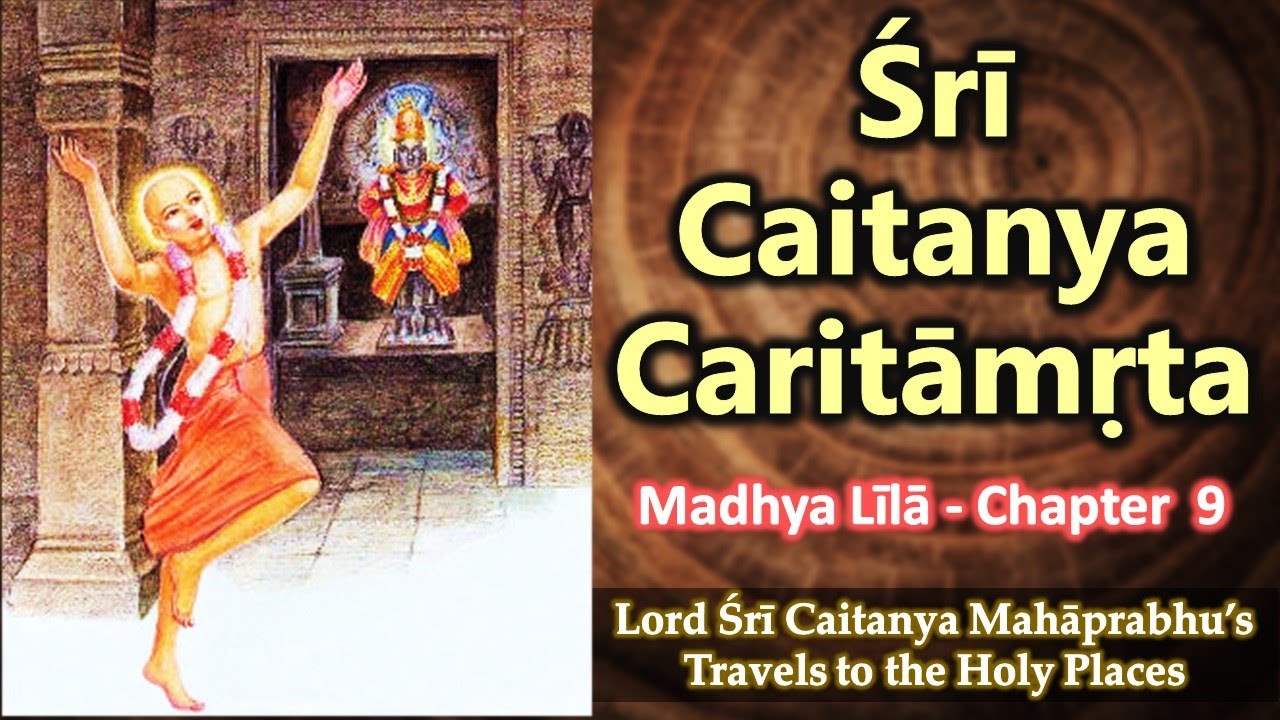
At Kumbhakarṇa- kapāla, Śrī Caitanya Mahāprabhu saw a great lake and then the holy place named Śiva- kṣetra, where a temple of Lord Śiva is located. (78) After visiting the holy place named Śiva- kṣetra, Caitanya Mahāprabhu arrived at Pāpanāśana and there saw the temple of Lord Viṣṇu. Then He finally reached Śrī Raṅga- kṣetra. (79) After bathing in the river Kāverī, Śrī Caitanya Mahāprabhu saw the temple of Raṅganātha and offered His ardent prayers and obeisances. Thus He felt Himself successful. (80) In the temple of Raṅganātha, Śrī Caitanya Mahāprabhu chanted and danced in ecstatic love of Godhead. Seeing His performance, everyone was struck with wonder. (81) A Vaiṣṇava known as Veṅkaṭa Bhaṭṭa then invited Śrī Caitanya Mahāprabhu to his home with great respect. (82) Śrī Veṅkaṭa Bhaṭṭa took Śrī Caitanya Mahāprabhu to his home. After he washed the Lord’s feet, all the members of his family drank the water. (83) After offering lunch to the Lord, Veṅkaṭa Bhaṭṭa submitted that the period of Cāturmāsya had already arrived. (84)
Veṅkaṭa Bhaṭṭa said, “Please be merciful to me and stay at my house during Cāturmāsya. Speak about Lord Kṛṣṇa’s pastimes and kindly deliver me by Your mercy.” (85) Śrī Caitanya Mahāprabhu remained at the house of Veṅkaṭa Bhaṭṭa for four continuous months. The Lord passed His days in great happiness, enjoying the transcendental mellow of discussing Lord Kṛṣṇa’s pastimes. (86) While there, Śrī Caitanya Mahāprabhu took His bath in the river Kāverī and visited the temple of Śrī Raṅga. Every day the Lord also danced in ecstasy. (87) The beauty of Lord Caitanya’s body and His ecstatic love of God were witnessed by everyone. Many people used to come see Him, and as soon as they saw Him, all their unhappiness and distress vanished. (88) Many hundreds of thousands of people from various countries came to see the Lord, and after seeing Him they all chanted the Hare Kṛṣṇa mahā- mantra. (89) Indeed, they did not chant anything but the Hare Kṛṣṇa mahā- mantra, and all of them became Lord Kṛṣṇa’s devotees. Thus the general populace was astonished. (90) All the Vaiṣṇava brāhmaṇas residing in Śrī Raṅga- kṣetra invited the Lord to their homes. Indeed, He had an invitation every day. (91) Each day the Lord was invited by a different brāhmaṇa, but some of the brāhmaṇas did not get the opportunity to offer Him lunch because the period of Cāturmāsya came to an end. (92)
Deepen your Bhakti-yoga practice, harmonize relationships, and receive guided coaching — all at Vedavarsity.com