Rāya Rāmānanda replied, “Lord Kṛṣṇa is dhīra- lalita, for He can always keep His girlfriends in a subjugated state. Thus His only business is enjoying sense gratification. (187) “‘A person who is very cunning and always youthful, expert in joking and without anxiety, and who can keep his girlfriends always subjugated, is called dhīra- lalita.’ (188) “Day and night Lord Śrī Kṛṣṇa enjoys the company of Śrīmatī Rādhārāṇī in the bushes of Vṛndāvana. Thus His pre- youthful age is fulfilled through His affairs with Śrīmatī Rādhārāṇī. (189) “‘Thus Lord Śrī Kṛṣṇa spoke of the sexual activities of the previous night. In this way He made Śrīmatī Rādhārāṇī close Her eyes out of shyness. Taking this opportunity, Śrī Kṛṣṇa painted various types of dolphins on Her breasts. Thus He became a very expert artist for all the gopīs. During such pastimes, the Lord enjoyed the fulfillment of His youth.’” (190) Śrī Caitanya Mahāprabhu said, “This is all right, but please continue.” At that time Rāya Rāmānanda replied, “I don’t think my intelligence goes beyond this.” (191)
Rāya Rāmānanda then informed Śrī Caitanya Mahāprabhu that there was another topic, known as prema- vilāsa- vivarta. “You may hear of this from me,” Rāmānanda Rāya said, “but I do not know whether You will be happy with it or not.” (192) Saying this, Rāmānanda Rāya began to sing a song he had composed, but Śrī Caitanya Mahāprabhu, out of the ecstasy of love of Godhead, immediately covered Rāmānanda’s mouth with His own hand. (193) “‘Alas, before We met there was an initial attachment between Us brought about by an exchange of glances. In this way attachment evolved. That attachment has gradually grown, and there is no limit to it. Now that attachment has become a natural sequence between Ourselves. It is not that it is due to Kṛṣṇa, the enjoyer, nor is it due to Me, for I am the enjoyed. It is not like that. This attachment was made possible by mutual meeting. This mutual exchange of attraction is known as manobhava, or Cupid. Kṛṣṇa’s mind and My mind have merged together. Now, during this time of separation, it is very difficult to explain these loving affairs. My dear friend, though Kṛṣṇa might have forgotten all these things, you can understand and bring this message to Him. But during Our first meeting there was no messenger between Us, nor did I request anyone to see Him. Indeed, Cupid’s five arrows were Our via media. Now, during this separation, that attraction has increased to another ecstatic state. My dear friend, please act as a messenger on My behalf, because if one is in love with a beautiful person, this is the consequence.’ (194)
“‘O my Lord, You live in the forest of Govardhana Hill, and, like the king of elephants, You are expert in the art of conjugal love. O master of the universe, Your heart and Śrīmatī Rādhārāṇī’s heart are just like shellac and are now melted in Your spiritual perspiration. Therefore one can no longer distinguish between You and Śrīmatī Rādhārāṇī. Now You have mixed Your newly invoked affection, which is like vermilion, with Your melted hearts, and for the benefit of the whole world You have painted both Your hearts red within this great palace of the universe.’” (195) Śrī Caitanya Mahāprabhu confirmed these verses recited by Śrī Rāmānanda Rāya, saying, “This is the limit of the goal of human life. Only by your mercy have I come to understand it conclusively. (196) “The goal of life cannot be achieved unless one practices the process. Now, being merciful upon Me, please explain that means by which this goal can be attained.” (197) Śrī Rāmānanda Rāya replied, “I do not know what I am saying, but You have made me speak what I have spoken, be it good or bad. I am simply repeating that message. (198) “Within these three worlds, who is so undisturbed that he can remain steady as You manipulate Your different energies? (199) “Actually You are speaking through my mouth, and at the same time You are listening. This is very mysterious. Anyway, kindly hear the explanation of the process by which the goal can be attained. (200)
“The pastimes of Rādhā and Kṛṣṇa are very confidential. They cannot be understood through the mellows of servitude, fraternity or parental affection. (201) “Actually, only the gopīs have the right to appreciate these transcendental pastimes, and only from them can these pastimes be expanded. (202) “Without the gopīs, these pastimes between Rādhā and Kṛṣṇa cannot be nourished. Only by their cooperation are such pastimes broadcast. It is their business to taste the mellows. (203) “Without the help of the gopīs, one cannot enter into these pastimes. Only one who worships the Lord in the ecstasy of the gopīs, following in their footsteps, can engage in the service of Śrī Śrī Rādhā- Kṛṣṇa in the bushes of Vṛndāvana. Only then can one understand the conjugal love between Rādhā and Kṛṣṇa. There is no other procedure for understanding. (204-205) “‘The pastimes of Śrī Rādhā and Kṛṣṇa are self- effulgent. They are happiness personified, unlimited and all- powerful. Even so, the spiritual humors of such pastimes are never complete without the gopīs, the Lord’s personal friends. The Supreme Personality of Godhead is never complete without His spiritual potencies; therefore unless one takes shelter of the gopīs, one cannot enter into the company of Rādhā and Kṛṣṇa. Who can be interested in Their spiritual pastimes without taking their shelter?’ (206)
“There is an inexplicable fact about the natural inclinations of the gopīs. The gopīs never want to enjoy themselves with Kṛṣṇa personally. (207) “The happiness of the gopīs increases ten million times when they serve to engage Śrī Śrī Rādhā and Kṛṣṇa in Their transcendental pastimes. (208) “By nature, Śrīmatī Rādhārāṇī is just like a creeper of love of Godhead, and the gopīs are the twigs, flowers and leaves of that creeper. (209) “When the nectar of Kṛṣṇa’s pastimes is sprinkled on that creeper, the happiness derived by the twigs, flowers and leaves is ten million times greater than that derived by the creeper itself. (210) “‘All the gopīs, the personal friends of Śrīmatī Rādhārāṇī, are equal to Her. Kṛṣṇa is pleasing to the inhabitants of Vrajabhūmi, just as the moon is pleasing to the lotus flower. His pleasure- giving potency is known as āhlādinī, of which the active principle is Śrīmatī Rādhārāṇī. She is compared to a creeper with newly grown flowers and leaves. When the nectar of Kṛṣṇa’s pastimes is sprinkled on Śrīmatī Rādhārāṇī, all Her friends, the gopīs, immediately appreciate the pleasure a hundred times more than if they were sprinkled themselves. Actually this is not at all wonderful.’ (211)
“Although the gopīs, Śrīmatī Rādhārāṇī’s friends, do not desire to enjoy themselves directly with Kṛṣṇa, Śrīmatī Rādhārāṇī makes a great endeavor to induce Kṛṣṇa to enjoy Himself with the gopīs. (212) “Presenting various pleas for the gopīs, Śrīmatī Rādhārāṇī sometimes sends the gopīs to Kṛṣṇa just to enable them to associate with Him directly. At such times, She enjoys a happiness ten million times greater than that enjoyed through direct association. (213) “The transcendental mellow is nourished by that mutual behavior in transcendental love of Godhead. When Lord Kṛṣṇa sees how the gopīs have developed pure love for Him, He becomes very satisfied. (214) “It is to be noted that the natural characteristic of the gopīs is to love the Supreme Lord. Their lusty desire is not to be compared to material lust. Nonetheless, because their desire sometimes appears to resemble material lust, their transcendental love for Kṛṣṇa is sometimes described as lust. (215)
“‘Although the dealings of the gopīs with Kṛṣṇa are on the platform of pure love of Godhead, such dealings are sometimes considered to be lusty. But because they are completely spiritual, Uddhava and all the other dearmost devotees of the Lord desire to participate in them.’ (216) “Lusty desires are experienced when one is concerned with his own personal sense gratification. The mood of the gopīs is not like that. Their only desire is to satisfy the senses of Kṛṣṇa. (217) “Among the gopīs, there is not a pinch of desire for sense gratification. Their only desire is to give pleasure to Kṛṣṇa, and this is why they mingle with Him and enjoy with Him. (218) “[All the gopīs said:] ‘Dear Kṛṣṇa, we carefully hold Your delicate lotus feet upon our hard breasts. When You walk in the forest, Your soft lotus feet are pricked by small bits of stone. We fear that this is paining You. Since You are our life and soul, our minds are very much disturbed when Your lotus feet are pained.’ (219) “One who is attracted by that ecstatic love of the gopīs does not care about popular opinion or the regulative principles of Vedic life. Rather, he completely surrenders unto Kṛṣṇa and renders service unto Him. (220)
“If one worships the Lord on the path of spontaneous love and goes to Vṛndāvana, he receives the shelter of Vrajendra- nandana, the son of Nanda Mahārāja. (221) “In his liberated stage the devotee is attracted by one of the five humors in the transcendental loving service of the Lord. As he continues to serve the Lord in that transcendental mood, he attains a spiritual body to serve Kṛṣṇa in Goloka Vṛndāvana. (222) “Those saintly persons who represent the Upaniṣads are vivid examples of this. By worshiping the Lord on the path of spontaneous love, they attained the lotus feet of Vrajendra- nandana, the son of Nanda Mahārāja. (223) “‘Great sages conquer the mind and senses by practicing the mystic yoga system and controlling the breath. Thus engaging in mystic yoga, they see the Supersoul within their hearts and ultimately enter into impersonal Brahman. But even the enemies of the Supreme Personality of Godhead attain that position simply by thinking of the Supreme Lord. However, the damsels of Vraja, the gopīs, being attracted by the beauty of Kṛṣṇa, simply wanted to embrace Him and His arms, which are like serpents. Thus the gopīs ultimately tasted the nectar of the lotus feet of the Lord. Similarly, we Upaniṣads can also taste the nectar of His lotus feet by following in the footsteps of the gopīs.’” (224)
“The word ‘sama- dṛśaḥ,’ mentioned in the fourth line of the previous verse, means ‘following the mood of the gopīs.’ The word ‘samāḥ’ means ‘the śrutis’ attainment of bodies like those of the gopīs.’ (225) “The word ‘aṅghri- padma- sudhā’ means ‘associating intimately with Kṛṣṇa.’ One can attain such perfection only by spontaneous love of God. One cannot obtain Kṛṣṇa in Goloka Vṛndāvana simply by serving the Lord according to regulative principles. (226) “‘The Supreme Personality of Godhead, Kṛṣṇa, the son of mother Yaśodā, is accessible to those devotees engaged in spontaneous loving service, but He is not as easily accessible to mental speculators, to those striving for self- realization by severe austerities and penances, or to those who consider the body the same as the self.’ (227) “Therefore one should accept the mood of the gopīs in their service. In such a transcendental mood, one should always think of the pastimes of Śrī Rādhā and Kṛṣṇa. (228) “After thinking of Rādhā and Kṛṣṇa and Their pastimes for a long time and after getting completely free from material contamination, one is transferred to the spiritual world. There the devotee attains an opportunity to serve Rādhā and Kṛṣṇa as one of the gopīs. (229)
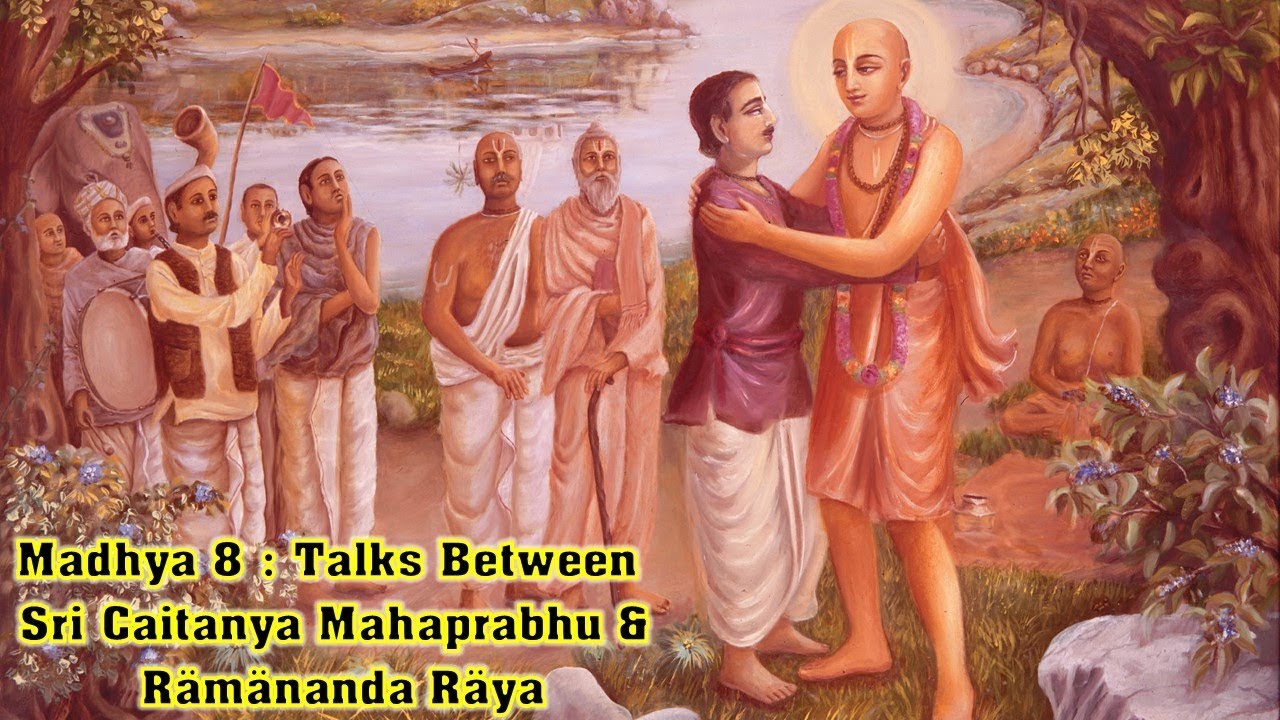
“Unless one follows in the footsteps of the gopīs, he cannot attain the service of the lotus feet of Kṛṣṇa, the son of Nanda Mahārāja. If one is overcome by knowledge of the Lord’s opulence, he cannot attain the Lord’s lotus feet, even though he is engaged in devotional service. (230) “The unspoken example in this connection is the goddess of fortune, who worshiped Lord Kṛṣṇa in order to attain His pastimes in Vṛndāvana. But due to her opulent life- style, she could not attain the service of Kṛṣṇa in Vṛndāvana. (231) “‘When Lord Śrī Kṛṣṇa was dancing with the gopīs in the rāsa- līlā, the gopīs were embraced around the neck by the Lord’s arms. This transcendental favor was never bestowed upon the goddess of fortune or the other consorts in the spiritual world. Nor was such a thing ever imagined by the most beautiful girls in the heavenly planets, girls whose bodily luster and aroma resemble the beauty and fragrance of lotus flowers. And what to speak of worldly women, who may be very, very beautiful according to material estimation?’” (232) After hearing this, Lord Śrī Caitanya Mahāprabhu embraced Rāmānanda Rāya, and both of them, embracing shoulder to shoulder, began to cry. (233)
Deepen your Bhakti-yoga practice, harmonize relationships, and receive guided coaching — all at Vedavarsity.com