My dear friends, just see, Krsna is enjoying the season of spring! With the gopīs embracing each of His limbs, He is like amorous love personified. With His transcendental pastimes, He enlivens all the gopīs and the entire creation. With His soft bluish black arms and legs, which resemble blue lotus flowers, He has created a festival for Cupid.’ (144) “He also attracts Nārāyaṇa, who is the incarnation of Saṅkarṣaṇa and the husband of the goddess of fortune. He attracts not only Nārāyaṇa but also all women, headed by the goddess of fortune, the consort of Nārāyaṇa. (145) “[Addressing Kṛṣṇa and Arjuna, Lord Mahā- Viṣṇu (the Mahāpuruṣa) said:] ‘I wanted to see both of you, and therefore I have brought the sons of the brāhmaṇa here. Both of you have appeared in the material world to reestablish religious principles, and you have both appeared here with all your potencies. After killing all the demons, please quickly return to the spiritual world.’ (146) “‘O Lord, we do not know how the serpent Kāliya attained such an opportunity to be touched by the dust of Your lotus feet. For this end, the goddess of fortune performed austerities for centuries, giving up all other desires and observing austere vows. Indeed, we do not know how this serpent Kāliya got such an opportunity.’ (147)
“Lord Kṛṣṇa’s sweetness is so attractive that it steals away His own mind. Thus even He wants to embrace Himself. (148) “‘Upon seeing His own reflection in a bejeweled pillar of His Dvārakā palace, Kṛṣṇa desired to embrace it, saying, “Alas, I have never seen such a person before. Who is He? Just by seeing Him I have become eager to embrace Him, exactly like Śrīmatī Rādhārāṇī.”’” (149) Śrī Rāmānanda Rāya then said, “I have thus briefly explained the original form of the Supreme Personality of Godhead. Now let me describe the position of Śrīmatī Rādhārāṇī. (150) “Kṛṣṇa has unlimited potencies, which can be divided into three main parts. These are the spiritual potency, the material potency and the marginal potency, which is known as the living entities. (151) “In other words, these are all potencies of God—internal, external and marginal. But the internal potency is the Lord’s personal energy and stands over the other two. (152) “‘The original potency of Lord Viṣṇu is superior, or spiritual, and the living entity actually belongs to that superior energy. But there is another energy, called the material energy, and this third energy is full of ignorance.’ (153)
“Originally Lord Kṛṣṇa is sac- cid- ānanda- vigraha, the transcendental form of eternity, bliss and knowledge; therefore His personal potency, the internal potency, has three different forms. (154) “Hlādinī is His aspect of bliss; sandhinī, of eternal existence; and samvit of cognizance, which is also accepted as knowledge. (155) “‘My dear Lord, You are the transcendental reservoir of all transcendental qualities. Your pleasure potency, existence potency and knowledge potency are actually all one internal spiritual potency. The conditioned soul, although actually spiritual, sometimes experiences pleasure, sometimes pain and sometimes a mixture of pain and pleasure. This is due to his being touched by matter. But because You are above all material qualities, these are not found in You. Your superior spiritual potency is completely transcendental, and for You there is no such thing as relative pleasure, pleasure mixed with pain, or pain itself.’ (156) “The potency called hlādinī gives Kṛṣṇa transcendental pleasure. Through this pleasure potency, Kṛṣṇa personally tastes all spiritual pleasure. (157)
“Lord Kṛṣṇa tastes all kinds of transcendental happiness, although He Himself is happiness personified. The pleasure relished by His pure devotees is also manifested by His pleasure potency. (158) “The most essential part of this pleasure potency is love of Godhead [prema]. Consequently, the explanation of love of Godhead is also a transcendental mellow full of pleasure. (159) “The essential part of love of Godhead is called mahābhāva, transcendental ecstasy, and that ecstasy is represented by Śrīmatī Rādhārāṇī. (160) “‘Among the gopīs of Vṛndāvana, Śrīmatī Rādhārāṇī and another gopī are considered chief. But when we compare the gopīs, it appears that Śrīmatī Rādhārāṇī is most important because Her real feature expresses the highest ecstasy of love. The ecstasy of love experienced by the other gopīs cannot be compared to that of Śrīmatī Rādhārāṇī.’ (161) “The body of Śrīmatī Rādhārāṇī is a veritable transformation of love of Godhead; She is the dearmost friend of Kṛṣṇa, and this is known throughout the world. (162)
“‘I worship Govinda, the primeval Lord, who resides in His own realm, Goloka, with Rādhā, who resembles His own spiritual figure and who embodies the ecstatic potency [hlādinī]. Their companions are Her confidantes, who embody extensions of Her bodily form and who are imbued and permeated with ever- blissful spiritual rasa.’ (163) “That supreme ecstasy of Śrīmatī Rādhārāṇī is the essence of spiritual life. Her only business is to fulfill all the desires of Kṛṣṇa. (164) “Śrīmatī Rādhārāṇī is the topmost spiritual gem, and the other gopīs—Lalitā, Viśākhā and so on—are expansions of Her spiritual body. (165) “Śrīmatī Rādhārāṇī’s transcendental body is brilliant in luster and full of all transcendental fragrances. Lord Kṛṣṇa’s affection for Her is like a perfumed massage. (166) “Śrīmatī Rādhārāṇī takes Her first bath in the shower of the nectar of compassion, and She takes Her second bath in the nectar of youth. (167) “After Her midday bath, Rādhārāṇī takes another bath in the nectar of bodily luster, and She puts on the garment of shyness, which is Her black silk sari. (168)
“Śrīmatī Rādhārāṇī’s affection for Kṛṣṇa is Her upper garment, which is pinkish in color. She then covers Her breasts with another garment, composed of affection and anger toward Kṛṣṇa. (169) “Śrīmatī Rādhārāṇī’s personal beauty is the reddish powder known as kuṅkuma, Her affection for Her associates is sandalwood pulp, and the sweetness of Her smile is camphor. All these, combined together, are smeared over Her body. (170) “Conjugal love for Kṛṣṇa is an abundance of musk, and with that musk Her whole body is decorated. (171) “Craftiness and covered anger constitute the arrangement of Her hair. The quality of anger due to jealousy is the silk garment covering Her body. (172) “Her attachment for Kṛṣṇa is the reddish color of betel nuts on Her brilliant lips. Her double- dealings in loving affairs constitute the black ointment around Her eyes. (173) “The ornaments decorating Her body are the blazing ecstasies of goodness and the constantly existing ecstasies, headed by jubilation. All these ecstasies are the ornaments all over Her body. (174)
“Also ornamenting Her body are the twenty kinds of ecstatic symptoms beginning with kila- kiñcita. Her transcendental qualities constitute the flower garland hanging in fullness over Her body. (175) “The tilaka of good fortune is on Her beautiful broad forehead. Her various loving affairs are a gem, and Her heart is the locket. (176) “Śrīmatī Rādhārāṇī’s gopī friends are Her mental activities, which are concentrated on the pastimes of Śrī Kṛṣṇa. She keeps Her hand on the shoulder of a friend, who represents youth. (177) “Śrīmatī Rādhārāṇī’s bedstead is pride itself, and it is situated in the abode of Her bodily aroma. She is always seated there thinking of Kṛṣṇa’s association. (178) “Śrīmatī Rādhārāṇī’s earrings are the name, fame and qualities of Lord Kṛṣṇa. The glories of Lord Kṛṣṇa’s name, fame and qualities are always inundating Her speech. (179) “Śrīmatī Rādhārāṇī induces Kṛṣṇa to drink the honey of the conjugal relationship. She is therefore engaged in satisfying all the lusty desires of Kṛṣṇa. (180) “Śrīmatī Rādhārāṇī is a mine filled with valuable jewels of love for Kṛṣṇa. Her transcendental body is complete with unparalleled spiritual qualities. (181)
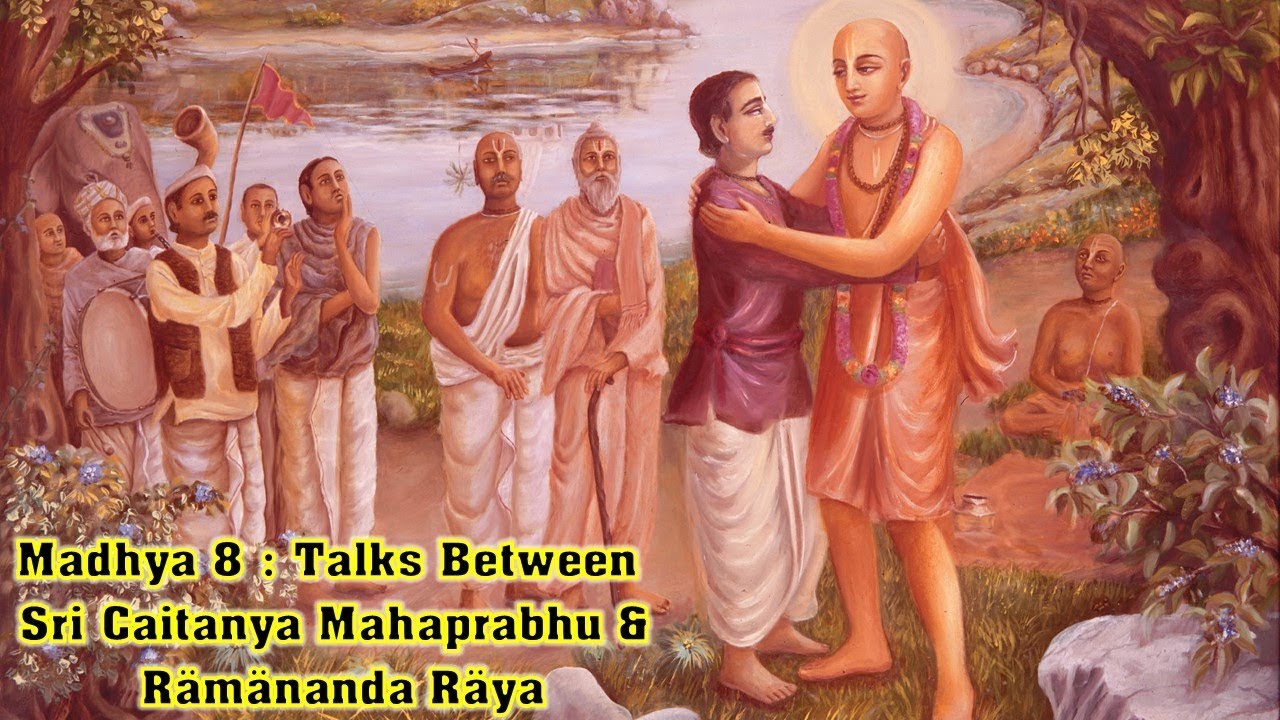
“‘If one asks about the origin of love of Kṛṣṇa, the answer is that the origin is in Śrīmatī Rādhārāṇī alone. Who is the most dear friend of Kṛṣṇa? The answer again is Śrīmatī Rādhārāṇī alone. No one else. Śrīmatī Rādhārāṇī’s hair is very curly, Her two eyes are always moving to and fro, and Her breasts are firm. Since all transcendental qualities are manifested in Śrīmatī Rādhārāṇī, She alone is able to fulfill all the desires of Kṛṣṇa. No one else.’ (182) “Even Satyabhāmā, one of the queens of Śrī Kṛṣṇa, desires the fortunate position and excellent qualities of Śrīmatī Rādhārāṇī. All the gopīs learn the art of dressing from Śrīmatī Rādhārāṇī, and even the goddess of fortune, Lakṣmī, and the wife of Lord Śiva, Pārvatī, desire Her beauty and qualities. Indeed, Arundhatī, the celebrated chaste wife of Vasiṣṭha, also wants to imitate the chastity and religious principles of Śrīmatī Rādhārāṇī. (183-184) “Even Lord Kṛṣṇa Himself cannot reach the limit of the transcendental qualities of Śrīmatī Rādhārāṇī. How, then, can an insignificant living entity count them?” (185) Lord Śrī Caitanya Mahāprabhu replied, “Now I have come to understand the truth of the loving affairs between Rādhā and Kṛṣṇa. Nonetheless, I still want to hear how both of Them gloriously enjoy such love.” (186)
Deepen your Bhakti-yoga practice, harmonize relationships, and receive guided coaching — all at Vedavarsity.com